Thursday, 22 September 2011

Nice flight today

Time for a day out in the 'Top Toy'; our group-owned 1951 de Havilland Chipmunk.

These pictures, especially the airborne ones, are best viewed full size by clicking on them twice.


Pre-flighting the Chippy at Liverpool John Lennon airport this morning


Forty minutes or so later, Sierra Lima is on the much more appropriate setting of Sleap Aerodrome's grass apron. The landing had been a cracker - a straight in approach to runway 23, holding off over the displaced threshold to touch down 3-point on the numbers and roll to walking pace in plenty of time to take the first turn-off.


After the usual lovely lunch in the cafe in Sleap's Tower, I did a circuit followed by a touch-and-go so I'd have completed three landings (two at Sleap, one back at Liverpool) which enables me to meet the legal requirement for passenger carrying of having made at least three landings in the last ninety days. In the picture above I'm downwind left hand for runway 23, further out than I'd like to be as there two others in the circuit.


Curving around to a short final for runway 23 for my second landing at Sleap today. This was for a 'touch and go'; a landing followed by an immediate take off without stopping on the runway. If you enlarge this picture by clicking on it twice, you can see the displaced threshold with the '23' numbers, in white on the runway surface, denoting the start of the usable runway (the several hundred yards from the start of the tarmac to 'the numbers' is rough and unusable). The first turnoff that I took in my original landing can be seen soon after the numbers on the left.
It's not easy, by the way, to fly the aeroplane to a tightish final like this while taking photographs at the same time!


After the touch and go, I headed north from Sleap back to Liverpool. Here passing the Shropshire town of Wem. Out here in open airspace we are not under any air traffic control authority and can wander around at will.


The short movie below that I filmed on today's flight
gives an impression of what it's like in the noisy
cockpit of a small aerobatic 2-seat aeroplane.


Cruising along at about fifteen hundred feet affords a bird's eye view of the richly rural Shropshire countryside


Whitchurch, Shropshire


Combermere ahead, Osmere to the left


Leaving 'uncontrolled' airspace now, I am cleared by Liverpool Approach to enter the Liverpool Zone under Liverpool Air Traffic Control. I've just passed my zone entry point of Oulton Park Motor Racing Circuit and are headed to Helsby Hill, my current clearance limit. The forest of Delamere lies between us and the Mersey glinting in the distance. John Lennon Airport is just the other side of that estuary.


Passing Helsby Hill having been handed over from Liverpool Approach to Liverpool Tower I'm cleared onward across the Mersey to position left base for runway 27 at Liverpool


A glance out to the right shows the extensive chemical works at Weston Point. The River Weaver snakes in from the right to join the Manchester Ship Canal which itself closely follows the south bank of the Mersey.


Crossing the Mersey, the ruler-straight Ship Canal clearly visible in the foreground


A closer look at Weston Point showing how the Ship Canal clings to the south bank
of the Mersey


Cleared to land, I curve around onto a short final for runway 27 at Liverpool John Lennon maintaining about 100 knots all the way in from Helsby in order to prevent delay for following traffic


Becoming established on short final, pulling the power right back while holding height to bring the speed back to flap limit speeds, re-trimming at 80 knots with flaps 'one' set, further reducing to 70 knots with 'flaps 2' set, and then stabilising the approach, trimmed at 60 knots.

To the right of the runway can be seen two concrete aprons. The far one is the commercial apron from where the airliners operate, the nearer one is the General Aviation (GA) apron for light aircraft. The Ravenair hangar where our Chipmunk lives is the nearer (green) one on the GA apron. The main taxyway is parallel to the runway, between the runway and the aprons.


Having vacated the runway at point 'Foxtrot', I slide the canopy back and pause to let an Easy Jet (taxying out from the commercial apron) pass before following it along the main taxyway. I'll be turning left up ahead where the yellow centre line diverges onto the GA apron, while the 'Easy' will continue straight ahead then follow the taxy way as it curves round to the right to the end of the runway, for departure.

It's lovely blattering along on the ground in the Chippy with the canopy open, the prop blast tugging at one's hair. Almost as good as flying it; but not quite!


.

Tuesday, 20 September 2011

A new toy arrives!


I went to Reading by early train this morning to collect this, 06:58 via Euston; thank heavens for the Old Git's Railcard that makes such a journey cost just over £50, as opposed to almost £300 that it would have been without.

The bike's a 14 year old but quite immaculate Suzuki F650 Freewind, and it's covered only around 6,000 miles from new. It's had one owner 'till last year, owned by a police motorcyclist since then. I rode it 180+ miles home today (through some atrocious weather in the Midlands making the heated grips most welcome). It's lovely and I got it very cheaply - a 650CC twin-spark 4-valve twin carb single (so it's got a bit o'character!). It was lovely and clean when I left Reading this morning, and filthy with motorway spray by the time I got home, so I washed and leathered it, and it's keeping the vintage Bonnie company in the garage right now.

A week or so later I've ridden this bike considerably more than a hundred miles since I rode it home 180 miles from Reading on the motorway. This later riding has been mostly in the Peak District (motorway riding tells you little about a bike) and I have confirmed that it is everything I hoped it would be. It has a high seating position so you can see over walls, hedges, and traffic, it has ample power for good acceleration, and it has lovely handling - just drops into the bends. And when opened up to enjoy the smooth power, it sounds nice too - not the muted roar of the parallel twin Bonnie, but the purposeful beat of a big single. And as I already knew from my ride up from Reading, It's also comfortable over long distances.

The picture above taken by Peter Helliwell of Wilmslow, one time revolutionary head of Lindow School, and now retired. He has a tradition of photographing his mates with any new cars or motorcycles they acquire.


.

A family wedding in Abersoch

We returned yesterday from several days in Abersoch, North Wales. The primary reason for the visit was to attend the wedding of my nephew Jim Nichols, but Chris and I decided to make it a bit of a mini break as well.

To see these pictures in all their glory, click twice on each image to view it full size:


The magnificent beach at Morfa Nefyn last Thursday


Setting off on Thursday morning saw us at The Cliffs Inn, Morfa Nefyn for lunch. For decades we came here when the children were young, hiring a local cottage for a week or two. After lunch we strolled along the magnificent beach a Morfa, paddling in the surprisingly warm sea which is always so clear here.

After checking in at 'Venetia' ( http://www.venetiawales.com/ ), our delightful 'boutique' hotel in Abersoch, we walked up towards the Yacht Club to visit my sister Elaine Nichols and guests Jan and Al who were staying with Elaine and her husband John.

The marquees on Thursday afternoon, in the process of fitting out for the reception on Saturday, as viewed from John and Elaine (Nichols) garden.

Jim was across the lane, just above the Yacht Club, supervising the installation of the marquees on the Abersoch headland for the reception on Saturday. There seemed to be a great deal still to do!

On Friday, the weather did not bode well for the wedding the next day. Before the atrociously heavy and prolonged blustery showers kicked off for the day we visited the church where the wedding would take place.

St Pedrog's Church, Llanbedrog, on Friday morning

We visited the art gallery nearby at Plas Glyn-y-Weddw before visiting Pwlhelli and then on to Aberdaron for lunch.

Saturday was the day of the wedding.......


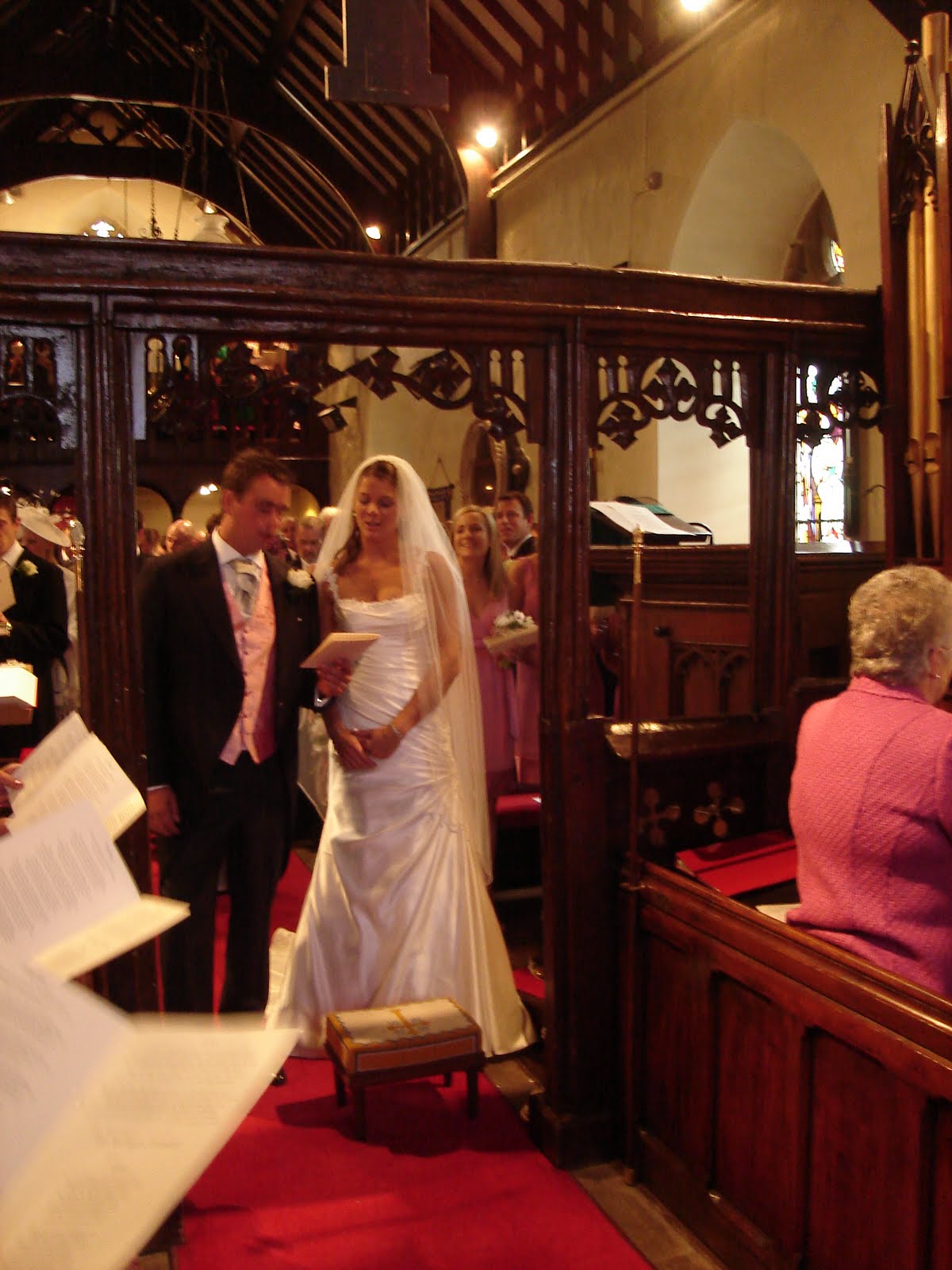
The bride and groom, Anna and Jim, Saturday morning


The little church was absolutely packed, with some standing at the back or sitting on the floor of the aisle. We, the family, were OK though; we had reserved seats in 'Business Class' (the choir stalls) at the front of the church.


How pink is that waistcoat? Chris and I pose outside the church after the ceremony


Anna and Jim, the new Mr & Mrs Nichols


The location for the reception was quite stunning - on the Abersoch headland with sea views all around, and the mountains on the far side of Cardigan Bay clearly visible in the unstable airflow. There were no showers on Saturday at all, quite amazing considering this airflow produced some crackers on the Friday and the Sunday! Pictured above is a raised platform so guests could enjoy the fabulous views.


The 'reception' marquee; Jan and Sue (my sister in law) seated, my brother Phil bringing the drinks. The trio standing in the middle are Chris, Barbara (back to us) and the lovely Wendy. Just peeping over the marquee roof is my sister Elaine's and her husband John's house.


This was a surprise; at 16:30 two Yaks of the 'Yakovlevs' aerobatic team roared overhead from behind the venue with the fabulous sound of the two Vendeneyev 9-cylinder radials bringing back memories for me of our erstwhile group-owned Yak 52. A video of part of the display, and 'drawing a heart in the air', can be seen here:

http://www.youtube.com/watch?v=4Z7wqp24gW0&feature=autoplay&list=ULnYvMCPV0AHQ&lf=mfu_in_order&playnext=1

Here is another taken by a bystander (not a wedding guest):

http://www.youtube.com/watch?v=nSgL2RIM9po&feature=related


The champagne flowed - hundreds of bottles of it! And the caterers, 'Golden Goose', provided endless supplies of delicious canapes.


The meal and speeches were in the evening. Retired gynecologist, Anna's father gives his speech and manages to avoid (just!) any gynecology jokes.


Jim's speech did include a couple!


The Best Man's speech from Jim's brother Matthew was hilarious. Not to be outdone by Anna's father's and Jim's prominent eyebrows, Matt has brought his own! My brother in law John is centre and my sister Elaine on the right.


Reeeee - lax! ......Matthew and my mum.


Endless supplies of wine, champagne, and even draught real ale (Dunham 'Big Tree') helped to ensure a jolly time was had by all.

Jim and Anna take to the floor before we all piled in to bop to the pretty good live band.


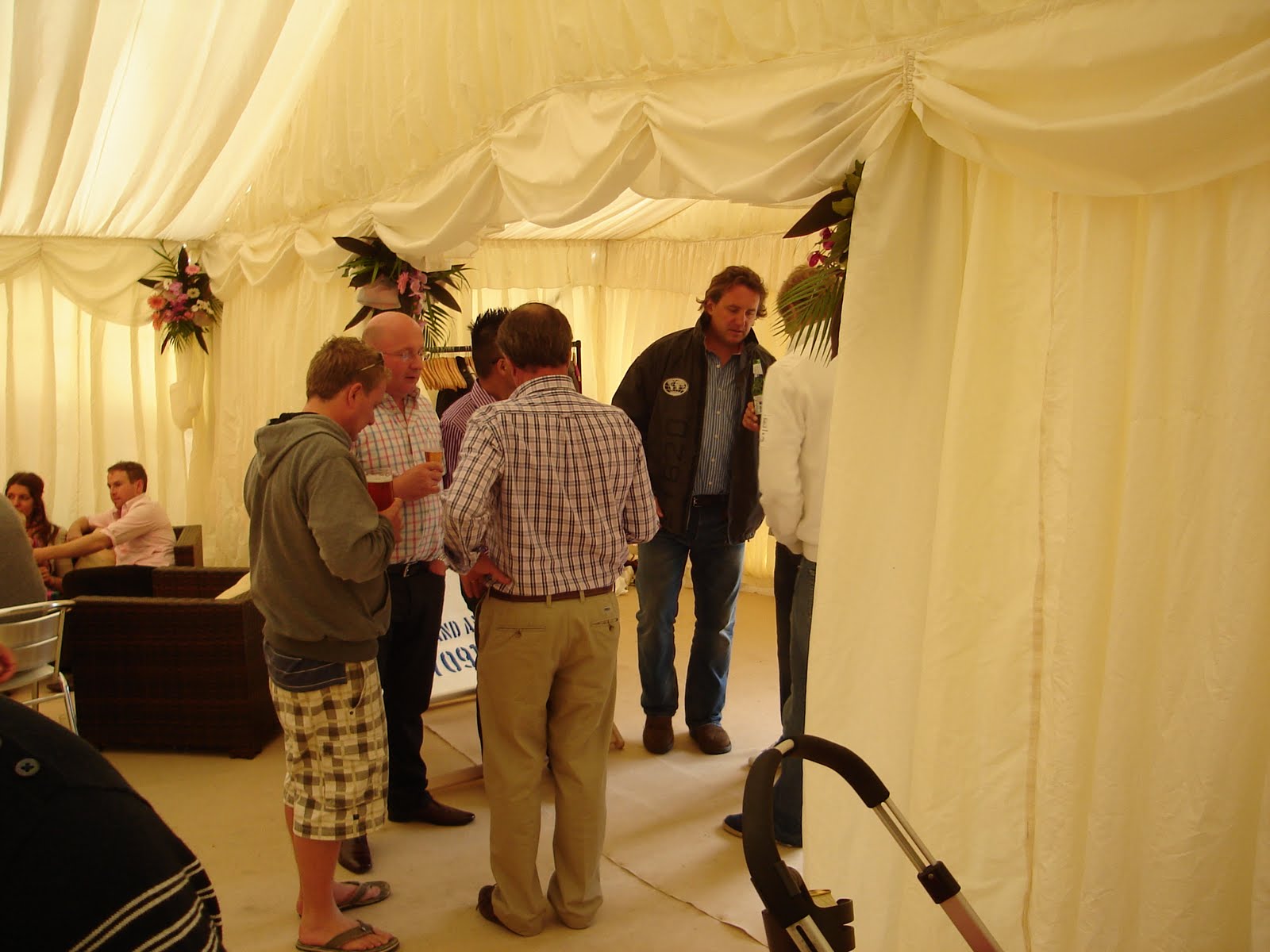
On Sunday morning an informal get together in the reception marquee took place, with the booze still flowing and canapes being served


'Golden Goose' ran the bar and provided canapes until mid afternoon. After that, the bar was self service!


It's a good job the wedding was on Saturday. Some wicked showers rattled through on Sunday morning as they had on Friday, but later on Sunday the skies cleared. That's a pint of 'Big Tree' on the fence post!

We ate in Venetia again Sunday night and drove home the next day. Wow! I think we'd better lay off the food and booze for a while now - what a weekend!


.

Friday, 9 September 2011

Litton, Hulme End, and The Cat... on the Bonnie

Good biking weather forecast for today; dry, sunny intervals, a bit cloudy and a bit of wind - fine for an outing on the Old Tart (1979 Triumph Bonneville T140 UK Special). A run down to the petrol station revealed a none-working LH rear indicator, soon fixed by removing the bulb from Mr Lucas's indicator unit, cleaning the contacts, and replacing. Joe Lucas, eh; Prince of Darkness!

I decided to head up to the Red Lion at Litton, near Tideswell in the Derbyshire Peak. I routed out through Prestbury and Macclesfield then over the Cat & Fiddle road, which was still a bit damp in places from earlier rain so I had to take it easier than usual. At Ladmanlow I took the Harper Hill 'Buxton Avoid' route to Brierlow Bar, then the delightfully sweeping A5270 across to the A6 (briefly), before turning left through Millers Dale and on up to Litton where I stopped for lunch.

The Bonnie outside the Red Lion at Litton

I sat outside enjoying the day, and some excellent melt-in-the-mouth fish, washed down with a lovely refreshing pint of very hoppy and delightfully smooth Wild Swan from Bakewell brewers, Thornbridge. This is a new brewer to me, but that pint is among the best I can ever remember drinking. Pity I couldn't risk more than just one.... must come back by bus sometime and sample some more!

From Litton I headed back to Brierlow Bar, the A5270 having dried out a bit so I could enjoy its sinuous sweeping reverse curves. Down past the Dragon's Back hills at Earl Sterndale to Longnor, where I turned left to take one of my favorite (from a scenic point of view) Peakland roads, which climbs to run along the ridge top between the upper Dove and Manifold valleys. The visibility today was stunning, as were the views of the deep valleys and rolling hills of the White Peak from this road. This really is God's Own Country!

Down through Sheen to a brief stop at Hulme End visitor centre; many decades ago this was the terminus of the narrow gauge Leek & Manifold railway, which collected milk from the dairy farms of the area for transfer to the main line railway system at Waterhouses for onward distribution. The track bed today forms a narrow roadway along the valley bottom.

From Hulme End I looped back round to Longnor before turning left along another ridge-top road to join the A53 at Flash Bar. Climbing out of Hollinsclough there are side-on views of the Dragon's backs; Chrome Hill and Parkhouse Hill. These razor-edged grassy ridges used to be off limits to walkers, but are now 'access land' and well worth the energetic scramble to the tops.

View from the top of Chrome Hill, looking across to Parkhouse Hill, taken on a walk with 'Stockport Walkers' on 16th June 2010

A short blast up the A53 took me to the cattle gridded track across Axe Edge Moor to emerge on the Cat & Fiddle road, about a mile east of the pub. The damp patches had gone, so while remaining wary of the 50mph average speed cameras, I was able to enjoy the Cat's classic twistys with gusto. On one very tight left hander something on the Bonnie touched the road with a graunching sound. Never had that before - must be going well!

Back through Macclesfield and Prestbury to home, where I tried to discover what could have 'touched down' on that left hand bend. It had to be the side stand, but so great was the angle of lean required to get it to actually touch the garage floor that single-handed I could not lean the bike that far over without risking dropping it, though of course it would have been lower with my not inconsiderable weight and the cornering 'G' force acting on it. I must have been going some around that bend, and look at the road wear pattern on the rear tyre showed that I'd been enjoying the Bonnie's crisp handing right to (and it seems maybe a bit beyond!) the limit.

The Old Tart ran as well if not better than she ever has. She must have been enjoying it as much as I was!


.

Wednesday, 7 September 2011

Published in the Gruniad - again!

I have had several letters and and answers to the 'Notes & Queries' feature published in the 'Guardian' over the years. Readers send in questions to N&Q, and one was about wind turbines. This morning, my answer to that query was published:


Why do wind turbines have only three blades? Wouldn't four be more effective?

Like many design considerations, the number of blades on a wind turbine is a compromise. Each blade disturbs the air for the following blade, so ideally you want as few blades as possible to maximise efficiency. You need to have at least two to keep the turbine balanced, and the longer the blade the more energy it will harvest from the wind. But if too long, the blade tips will approach the speed of sound as they rotate, which curtails efficiency. Also, the longer the blade the taller the mast has to be to give sufficient ground clearance and to ensure that the entire blade 'disc' (the area swept by the blades) is high enough to be in the stronger winds away from the ground. It has been found that three blades gives a good compromise; not too much air disturbance for the following blade, tip speeds below transonic, reasonable mast height, and a reasonable amount of energy gathered from the airflow and delivered to the electrical generator atop the mast.

Vince Chadwick, Wilmslow, Cheshire


This is similar to the considerations regarding aeroplane propeller design, and indeed I sent the Guardian more than they published. The second paragraph drew the parallel with propellers but I was pretty sure they wouldn't print that as they are short of space and it's not strictly relevant to the question.

Here's the entire text I sent to them:

Like many design considerations, the number of blades on a wind turbine is a compromise. Each blade disturbs the air for the following blade, so ideally you want as few blades as possible to maximise efficiency. You need to have at least two to keep the turbine balanced, and the longer the blade the more energy it will harvest from the wind. But if too long, the blade tips will approach the speed of sound as they rotate, which curtails efficiency. Also, the longer the blade the taller the mast has to be to give sufficient ground clearance and to ensure that the entire blade 'disc' (the area swept by the blades) is high enough to be in the stronger winds away from the ground. It has been found that three blades gives a good compromise; not too much air disturbance for the following blade, tip speeds below transonic, reasonable mast height, and a reasonable amount of energy gathered from the airflow and delivered to the electrical generator atop the mast.

Similar considerations are given to aircraft propeller design, but the problems of ground clearance are more acute because the propeller is close to the ground when the aircraft is not airborne. For this reason, aircraft propellers have up to six blades to absorb engine power, the designer accepting a small loss of efficiency, or contra-rotating propellers are used (two propellers, one behind the other, and rotating in opposite directions). These are aerodynamically efficient as the air from the front propeller makes the rear propeller more effective; but there are losses in the more complex mechanical drive system of this arrangement.

However, I would not be surprised to see contra-rotating wind turbines developed for use in particularly windy locations. Perhaps they already have been?

Nice to see that they printed my first paragraph absolutely verbatim!


.

Thursday, 1 September 2011

'Thomas' time again at MoSI

The phenomena of TTTE (Thomas The Tank Engine) in this century amazes me. I read the original Reverend Awdry books as a child, and in turn read them to my children, and I still have them as superb examples of stories which, although simple for young children to enjoy, incorporated many operating procedures and disciplines found on real railways. I think that the logic Awdry portrayed in his stories, in the common sense of those procedures and disciplines as evidenced by what happened to engines who ignored them, has a direct appeal to the natural sense of justice in children (and some adults!).

Since Awdry sold the rights of TTTE to an entertainment company, those roots in real railway practice have given way to less railway oriented storylines as that company sought the most profitable way to maximise the commercial potential of TTTE. The result is that while children brought up on Awdry's books would have an understanding of what railways are about and why they work as they do, to today's young 'Thomas' fans the characters in the stories might as well be Harry Potter characters. The link to railway practices has been lost, but I hope 'Thomas' will still inspire a love of railways in children. The number who turned up to MoSI on the Thursday and Friday indicates that it perhaps might.

While I'm having a bit of a rant about the commercialism of TTTE, something that grates with me is the abominations carried out to historic railway locomotives so they fit the 'Thomas' profile. A case in point is this year's 'Thomas' at MoSI; a 1903 Hudswell Clarke tank engine which spent its life working on the extensive dock and canal side railway system of the Manchester Ship Canal Company. This engine carries a wealth of local industrial heritage and history, yet it has been painted a hideous blue with yellow trimmings to become a 'Thomas'. Worse... far worse.. its attractive appearance, a result of 'form following function' rather than any attempt at styling by Messers Hudswell Clarke, has been upset by welded-on upper extensions to the side tanks to make it look more 'Thomas-like'. They are visually intrusive and out of place.

Please click twice on the pictures to see full size images.

Manchester Ship Canal 1903 Hudswell Clarke tank engine no.32 'Gothenburg' as she should look


'Gothenburg' today at MoSI with modified side tanks, far from original livery, and a plastic face, as this year's 'Thomas'


Still, it gives me a chance to fire and drive this historically significant locomotive! I was rostered for 'preparation' today (Thursday) and as fireman on the Friday. Both days required a 7am book-on which saw me getting up at 5:30!


About 8:00am Friday morning. I've lit the fire in No.32, and the hose is filling her water tanks


The footplate of No.32. She is right hand drive, so the driver's position is nearest the camera, the fireman's on the far side.


By about 9:45 we have full steam pressure and No.32 is coupled to her stock and in the platform ready for a 10:00am start on the first train of the day


On an early run, before most of the crowds arrive, we pass 'Sir Toppham Hat' AKA 'The Fat Controller'

The same location a bit later, as Thomas stops beside Sir Toppham to receive his gift of a 'coal cake' as a reward for working so hard


No.32 may look unoriginal from the outside, but in here she's still an MSC Hudswell Clarke. This is the view from the fireman's seat.


With the live steam ejector continuously 'on' while running to keep the vacuum brakes 'off', coal and water consumption is prodigious. Here, I pause between tending to my fire and keeping the boiler level correct to photograph Lauren (our assistant on the engine) who is preparing to fill the water tanks. This has to be done every second trip up the line to keep the tanks sufficiently replenished.

Here are some videos taken on the Friday:


The fat Controller leads a sing song before
rewarding Thomas with a coal cake


View out of my side of the locomotive as, having run up
from the MoSI station to the Salford end of the site on the line
to the right, we reverse down the 'Pineapple' line.


Coming back off the 'Pineapple' line to the junction,
from where we will reverse back down to the MoSI
station down the line coming in from the left. The gates
ahead of the engine with the red discs on them, visible
when we come to a stop, guard the line out of the MoSI
site which connects MoSI to the nation rail network.


.

Sunday, 28 August 2011

Bolton Steam Museum

Located in what used to be the cotton warehouse of Atlas Mills in Bolton is the steam museum, home of several large mill steam engines and many smaller engines. Because of the cost of gas for the boiler, the museum only steams its engines a few days a year; today was one of them, and Mike Hyslop and myself zoomed down there in his Porche 911. We were joined later by Graham Robertshawe who arrived by motorcycle (a nice Aprillia) from his Northwich home.

Double click on the pictures for full size images.


A view down one side of the museum.....


....and a view down the other side


A tandem compound mill engine, so called because the high pressure cylinder (on the right) and the low pressure cylinder (on the left) are in line on a common piston rod. The high pressure cylinder has Corliss variable cut-off valve gear controlled by the governor, whereas the low pressure one has a simple slide valve. The video below shows the Corliss valve gear in operation.


We were taken 'behind the scenes' to see the boiler. Like the one at Styal Mill it is gas fired and not very interesting to look at. Alongside the boiler is the control panel and the water gauge glasses.


We noticed an eccentric drive on this twin beam engine (the oldest in the museum) seemed to be juddering through lack of lubrication. Mike watches while on the staff gives it a few squirts of oil from a can. It didn't seem to fix it, though!


'Audrey' was built by Sissons of Gloucester as late as 1961 as a 'teaching' engine for training students at a time when when steam power was part of their curriculum. It spent its life at Harris College in Preston and can be configured as twin cylinder compound, or as two separate single cylinder engines. It has two types of valve gear and incorporates many features that not normally all seen together in one engine.


This steam driven water pump is reminiscent of the one we have at Styal Mill, with the piston rods of the engine and pump connected by a 'banjo' (painted red, on the side of the engine nearest to the camera) in which the crank which drives the flywheel rotates.


The Bolton Steam Museum is run entirely by volunteers. The engines have been restored, many from near-scrap condition, by museum members, and even the building itself has been largely made suitable for purpose by the volunteers. There has been some financial help from Morrisons supermarket who own the site, but otherwise the museum is purely self-funded. They don't even charge for entry, though donations are welcome. What a great job they are doing!

.