Tuesday, 11 November 2014

New Metrolink line to the Airport

Manchester's Metrolink system continues to expand and just over a week ago, on 3rd November, the new line to Manchester Airport opened. That's over a year ahead of schedule. The route leaves the existing East Didsbury line (which uses the alignment of the former Midland Railway main line from Manchester Central) at St Werburg's Road station and routes through Chorlton, over the Mersey by Sale Water Park, then through Wythenshawe to the Airport.

As usual, please click on any image to enlarge it.

The route of Manchester Metrolink's new Airport line

Some time ago a few of us had a day out catching up with the new Metrolink lines we hadn't explored; those to East Didsbury, Rochdale and Ashton Under Lyne. Today I decided to 'complete the set' by having a ride on the new Airport line.
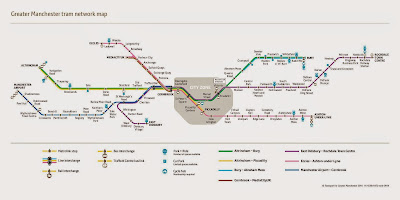
Map of the entire Manchester Metro system

The 'Connect 88' bus took me from near home in south Wilmslow to Altrincham where I caught a Metrolink tram to Cornbrook just south of Manchester City Centre. The Airport service currently originates and terminates there as there is at present insufficient capacity through the city centre to accommodate those extra trams. Metrolink are working on this and are constructing a second cross-city link to provide the required capacity.

Metrolink second city crossing route

The 'Connect 88' bus connects Knutsford to Altrincham via Wilmslow and took me to Altrincham this morning, and back from Altrincham at the end of my trip. It has recently been re-launched as a half-hourly service instead of hourly, using these new 'luxury' buses. 

These new buses feature leather seats and even a table! Great for stretching your legs out as long as no-one is sitting opposite (they weren't on my journeys today).

Cornbrook Metrolink station with a tram leaving for Media City

Unlike many existing Metrolink lines, the Airport line is an entirely new route, in that it does not use any former heavy rail alignments once it leaves the East Didsbury line. Part of the route uses street running, part runs alongside roads, but linking these are sections which have seen neither the iron or the tarmac road to date.

From Cornbrook the tram follows the route to Altrincham as far as Trafford Bar station, where it turns left onto the East Didsbury line past the depot (where a few of the now obsolete first generation Metrolink trams are still parked) until St Werburg's Road station, where the new route begins. After running along Mauldeth Road and Hardy Lane, the line crosses the River Mersey.

The following three photographs are by Greg Mape, from the excellent Charlie Hulme website:  North Wales Coast Rail.

Metrolink tram crosses the River Mersey on the Airport Line

After passing close to Sale Water Park and Wythenshawe Park, the line crosses the M60 Manchester orbital motorway and (above) the Stockport to Altrincham railway at Baguley. Years ago there used to be a railway station at Baguley close to this point, and there is a campaign to build a new station on the railway here so passengers can interchange between tram and train. Note the solid concrete-base track used extensively on the Airport line.

The line crosses the M56 motorway before passing though central Wythenshawe and Shadow Moss to arrive at the Airport station (above), one of the few stretches where ballasted track is used. The Metrolink platforms are adjacent to the heavy rail platforms at the Airport.  The station is becoming an ever more important terminus in the Manchester railway system, and will close for three weeks early next year while finishing work is completed on an additional fourth platform.


The Transport Interchange at Manchester Airport incorporates a Railway Station, Metrolink Tram Station, and Bus Station. It is linked to the Airport terminals by covered moving walkways.

I returned to Cornbrook on another tram. The only part of the Metrolink system apart from the Airport line I hadn't yet travelled on was the Media City branch off the Eccles line, so I took the opportunity to board a Media City tram at Cornbrook. Media City has been built on the redeveloped Salford Docks, and looks today very different to my memories of the area back when Manchester and Salford Docks were teeming with activity, the wharves full of ocean-going ships that had sailed up the Manchester Ship Canal from the sea at Liverpool.

Media City, Salford; a bit different to when this was Salford Docks

Today the Docks and the ships are long gone and the area is the home of TV and Radio; it brightened my day to see BBC North West Tonight presenter Kate Simms sitting opposite me on the tram. I must admit I didn't know who she was at the time though I did recognise her face as someone 'on the telly'.

BBC Northwest Tonight presenter Kate Simms


That tram took me back to Manchester's Piccadilly main line station, from where I decided to make fuller use of my GMPTE Wayfarer ticket (covers local rail, bus, and Metrolink) and take an East Midlands fast train on the CLC (Cheshire Lines Comittee) route to Liverpool as far as Warrington Central. This passes through the parts of Stretford and Trafford Park where I spent my early childhood and it's always interesting to see it from the railway. Back in the 1950s, of course, it was the passing steam trains on this line, and the little steam locos on the Ship Canal and Trafford Park railway systems, that interested us. My first ever footplate ride was on such a small steam shunting engine on the industrial railway alongside the Kelloggs Corn Flake factory which is visible today from the train.

The line also passes Trafford Park Container Terminal, which generates a great deal of rail freight traffic inbound and outbound along our local railway line through Wilmslow and Alderley Edge.


Trafford Park Container Terminal, with the dome of the Trafford Centre shopping complex in the background

A few minutes after I arrived at Warrington Central, I boarded an opposite direction stopping Northern Rail service which returned me to Deansgate station, Manchester, where I crossed the bridge to the adjacent Metrolink station for a tram to Altrincham, and then via the 'Connect 88' bus to home.

Finally, a note on signalling. Metrolink used to use colour light 'block interval' siganlling on all but the on-street sections of tramway. This only allows one tram at a time in a section, but does limit capacity on the line. In view of this and because the trams can stop quickly compared to a railway train, the block section signals are no longer used. On the Altrincham line they are out of use with plastic bags over the signal heads, and the new Airport line has no signals at all. Instead, drivers rely on 'line of sight', remaining a safe distance behind the tram in front.

At certain locations, for instance the bi-directional single track section between Timperley and Navigation Road, signals have, of necessity, been retained to control the flow of traffic. And the electronic 'stop / go' indicators at road crossings are retained, as are the 'line straight ahead or diverge' indicators at junctions.

So not bad; a whole day out for £5, the cost of my (senior) Wayfarer ticket. A word of warning though - they've gone up to £6 now!


.

Saturday, 8 November 2014

Some thoughts on broadband speeds

Some time ago FTTC (Fibre To The Cabinet) broadband was introduced locally, and we upgraded to it. So what is FTTC?

Before asking that, lets go back a bit to how we connected to the internet before broadband came along. Remember dial-up modems? They used the telephone line in your home to send data to and from the telephone exchange, where it connected to the Internet. The modem converted the digital data (ones and zeros, the language of computers) into analogue audible tones which it sent down the telephone line. As the modem 'synced up'  (established the data connection) you could first hear the dial tones of the modem dialing, then the tones being sent down the line as the two modems established the maximum speed they could use to communicate over the phone line, the speed being dependent on the distance to the exchange and the electrical condition of the line. Modern modems with data compression, error checking and correction functions could typically achieve a maximum speed of around 9,600 bps (bits per second), a bit being a one or a zero in the data stream.

Back in the early 1970s when I was first involved in working with data communications in the computer industry (with Burroughs - remember them?), even 9,600 bps over telephone lines was undreamed off. For instance, the UK banks had computer terminals in their branches connected to computer centres by dedicated 4-wire lines. 'Dedicated' means these lines did not route through any telephone equipment in exchanges - they were direct point-to-point connections from the bank branch to the computer centre. And '4-wire' meant that they comprised double the number of conductors used in standard 2-wire telephone lines, so could carry twice the data. These state-of-the-art communication links ran at the then dizzy speed of 1,200 bps! If the dedicated 4-wire line failed, there was a fall back of a dial-up connection through the telephone network using ordinary 2-wire phone lines. These ran at 300 bps. And the modems that achieved this amazing performance were big tin boxes rented from the Post Office (GPO) who back then ran the telephone network. In those pre-privatised times one was only allowed to connect GPO equipment to GPO lines, so even where our Burroughs computers incorporated internal modems neatly implemented on a circuit board within the machine, we were not allowed to use them and had to rent these massive boxes from the GPO instead.

A 1970s GPO Modem on a filing cabinet to indicate its size

So home internet connection at 9,600 bps in the 1990s over a standard telephone line using a modem the size of a match box that cost a few pounds seemed a massive advance on what had gone before. Then we got broadband, and that brought a step change in home internet connection speeds.

Communications engineers had developed a technology to send data in digital form down a standard telephone line instead of converting it to analogue tones as modems did. By using very high frequencies for the data, the line's simultaneous use for the voice telephone was not compromised. This new technology was ADSL, or Asymmetric Digital Subscriber Line. Asymmetric because the available capacity, or bandwidth, was asymmetrically divided to give a download speed (data from the Internet to the home computer) several times the upload speed (data from the home computer to the Internet). ADSL gave download speeds of typically 3 or 4 Mbps (Mega bits per second, or million bits per second). So the same copper pair of telephone wires which in the early 1970s could carry 300 bits per second could now carry 4,000,000 bits per second!

This is the speed between the home and the telephone exchange, over the copper wires of the telephone line. The connection from the Internet to the telephone exchange is fibre optic. Fibre optic technology uses glass fibres to carry the information in the form of light, whereas conventional communications cables are made of copper down which electrical signals flow. The advantage of fibre optic over copper cable is that the former can carry far more information at much higher speeds, and the speed does not degrade with distance as it does with copper cables.

So the bottleneck between the home and the very high speeds of fibre optic technology available in the exchange (about 100 Mbps) is the copper telephone line. Although ADSL allows formerly unimaginable 4 Mbps speeds over this copper link, it's still pretty slow compared to fibre speeds. The obvious answer is to replace the old copper telephone line with a fibre optic link from the home computer to the exchange. This is possible, and is known as FTTP (Fibre To The Premises) and is sometimes supplied to business customers, but it is very expensive to install such a link to each house. A compromise system has therefore been developed, FTTC (Fibre To The Cabinet).

FTTC diagram. This diagram doesn't show that the fibre optic link is in addition to the original copper links between the exchange and the street cabinet.

Telephone lines utilise copper cables from the exchange to the street cabinet from which copper telephone lines radiate to each house. FTTC implements an additional fibre optic link from the exchange to a second street cabinet adjacent to the first, to carry 100 Mbps internet traffic. Within the second cabinet the internet connection is transferred to copper wires which link into the original street cabinet for distribution over the existing telephone infrastructure to each house. The technology used to transmit the data at high speed over the copper links between the street cabinet and the home is VDSL 2. Note that the original copper connection from the street cabinet to the exchange is retained for use by the voice telephone system (and ADSL broadband). Schematically, it looks like this:

Schematic showing how the original copper telephone lines from the exchange to the home are supplemented in FTTC by a fibre link to a second street cabinet which originates VDSL copper broadband connections to the original cabinet. Note that there is still a copper path from the home to the exchange for use by voice telephone and ADSL broadband users.  


In the foreground is the FTTC street cabinet where the 100 Mbps fibre link from the exchange is converted to copper VDSL 2 links, one for each FTTC-connected house. These connect to the adjacent original street cabinet (in the background) which uses the existing telephone infrastructure to provide a VDSL link to each house as well as carrying voice traffic for the telephone.

 The speed of VDSL and therefore the speed of one's broadband link depends on the distance between the cabinet and the home, as this graph shows (click on it to enlarge it).

The line on the graph that we are interested in is the VDSL 2 line. It can be seen that the speed falls off rapidly with distance, down to about a quarter of the potential 100 Mbps for premises 300m or more from the cabinet. Engineers are working on improved technologies to give even faster data speeds over copper wires, so hopefully those of use who live some distance from out street cabinet might enjoy speeds closer to the theoretical maximum than we now do.

Nevertheless, even if one only enjoys a broadband speed of 18 Mbps or so, that's amazing when one compares that to the technology on the early '70s when I first became involved with data communications. A mere 300 bits per second over a telephone line back then; up to 100 million bits per second today!

By the way, fibre broadband is an oxymoron. Broadband is a radio-originated term to describe carrying information over a broad spectrum of frequencies, which is the basis of ADSL and VDSL. Fibre optic links use a single-frequency laser light source to carry information down a glass fibre at very high speeds. So fibre optic technology is not broadband, it is narrow band; uni-band, in fact. Therefore, strictly speaking, broadband is a term that should only be applied to the copper part of your fast internet link, the ADSL or VDSL part.

What has happened of course is that 'broadband' has become a term describing fast internet access regardless of the underlying technology, rather than a descriptor for a multi-frequency information carrying service.


.

Friday, 31 October 2014

Back to Rudyard Lake; now Malc's a guard, too!

This morning Malc and I rode down to the railway on somewhat mis-matched bikes; I'd suggested we go on our 650 Suzuki Freewinds, but Malc turned up on his 80cc Townmate. However, we got there OK.

My Freewind and Malc's T80 at the railway this morning. In the background, Alan polishes 'Merlin'.

Malc was to have a go as guard, so I showed him the ropes (i.e. the ticket machine and the money bag) and he pretty soon picked it up from there.

The guard's compartment at the rear of the train (front of the train on the return trip)

Once again our loco today was 'King Arthur', ready here to leave Rudyard with the first train this morning

'King Arthur's' footplate is almost identical to the other Exmoor engines

I drove 'King Arthur' several times today, running around the train, and fired her up and down the line with Joe as driver. Here's a shot Malc took of me at Rudyard this morning.

This is the far end of the line; Hunt House Wood, looking towards Rudyard. Joe polishes 'The King' ready for our return journey down the lake.

Gluttons for punishment (only joking!) we're back there tomorrow. Let's see if Malc can come on the right bike this time!

SATURDAY (1st Nov) UPDATE:

Yes, he did. Both on our Freewinds today. The day started with some carriage cleaning and general train preparation, and I did a bit more guarding while Malc started to build a signal post in the workshop for use at Hunthouse Wood.

The train loco today was 'Pendragon', and I got to drive her back to Rudyard from Lakeside Loop on a passenger train with rostered driver Matt acting as firemen. That's the first time I've driven one of these engines on a train, so more mass to control than when driving light engine, and the train air brake to use as well. Even though I've done that hundreds of times at the MoSI railway (see elsewhere on the blog) on the much larger and heavier standard gauge replica 'Planet' loco and saddle tank 'Agecroft No.1', the techniques are quite different on these little trains.

The air brake on 'Planet', and vacuum brake on 'Agecroft'  have more delay and more power; one has to anticipate application and then release the brake and re-apply always anticipating the delayed response to come to a smooth stop in the right place. On this little railway the air brake is more an on/off switch, as the brakes are much less effective (due the much smaller diameter wheels). Often, a more effective way of slowing the train is to put the loco into reverse (with drain cocks open and regulator closed) in either first, second, or third notch on the reverser lever. 


.

Tuesday, 28 October 2014

More Rudyard Volunteering; now I'm a guard!

Malc is away visiting family but the RLSR is operating this week, so I went down there on my own today. There were just three of us in attendance; Joe (who I know from the Churnet Valley Railway), Alan, and myself. Joe and Alan took turns driving and I was instantly promoted to Guard. It's a role I started to pursue on the Churnet Valley but so convoluted was the training for what's essentially a pretty simple job that I decided to stick to Signalling on that railway (a complex job with suitably complex training!). At Rudyard, it's recognised that Guarding is not rocket science; a hand held machine tots up the fares to be charged to passengers, and (sometimes!) prints the tickets. Then I take the fares in cash, tendering change from my cash bag. I also made some station announcements at 'The Dam' intermediate station, and 'Hunthouse Wood' terminus. There's also an emergency brake in the guard's compartment which I can apply if I spot anything amiss with the train. After my first trip up and down the line, I had the job pretty much  taped.

We ran five return trips on the scenic 1.5 mile lakeside line today, one per hour starting at 11:00, the last train getting back to Rudyard about 15:45.

As a bonus for being Guard all day, at Rudyard I got to run the locomotive round between trains (our engine today was Pendragon, another fine little Exmoor loco). This involves uncoupling from the train, driving the engine to the water column, watering and coaling (so easy on these little engines!), then driving it along the station loop line, reversing it onto the train, and coupling up (including attaching the air brake pipes) ready for departure. I then oiled round the motion and topped up the cylinder oil in the lubricator.

'Pendragon' photographed on another day, leaving Rudyard station

Then it's time to wash my hands before selling the tickets for the next train to passengers already in the coaches. When it's time to go, I press a plunger switch on the platform and the barrier alarms sound as the barriers to the car park exit road level crossing descend, and a pre-recorded announcement welcomes passengers to the railway and gives basic safety information. Once the barriers are down the starter signal pulls off automatically, and I give the driver the 'right away'.

At the end of the day I ran 'Pendragon' round from the front to the back of the train, coupled on, and propelled the train backwards into the carriage shed for the night. Joe uncoupled the loco and I ran her onto shed and put one of the injectors on (to top up the boiler with water for next time),  raked out the fire, and put her away in the engine shed.

I'm back at Rudyard on Thursday. If it's a similar day to today, I'm really looking forward to it!

THURSDAY UPDATE:

Another day of Guarding, and driving the locomotive during run-arounds. Our engine today was 'King Arthur' (all the Exmoor locos are named after Arthurian characters). 'The King' is the largest engine on the fleet having six coupled driving wheels. She is also considerably heavier than the four-coupled locos, a distinct advantage in the leaf-fall season when fallen leaves can make the tracks slippery and promote slipping by the locomotives.

Me in 'King Arthur'

'Here's Excaliber's' cab, which has much the same layout as the other 'Exmoor' engines. 

On the left is the reverser lever, which controls direction of travel and 'notching up' of the valve cut-off setting. The handbrake is on the right, with the train air brake lever on the cab front wall just above it, together with its associated air pressure gauge. 

The boiler steam pressure gauge is prominent in the centre between the two spectacle windows, with the 'blower' control tap beneath it (the blower sends a variable blast of steam up the chimney to draw the fire). Either side of the blower control are the steam valves for the left and right injectors (used with the associated water taps to feed water into the boiler against boiler pressure). Those injector water taps are either side of the boiler backhead, outboard of the two gauge glasses which show boiler water level. 

Between the gauge glasses is the firebox door, and the two coal bunkers are either side of the backhead (only the left one is visible here). The lever with the yellow handle is the sander (for use if the loco slips on the rail), and below that is the control for the cylinder drain cocks. 

The regulator, which admits steam to the cylinders to make the locomotive move, is the horizontal red handle with silver end, above the gauge glasses. The whistle lever is by the right hand spectacle glass. Just in sight at the base of the backhead are the two boiler blowdown valves.

I'll be back at the railway again tomorrow, hopefully for more of the same!


.
.

Saturday, 18 October 2014

Volunteering at the Rudyard lake Steam Railway

Malc and I have just completed our third full day as volunteers on this delightful ten and a quarter inch gauge railway that runs for a mile and a half alongside picturesque Rudyard lake in Staffordshire. We have visited the railway before and two of those visits are reported earlier in this blog ( Link to RLSR Steam Gala ) and this one (  And an earlier visit ).

The first day of volunteering was on a 'work party' day; no trains were running and the object was to complete maintenance tasks. Malc and I were assigned to replacing a plywood end panel in a 'toastrack' coach. We removed the old rotted panel and carefully prised off the architrave surrounds of the perspex windows and removed the window panes, then marked out the new panel from the old on the new piece of plywood, including the two oblong window openings. Malc had rejected the original piece of plywood offered to us from the railway's stock as not fit for purpose - it was already delaminating from storage in the damp shed, and was not 'out door' quality. If used would soon have gone the same way as the one we were replacing and whole job would have to be repeated. No point 'making work', so after some deliberation Peter who was supervising us went off in his car and came back with the pukka stuff.

 The window openings were cut out of the new wood sheet, and using a router (pronounced "rowter", so not a component in a computer network) we cut 'rebates' around each window for the perspex window panes so they'd sit flush in the new panel. On the inside face of the panel we used the router to cut a stepped pattern to the window openings, just to make it look nice. The new panel was then cut out of the plywood sheet along the marked-out outline. A coat of undercoat was applied and left to dry.

Our next visit was an operating day, and we progressed our work of a few days before. The perspex window panes were fitted, and held in place by the architraves tacked into place and filler used to make good the joints between the four architrave pieces that made up each window surround. The window panes were masked off with tape ready for a coat of red top coat to be applied. The panel was fitted into the coach end and trimmed to fit, end-drilled for the fixing screws to hold it though the steel coach frame, and screwed into place. It just remained to apply the final paint coats to the new panel. After this we tidied up, put away painting equipment and all tools, and had a ride up and down the line as passengers.

This morning we rode across to Rudyard on the little bikes to finish the job; Mike, the railway owner had earlier in the week applied a coat of red top coat to the outside of the panel, and white on the inside. We applied the final top coats over those this morning - and then, job finished (apart from removing the masking tape from the window frames once the paint is dry), it was time to play!

Two locomotives were in steam, Exmoor Railway 'Excalibur' and ex-Isle of Mull Railway 'Victoria'. The first train was double headed using both locos and I bagged a cab seat in 'Excalibur' with driver Pete, while Malc did the same in the lead engine, 'Victoria' with his driver, Ian.

There's not a lot of room in these little engine cabs so it was tight fit, and each of us had one knee protruding from the cab side as we set off from Rudyard lake Station towards 'Dam', the first station on the line.

 'Excalibur' being prepared for traffic, by the water tower

Peter wasn't convinced that double heading was required, so at Dam station we detached 'Victoria' and sent her ahead to wait in the headshunt of Hunthouse Wood loop at the end of the line. We followed with the train, passing Lakeside Loop on the way, and on reaching Hunthouse Wood Station and loop we entered the 'main line' of the loop. Much to my surprise, Pete allowed me to drive 'Excalibur' off the head of our train, then to 'run her around' it in the loop. And my surprise didn't end there - 'Excalibur's regulator was mine for the entire length of the line, running light engine, she was mine to drive right back to Rudyard! I notched up to third notch as we accelerated down the line, but as we approached the end of the line I used a notch of 'forward gear' with drain cocks open (we were running reverse in this direction) to slow the loco on the gradual descent into Rudyard station (the locos only have hand brakes, while the coaches have continuous air brakes controlled from the locomotive, so without a train 'Excalibur' only had a hand brake to retard progress). 'Victoria' followed us with the train.

'Victoria' looks nice, but is a flawed design. She is difficult to maintain. For instance, to remove the boiler mudhole doors for a wash-out, the injectors have to be removed. Even cleaning the boiler tubes is a pain as inside the smokebox, in front of the front tube plate, is a spaghetti of pipework. The footplate is not a good workplace, either, with features such as the coal bunker being under the driver's seat  rather than conventionally, either side of the forward wall of the cab, rearward of the side tanks, as with 'Excalibur' and the other 'Exmoor' engines.

'Victoria', ex-Isle of Mull Railway, and not the most practical design from the driving and maintenance point of view

I was also allowed to drive 'Excalibur' solo in the station environs, to the water tower, and forward to a position ready to take the next train out  after 'Victoria' had arrived back with the train, with Malc on the footplate.

Later in the day I had another ride up and down the line on 'Excalibur', this time with Dave driving and me firing (Pete was guard), and was allowed to do a 'solo' run around the train in Hunthouse loop on 'Excalibur'.

The technique of firing these little engines, and operating the injectors to keep the boiler water level topped up (the fireman's most vital job!) is much the same as on bigger engines such as 'Planet' and Agecroft' which I fire at MoSI (see elsewhere in this blog, here, for instance ).

Agecroft No.1 on the MoSI railway, though originally built to work at the power station whose name she carries, is a small engine for a standard gauge loco. However, as this drawing of yours truly climbing aboard her P1 side shows, this 1948 Robert Stephenson & Hawthorn 0-4-0 saddle tank is a giant compared to the RLSR engines

Everything happens more quickly with these small engines; pressure drops quickly but responds straight away to firing, and the water level drops as the small boiler uses it, but the injectors rapidly restore the correct level. And of course normally these engines are single-manned - driver and fireman combined.

In short, these little engines are great fun!

The railway is up for sale as Mike and his wife want to retire. I just hope it remains in sympathetic hands, and that in the not too distant future I might pass out as a driver here. And I must remember to take my camera next time!

Another look at Exmoor engine 'Excalibur', which I drove and fired today


.

Sunday, 28 September 2014

Foxfield Steam Gala 2014

The pleasant September weather continues this weekend. Yesterday Malc and I visited the Rudyard Lake Steam Railway on our big bikes (his TDM parallel 900cc twin, my Moto Guzzi V2 1200cc Griso) with a view to maybe volunteering there (watch this space!).

Today was even better weatherwise, and Ivan, Malc and I set off on the little bikes (two 7hp C90s and an SS50, in contrast to my Griso's 120hp) to visit the Foxfield Steam Gala, which I last visited on 22nd July 2012 (see the blog). We stuck to the small roads that suit these bikes best; Chelford, Jodrell Bank, Lower Withington, Congleton, east of Biddulph Moor, Rudyard, Longsdon, Cheddleton, Wetley Rocks, Cellarhead, and Caverswall to the railway.

It's food for thought that on a back roads trip like this, the difference in journey time between the 7hp C90 and the 120hp Griso is only a few minutes. But the Guzzi sure sounds better!

Having locked up the bikes and paid our entrance fee we had a look round the Caverswall Road site.

The railway was built to bring coal out of Foxfield colliery (which closed in 1965) to the main line at Blyth Bridge. Caverswall Road is the railway's main site, from where passenger trains run to Dilhorne Park. Freight trains run through to Foxfield Colliery, but the gradient between Dilhorne and Foxfield is  in places as steep as 1 in 19; the steepest adhesion-worked standard gauge line in Britain and too steep for passenger trains.

As usual, please click on any picture for a larger image.

This 1947 Peckett locomotive on show at Caverswall Road (though not in steam) incorporates many advances in industrial locomotive design made during the steam era. 

Here's an old friend - the Beyer Peacock saddle tank that spent some time at the Churnet Valley Railway recently (notably at the Winter Steam Gala on 22nd February this year - see the blog). Its train comprises the restored Knotty (North Staffordshire Railway) 4-wheel coaches - and very smart they are. Malc and I saw one of these coaches at Cheddleton Sunday 24th June this year, as reported in the blog for that date.

 We boarded a vintage Knotty coach fro the trip to Dilhorne Park. The recent restoration is to a very high standard; even the slots in all of the heads of the brass wood screws are vertical!

 Ivan and Malc observing the rural countryside go by the window between Caverswall Road and Dilhorne Park

Our train arrives at Dilhorne. From here we will walk the rest of the way to Foxfield colliery. 

 Malc goes over the stile, Ivan next, as we join the footpath down alongside the railway to the colliery


Not far down from Dilhorne the crane tank, banked by diesel 'Woolstanton No.3', worked up past us from the colliery. Here's the video of that:

'Woolstanton No.3' on the back of the train 

 Halfway to the colliery is 'leg-over stile', so called because some elderly gentlemen with arthritis can't get their leg over here! We managed OK, though. When I was last here, 2 years ago, this path was far too muddy to negotiate, but after our lovely dry late summer and autumn this year it was dry as a bone. Ivan and Malc having managed it, that's all of us over.

On arrival at Foxfield Colliery we watched some shunting, including these two wagons being let down the bank without use of a locomotive. Here's a video:

Eventually the train was assembled and climbed the bank. It's headed by 'Florence No.2', an 0-6-0 Bagnall from Florence colliery, Staffordshire. She is fitted with a Giesel  Ejector, which may have improved performance but does mean the exhaust is somewhat 'soft'; a tad disappointing on the bank. The colliery head gear can be seen in the background. The video is below:

A shuttle bus was provided between Caverswall Road and Foxfield colliery. We caught it back to Caverswall Road.


By the time we got back to Caverswall Road the crane tank and train were there having worked down from Dilhorne Park 

Here's a locomotive we've met before on this blog, well tank 'Bellerophon'. She was one of six built in 1874 for Haydock Collieries and is the sole survivor. Unusually for such an early locomotive she has outside Stephenson / Gooch valve gear and piston valves.

We took a ride behind 'Bellerophon' , once again in the vintage Knotty stock up to Dilhorne Park and back. Here's another view of the surprisingly rural scenery on this former industrial line. 

Back at Caverswall Road we prepare for the ride home. Malc with his and my Honda C90s, Ivan's SS50 behind them.

We rode back the same way as we had come, stopping for fuel at Chelford and for a lovely pint of Sam Smiths bitter at the Bird In Hand, Knolls Green.

So ended yet another great day out on manouvres for us on the little bikes.


.

Sunday, 14 September 2014

AVLR 'Tracks to Trenches' WW1 event

This weekend the Apedale Valley Light Railway (AVLR) near Newcastle under Lyme held its 'Tracks to Trenches' event to commemorate the centenary of the start of the First World War. The event concentrated on transport and logistics of the 'war to end all wars', and probably narrow gauge railways' finest hour. Me, Ivan, and Malc fired up the little bikes to go have a look, routing via Chelford, Jodrell Bank, Clonter Brook, Somerford Booths, Brownlow, and Kidsgrove.

As ever, please click on any picture for a larger image.

Malc and Ivan on arrival at Apedale this morning with the little bikes parked in the exhibitor area with some larger machines. Malc and I were on our Honda C90s, Ivan on his Honda SS50.

We had been invited to park our bikes as exhibits, so were able to ride directly into the AVLR site and park in the motorcycle exhibitor area. 

 AVLR resident Hudswell Clarke 0-6-0WT "Wee Pug" of 1916 in the station

 Visiting from the Greensand Railway Museum Trust on the excellent Leighton Buzzard Railway is Baldwin 4-6-0T "Yankee" of 1917

 AVLR resident Kerr Stuart 0-6-0T  Joffre  of 1917 on a freight train

Another view of the Joffre

 Hudswell Clarke 0-6-0WT of 1930 from the Statfold Barn Railway

The Joffre again 

A vehicle which is a cross between a traction engine and an early lorry, a 1917 Foden steam lorry. It has a horizontal traction engine boiler and cylinders driving a 'lorry' rear axle.  

 This Kerr Stuart "Wren" 0-4-0T of 1918 from the Vale of Rheidol Railway once worked at Driffield Army Camp

 This French Government Baguley "Inspection car" of 1918 is from the Statfold Barn railway

This Rolls Royce armored car is from the Duke of Westminster's Grosvenor estate 

This is a 4/5 replica of a Mk4 WW1 tank. The original had a 12 litre petrol engine, but this replica has a more reliable 2.5 litre Ford Transit diesel engine. The 3 colours on the flag represent the mud of the battlefield, the blood shed by countless soldiers, and the green fields beyond. 

Much effort had obviously gone into preparing this event, including digging these WW1 trenches, complete with duck boards and other details 

The Vale of Rheidol's little Wren again... 

...a truly minimalist steam locomotive 

'Wee Pug' on a freight train 

Joffre in the station roads having uncoupled from a freight train 

The Baldwin 'Yankee' in the station 

The Hudswell Clarke, a business-like little engine

The Yankee, cylinder drain cocks open 

 German Imperial Army Railway Henschel 0-8-0T "Brigadelok" of 1918 from the North Gloucestershire Railway

The Hudswell Clarke once belonged to Surrey County Council Highways Department. I wonder why they wanted a steam locomotive? Silly question! Doesn't everyone want a steam locomotive?

By the time we were ready to leave the bigger bikes had departed to be replaced by a type of car that was part of my childhood. Above, my C90, Malc's C90, and Ivan's SS50 find themselves next to a 1937 Ford Model Y . My father's first car in the early 1950s was one of these, and I can still remember it quite clearly. Looking through the windows of this one I am amazed how tiny it is - narrow seats and not much leg room. People must have been a lot smaller then.

Here's a video I took of the WW1 tank on the move:
Click here

Just after I took the above picture we fired up the steeds and headed home along the same route as our outward journey. Except we deviated very slightly to the 'Bird in Hand' at Knolls Green for a pint, in celebration of yet another great day out.


.