Sunday, 31 March 2019

The latest loco in the fleet

Here's the latest member of my miniature locomotive fleet (for now!). It's a 5" gauge model of a 'Large Penrhyn' Quarry Hunslet, and has replaced the Fowler locomotive 'The Wildfowler'.


This model is of the 'Large Penrhyn' type of Quarry Hunslet, and was built in 2009 by Alan Green, a master model engineer and fellow member of Urmston model engineer club, where we run the locos. It is named 'Samuel' after Alan's grandson, but I intend to rename it, probably to 'Penrhyn' as I am not particularly attracted to the names of any of the 'full size' locos of this type (they are far less numerous than the smaller 'Alice' class quarry Hunslets, or the similar sized 'Port' class)..

The loco is just over four feet long and weighs about 250 pounds!


The locomotive is a tribute to Alan's engineering skill (he is an ex-Metro Vickers professional engineer; their top apprentice in 1952). It is an absolute work of art and it's a privilege to own it).


.

Sunday, 10 March 2019

This is just delightful....

In my experience this rings true.

The best non-pilot 'pilots' I took flying were young girls like this. They have no pre-conceived ideas, and they don't treat it like driving a car (it isn't!). 

And the scene in the video where she runs her hand along the leading edge of the wing..... you know she's thinking 'wings are very very special'. And of course, they are. 

Understand the wing, and you understand flight.


.

Wednesday, 20 February 2019

A run out to MLS, by a rather indirect route....

Wednesday is Manchester Locomotive Society (MLS) day and though I don't go every Wednesday, I decided it was time for a little run out by train using my 'Northern' pass, so went to the club rooms on Stockport Station by a slightly indirect route.
I cycled down to Wilmslow station and tied up my steed (no parking problems with a bicycle) in time to see a Northern 323 Crewe to Liverpool Lime Street was due, so boarded that. It was a lengthy journey - it stopped at EVERY station on the way, including little-used Styal. It reversed at the Airport, emptied and filled again at Manchester Piccadilly and Oxford Road, before heading out over Chat Moss. It even stopped at places I'd never noticed before, such as Roby!
Through Olive Mount Cutting, Wavertree, and Edge Hill we snaked, and finally drew into the recently refurbished Lime Street.

A 'Northern' class 323 electric unit, one of which took me to Lime St this morning.
Now where? The journey had taken from 09:46 to 11:30 or thereabouts, so the day was rapidly getting used up. What I needed was quick whizz back to Stockport and the MLS club rooms. I couldn't find any destination indicator on the main concourse at Lime Street, only individual ones for each platform, but I didn't need one; the only quick way back to Stockport would be by an East Midlands train to Norwich, and on the far side of the station I espied that distinctive livery. Of course, my 'Northern' pass would not be valid, but I have yet to find that a problem!
The four-car 158 was due out at 11:52 but was still being prepared, with some passengers waiting to board. About ten minutes before departure, the doors were unlocked, and I found the Train Manager, showed him my pass and asked if I could ride as far as Stockport... "of course you can !".
The journey back was by the Cheshire Lines Committee (CLC) route via Liverpool South Parkway, Widnes, and Warrington stopping only at those places, then Oxford Road and Piccadilly, before arriving in Stockport about an hour after leaving Liverpool. On the way we'd sped through Chassen Road station at about 70mph, the station adjacent to Abbotsfield park home of our Urmston & District Model Engineering Society club railway track.

East Midlands Trains class 158, my fast transit from Lime St to Stockport. The one I used comprised two of these units coupled into a 4-car train.
Just time for a quick visit to the MLS club rooms; a cup of tea, a biscuit, a chat to a few members, pick up my club 'Mancunian' magazine, then back out onto platform 1 for the 13:16 to Crewe, a 'Northern' class 319 ex-Thameslink unit (that south east line now enjoying new replacement units - of course!).
I found one of only two seats in the 319 with a good window view (there are only two such seats in the entire train - one facing in each direction) and enjoyed a scenic run through the verdant Cheshire countryside down to Crewe, stopping at all stations. The return journey in the same unit, about twenty minutes after arriving in Crewe, ran non-stop Holmes Chapel to Alderley Edge, missing the Goostrey and Chelford stops.
I left the train at Wilmslow, my jolly by train ending pretty much where i came in; the 319 would continue to Lime Street as an all stations stopper, the same diagram as my first train this morning.

'Northern' class 319, ex-Thameslink cast-off. which took me Stockport to Crewe and back to Wilmslow.


Monday, 21 January 2019

The 4MT sees its first fire!

I took the new 4MT Standard Class Tank loco to Urmston club on Sunday for its hydraulic and steam test, and to see how it runs.
It passed both tests with no issues at all. A few teething troubles were revealed on running it, but once those are put right under warranty I think it has the potential to be a superb locomotive.
The pictures tell the story. 
On the 'arrival' table at Urmston club. This can be raised or lowered by compressed air to suit the height of one's car load area. 

 The flight deck

 On the prep bay. I'm replacing the two safety valves with one blanking plug and one blanking plug with a connection to 'Boiler' Bob's (standing next to me) calibrated pump and pressure gauge (behind the loco).

I have filled the boiler to the brim with water, and Bob will pressurise it to 1.5 times working pressure (135 psi for a working pressure of 90 psi). If it should fail (which it won't as it has a manufacturer's shell test certificate to twice working pressure) there will be no explosion, water being incompressible.

 With its door open so Bob can check the front of the boiler for hydraulic leaks, here's a look into the smoke box. 

The blast pipe is in the foreground (the exhaust steam from the cylinders exits her to blast up the chimney), below the skirt of the chimney petticoat. The two big copper pipes exiting the sides of the smoke box are the superheated steam feeds to each of the two cylinders from the superheater header.

In the background is the the front tube plate of the boiler showing the boiler flue tubes that run through the water space from the firebox at the back of the boiler.

The partial vacuum formed in the smoke box by the blast pipe is what draws the hot flue gasses through the boiler tubes and draws the fire to almost white heat when the loco is working hard.

The small copper pipe into the side of the blast pipe feeds boiler steam to the blower, controlled from the cab this gives a blast up the chimney to draw the fire when the loco is not on the move.

The steam test followed the hydraulic test. This ensures that the boiler has at least two methods of getting water into it (the 4MT has a live steam injector, a hand pump, and an axle pump) and that with full blower to give a maximum fire the safety valves blow off at or just before working pressure is reached, and can dissipate the steam at a rate that holds the boiler pressure within the limit. 

After I'd driven the loco around the track a few times 'Boiler' Bob has a go, watched by Malc. Loco blowing off healthily through both safety valves!

The 4MT in its element - albeit on the short Urmston track.
Note that the cylinder drain cocks have not fully closed hence the steam from the front end, one of several 'teething' faults to be addressed before we take her out on the main track.


.

Wednesday, 16 January 2019

It's arrived!

The Kingscale 5" gauge BR Standard Class 4 tank loco arrived this morning in a big wooden crate, all 15 stone of it. Once the rain stopped and I could wheel the motorbikes out of the garage (I needed to use the motorcycle lift) I could begin unpacking it.
The delivery man used his tail lift and pallet truck to unload it, and we got it onto one of my hydraulic trolleys so I could wheel it into the garage out of the rain. I used my electric drill to remove the many screws holding the lid down, observed the crate to be full of plastic foam 'squares' for packing and the loco invisible under a thick polystyrene sheet covered in shrink-wrap plastic. It was packed just as my Jubilee had been.

Bikes outside, end removed from packing case, ready to mate the hydraulic trolley to the (red) bike lift.

After lunch with the rain stopped I filled three bin bags with the plastic foam squares from inside the packing case, then as I had with the Jubilee, used a big claw hammer to lever off the packing case's external battens at one end, bashed the end off the packing case. I got the bikes outside, raised the bike lift platform and the hydraulic trolley to equal heights, removed the shrink wrap etc from the loco, and carefully maneuvered it out of the packing case onto the bike lift.

Shrink wrap cut, polystyrene sheet removed, and loco carefully maneuvered out of packing case onto the lift.

The edge of the packing case was overlapped with the bike lift to obviate the packing case and hydraulic trolley tipping as the 15 stone weight of the loco was moved out of the packing case onto the lift. The removable section of the lift (removable to allow a motorcycle's rear wheel to be dropped) made a good bridge between the case and the lift.

The packing case was then completely demolished flat so I could fit the bits into the car to take it to the tip later, and the 4MT was wheeled off the bike lift onto the hydraulic trolley for a good checking over and some photos!

 Job done! The 4MT on the hydraulic trolley where it will live when not in use.

 We even got a smidgen of sunshine to illuminate this lovely loco!

 Cab roof and back are removable (visible on the right, next to the loco) for driving and firing. The coal bunker is in the foreground (no coal in it yet) beneath which is the bunker water tank to supplement the water supply in the side tanks.

These are handsome locos!


.

Monday, 14 January 2019

G-BOAC gets a nose job!

Very glad to see that Manchester has at last put in place an enhancement to Concorde G-BOAC. They have allowed Heritage Concorde to re-activate the famous drooping nose, a modification that has already been applied to some other museum-based Concordes.
The mod involves installing a mains electricity-powered hydraulic pump to pressurise the nose and visor hydraulic circuits. The nose now operates exactly as it did in airline service, using the original 4-position cockpit selector switch.
Selections are:
1) Visor up, nose up. The position used in flight and while parked on the ground.
2) Visor down, nose in the 'up' position. The visor has to be selected 'down' before the nose can be lowered.
3) Nose lowered to 5 degrees, the position used for taxying and take off.
4) Nose lowered to 12.5 degrees, the position used for landing to give a clear view of the approaching runway despite the aeroplane's considerable nose-high pitch attitude on landing.
Now that the nose can be lowered to 12.5 degrees, the broken windscreen on the P2 side can be replaced. The windscreen failed about ten years ago and was a constant source of embarrassment to us tour guides as we had to explain time after time to flight deck visitors why the two windscreens were not identical.
Thank you Heritage Concorde.
Here is the nose-droop in action:

Saturday, 5 January 2019

The 4MTs are coming!

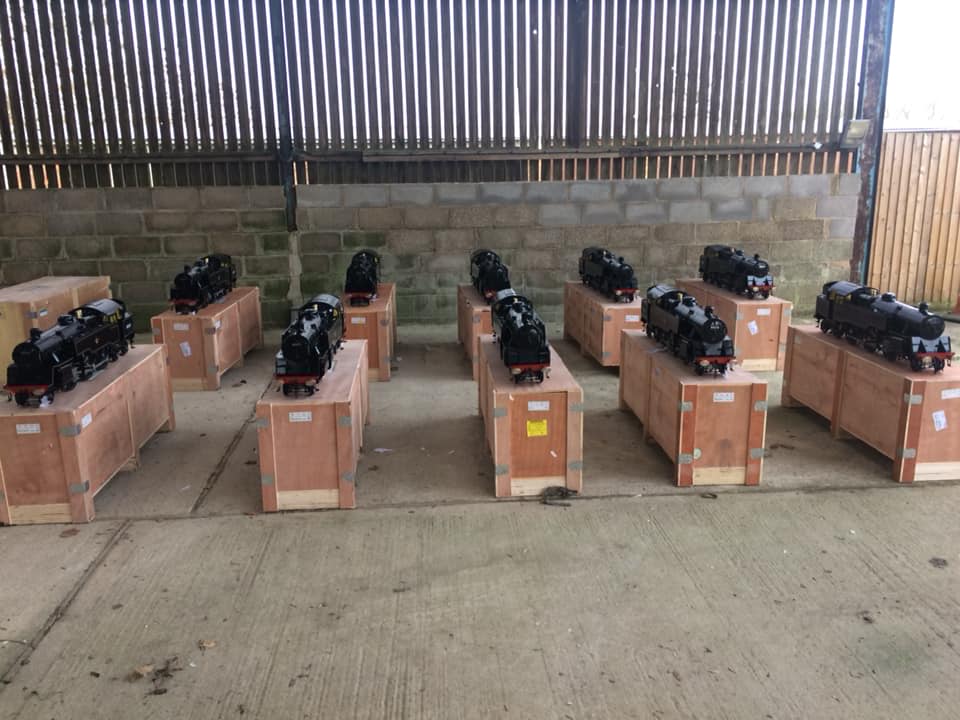
First batch of 10 (of 50 - all now sold) Kingscale 5" gauge BR Standard Class 4 Tank engines at Northampton for pre-delivery boiler hydraulic test and run-on-compressed-air test.
Should have mine soon!


.