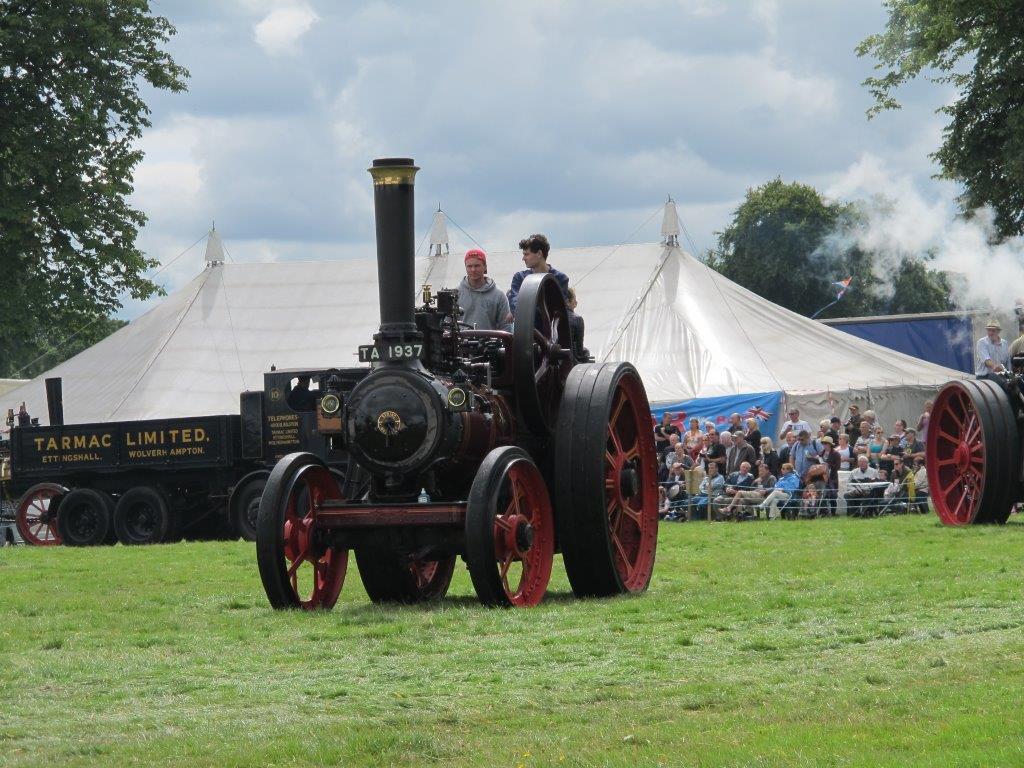
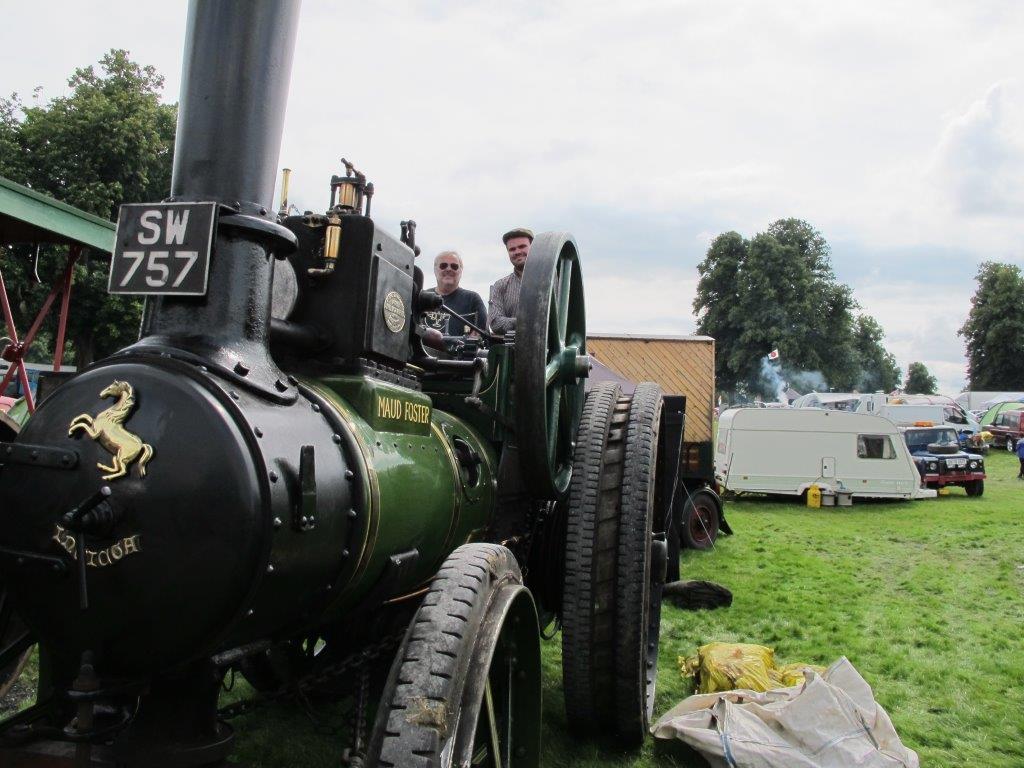
Early this year, we decided we'd do it, so we (me, Peter A, and Malc) booked accommodation through Peter A, who has an ex work colleague who owns a B&B near Sturminster Newton. He got us 'Mate's Rates' for this week, three nights Tuesday, Wednesday, Thursday, allowing two full days at the fair.
The organisers then decided to change the dates of the Steam Fair; they brought it forward several days, which meant our booked time in Dorset would no longer coincide with it. Malc bailed out at that point, but Garry stepped into the vacancy he left - I'm pretty sure Garry does not regret that.
We reasoned that as the accommodation was paid for and the dates could not be altered, nor new accommodation for the revised Fair dates found in the few weeks left before the Fair, we would go to Dorset anyway. We'd shelve the Steam fair for this year and do other stuff instead.
What a superb decision that was!
Here's what we did instead. Please click on any picture for a larger image.

On Tuesday morning (30th) Peter drove us down to the South West to our first port of call - the West Somerset Railway at Bishops Lydeard in plenty of time for a tea and snack before joining the 14:35 train for Minehead, hauled by ex-Great Western 7828 'Odney Manor'

At Williton diesel depot: class 52 'Western Campaigner' on the left, a class 35 Hymek in the middle, and a class 14 'Teddy Bear' on the right

The line heads north west to the north Somerset coast, seen here near Blue Anchor station

At Minehead our loco ran around the train for the journey back to Bishops Lydeard

Out of service 'prairie' at Minehead

Passing the harbour at Watchet on the return journey

Our home for the three nights we stayed in Dorset; the Old Causeway Bakery B&B, Hazelbury Bryan, near Sturminster Newton. I had an en-suite room in the main house, Peter and Garry shared 'The Cottage' extension to the right of the picture.

Peter's car (very comfortable) and the view over the fields from the B&B


Breakfast each morning was just down the road from the B&B, at The Pig's Blanket cafe, and eaten outside in the sunshine except on the morning we left which was a bit dull

Wednesday morning saw us driving to the south coast for a ride on the Swanage Railway, here approaching the scenic Corfe Castle

Corfe Castle station is the passing loop where opposite direction trains can cross on the single line railway, controlled by the large 'Southern' signalbox

Our locomotive, ex-Southern Railway 'U' class 31806, runs around its train back at Swanage after our trip to Norden, the current terminus. The railway is working to extend to meet the main line at Wareham, and passenger trains are expected to start running to Wareham next year.

Peter (in the blue shirt) photographs the next train arriving from Norden, hauled by Bulleid light pacific 'Manston', running tender first

Manston's nameplate and crest

Garry (in light blue jeans) photographing 'Manston' running around at Swanage

Next port of call was the Tank Museum at Bovington. Here's a 'Tiger' tank

'Chieftain' on the left, 'Challenger' on the right

Sherman tank 'Fury', which starred in the film of that name

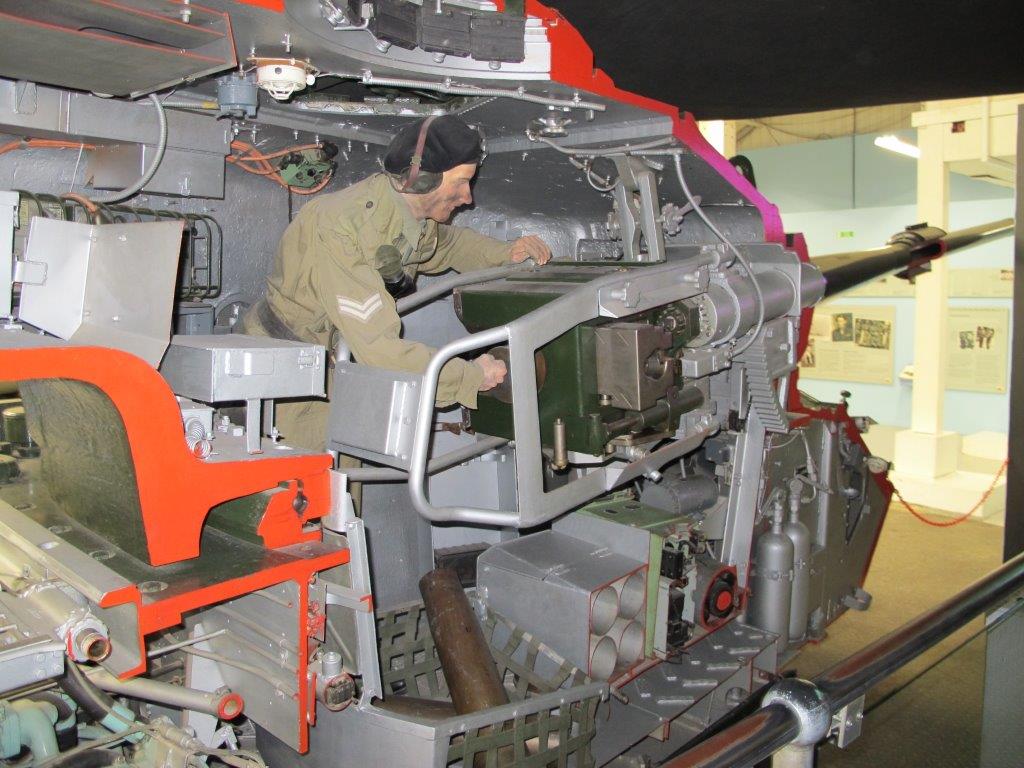

Centurion tank sliced in two, showing the cramped crew accommodation and its 'Meteor' engine (a modified Rolls Royce V12 Merlin)

Inside the only surviving WW1 tank. It must have been hot, noisy, and smelly sharing the limited space with the engine but that was probably the least of their concerns.

Handy little tracked motorcycle run about

A 'Tiger' tank captured by the allies in WW2, and in original condition
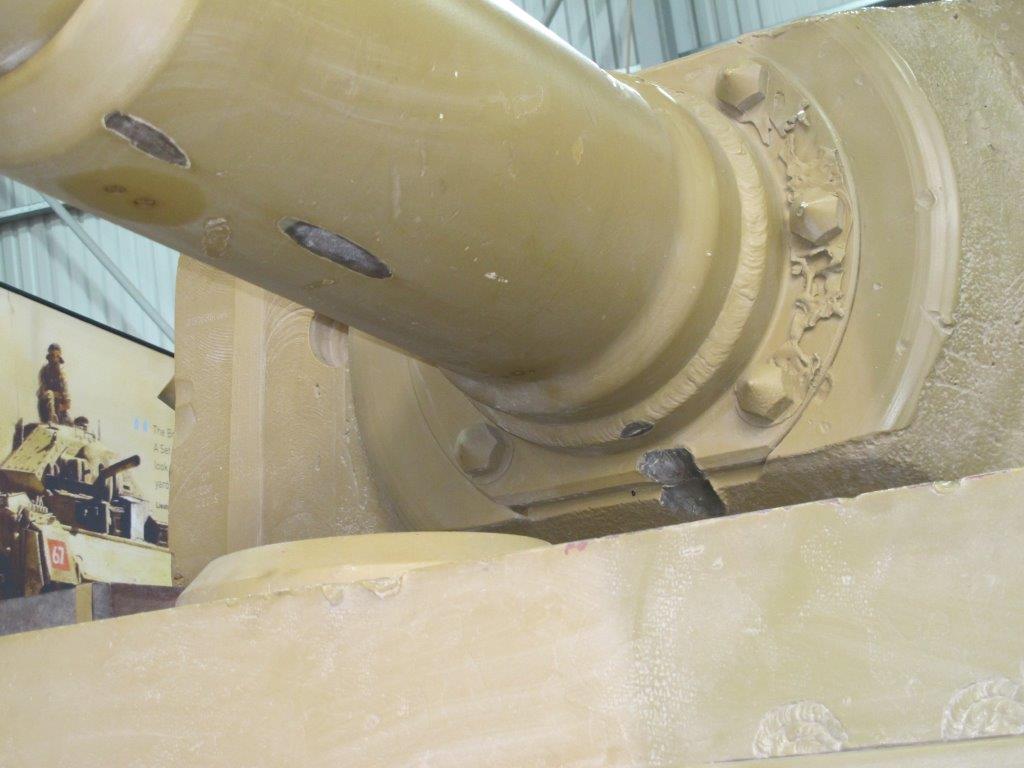
The tank shows evidence of battle damage, including above where a British shell has scraped the underside of the barrel before jamming itself between the turret and the body of the tank, preventing the turret from rotating. It was this that led to the crew abandoning the tank. They didn't have time to destroy it (which was the usual procedure) so it fell into allied hands who were able to evaluate it and devise tactics for allied tank crews to successfully attack the mighty 'Tiger'.

The museum has a large indoor storage area for artifacts not currently displayed in the museum

This is where we ate every evening - the White Hart Inn at Bishop's Caundle. Absolutely superb steaks and excellent golden ales. Highly recommended.

Thursday morning breakfast at the Pig's Blanket

Our third and final visit to a heritage railway; the East Somerset Railway at Cranmore. Here's our train loco at Cranmore; ex-Great Western 56XX tank engine 5637.

5637 runs around her train at the line's terminus, Mendip Vale

Ivatt class two 2-6-0 46447 of the Isle of Wight Steam Railway in the shed at Cranmore

5637 on arrival back at Cranmore

It's difficult to pick out a highlight of this Dorset sojourn for me, but this comes close. The Fleet Air Arm Museum at Yeovilton

But there's no argument about what is, for me, the highlight of this museum; G-BSST, the first British prototype Concorde

A view of Hall 4, with Concorde, the modified Fairey Delta Two, and the P1127 which was developed into the remarkable Harrier vertical take off aircraft

This odd looking aeroplane is the Handley Page HP115. Aerodynamicists knew that for minimum drag at supersonic speeds, a narrow delta wing is best. However, such a wing does not generate enough lift at low speeds (for take off and landing, for instance). Work done at the RAE by Webber and Kuchemann in the early 1950s revealed that a narrow delta wing develops vortices on the upper surface, which can be used to generate lift at low speeds. The HP115 was commissioned to investigate this low speed 'vortex lift', the secret of Concorde's ability to fly at relatively low speeds while having minimum drag at supersonic speeds.

HP115 wing, with smoke generator to make the vortices visible

Prototype Concorde's engine nozzles are completely different to those developed for the later production Concordes. In addition, both nose and tail are different to those on production aircraft (which are 20 feet longer), and the wing is of subtly different shape.

Bristol Olympus 593 engine from Concorde

Production Concordes have a pair of retractable tail wheels where the prototypes had a retractable tail skid

G-BSST's interior with just some of the 12 tons of flight test instrumentation she carried

A closer look at the racks of electronic test gear. 1960s electronics of course, so very bulky and inefficient by today's standards.

Unique to the prototypes, where crew abandonment by parachute was a possibility, are floor mounted air vents to rapidly de-pressurise the aeroplane prior to that event

Unlike our own production Concorde at Manchester (on which I am a guide) visitors cannot access G-BSST's flight deck. There is some similarity between this prototype flight deck and the one fitted to production Concordes, but also many differences.

Two seat Hawker Hunter. One of the few fast jets cleared for intentional inverted spinning.

The Fairey Delta Two WG774, which in 1956 became the first aircraft to exceed 1,000mph, faster than the apparent motion of the Sun across the Earth. In order for the pilot to see ahead during landing and take off, the FD2 had a 'droopable' nose, and to reach such a high speed it had a very thin wing, both features incorporated into Concorde. WG774 was converted to Concorde's 'ogee' wing planform for the investigation of that wing shape at high speeds as part of the Concorde development process.

Perhaps the biggest visible difference between G-BSST and the production Concordes is the shape of the nose (much more 'snub' on the prototype) and the visor with just two small forward-facing windows whereas the production machines had a fully glazed visor (see below).


The prototype's wing is of broadly similar shape to that of the production machines, but there are many subtle but vital differences between the two

Bristol Pegasus engine, as fitted to the legendary 'Harrier' jump jet

The BS 100 prototype engine for the proposed, but never built, supersonic Harrier. It employed 'plenum burning', a type of afterburner but applied to the bypass airflow only (so, on this engine, the front nozzles). The BS 100 was similar in layout to the Harrier's Pegasus, but based on the Bristol Olympus, the engines used to power Concorde.

Wessex helicopter

The 'Bent Wing Bastard', the Vaught F4U Corsair carrier-based fighter. An impressive machine!

A sea Fury, with folded wings

A viewing gallery in the museum allows a view of the apron of RNAS Yeovilton

A pair of Buccaneers, a Vampire, Sea Hawk (WV856), and a Wessex helicopter on the 'carrier deck' display

Sea Hawk and Gannet

The P1127, the prototype 'jump jet'. This was followed by the Kestrel which was developed into the legendary Harrier. The last development was the Navy's Sea Harrier which was (foolishly, in my opinion) withdrawn from RN service some years ago. They are still operated successfully abroad, not least in the US who further developed our Harrier into the AV8B.

Our last museum visited during this most enjoyable couple of days in Dorset was the Haynes Motor Museum at Sparkford, near Yeovil. This hall appears to be dedicated to red cars. Garry examines a Porche. A red one, of course.

Mk 3 Triumph Spitfire (I had a Mk 1V back in the early '70s)

Daimler Dart. A classic, but not the prettiest sports car

Garry and Peter discuss a Morgan. A red one, of course. Nearest the camera is a (red!) Lotus 7.

The first motor vehicle I ever owned was a rather tatty one of these - a Triumph Tigress scooter. Mine had the 250cc parallel twin 4-stroke engine, while the model in the museum sports the 175cc two-stroke engine.

Information on the Tigress. Click on the picture for a larger image.

The lovely Jaguar 'D' Type. This one would look better without its air intake being picked out in white; it gives it a 'rubber lipped' look.

Two magnificent Jaguars; XK120 and XK150. In the best colour, two.

The Lotus Elan, inspiration for the far more practical and reliable Mazda MX5

Garry with a pair of Triumph sports cars; a TR6 and a rare TR8

Peter takes a close look at possibly the best looking car of all time, the Ford GT40. It looks as good today as it did when it first appeared at Le Mans, winning the race four times in succession between 1966 and 1969.
A final evening was spent in the White Hart, and after our last Pig's Blanket breakfast on Friday morning we set off home to do battle with the M5 and M6 traffic. By 16:30 we were home.
What a superb few days. We are already planning the next such outing!
.