Sunday, 12 April 2015

Three events in one at the CVR this weekend

Well, 2 events and a 'behind the scenes' first. It was Churnet Valley Railway's Sci Fi weekend, resident N7 tank locomotive's last time in passenger service for probably a very long time. And the first time electric token machines have been used in Consall signal box and at Cheddleton ground frame.

I went down to the railway yesterday to learn something of the electric token system while Rus was rostered signal man. I was keen to do that as today I was rostered signalman. On both days, Emma, the railways signalling engineer, was in Consall box to 'baby sit' the new system.

All the while Consall was in Sci Fi mode, with Daleks, Storm troopers, Cybermen, and a Wookie among other Sci Fi characters abroad in the lovely valley. And the N7 tank engine was in charge of one of the two trains running all weekend, its last day in passenger service before its boiler certificate expires at midnight on 18th April, after which it will return to the East Anglian Railway Museum (who own it) as a static exhibit.

Please click on any picture for a larger image.

Saturday

I drove to Consall to join Emma and Rus in the signal box for a run-though of operation of the electric token system.

The electric token machine in Consall 'box.

As I've described previously on the blog, on two-train days the railway between Leekbrook Junction and Froghall is divided into two sections - Consall / Leelbrook and Consall / Froghall. There is a 'token' for each section, and only a train in possession of the relevant token may operate on the relevant section. This ensures that on our single track railway trains will not meet head-on. When only one train is running, it carries both tokens locked together as one so it can operate the entire length of the line. When two trains run, each has the appropriate token for the section they are running on, the trains 'cross' each other in Consall loop, and the tokens are exchanged there. 

The first train of a two-train day used to arrive at Consall from Cheddleton yard with both tokens (locked together), and would include both locomotives. The token would then be split using a key in Consall signal box, Consall 'box opened (it's 'switched out' when not in use) using the tokens, and one token was given to each driver. One driver set off to Froghall with his train to commence the train service from there, the other returned to Cheddleton to commence service from there. So there was a 'wasted' movement of a train from Cheddleton to Consall and back just to enable the tokens to be split and the signal box opened.

With the electric token system, only the Froghall train needs to travel to Consall using a token for the Cheddleton / Consall section taken from the machine at Cheddleton ground frame, together with the traditional Consall / Froghall token. On arrival at Consall the electric token from Cheddleton is inserted into the machine at Consall enabling a further token for the Cheddleton / Consall section to be extracted from the machine at Cheddleton for the second train to travel on that section (the placement of the first one into the Consall machine having electrically proved the section is no longer occupied by a train). Meanwhile the first train continues to Froghall using the traditional token for that section.

This not only eliminates the wasteful Cheddleton - Consall - Cheddleton movement of the 'old' system, but there is an equivalent saving at the end of the day.

Emma and Russ at Consall yesterday

The N7's driver leans out to check the injector has 'picked up' as he tops up the boiler water level (if it had't, water would be pouring from the injector drain instead of being injected into the boiler)  while Les guards the crossing to prevent passengers crossing when the train departs

With two trains running, and one brake coach in the carriage shed at Cheddleton undergoing restoration, the Class 33's diesel's train sported a goods brake van. Not being on duty on Saturday, I was free to have a ride up and down the line in it! Note the chimney indicating a cosy fug  from the pot-bellied stove inside!

The view looking forward from the rear veranda of the brake van as we set off up the valley. The 4-wheel van bumps along magnifying every uneven track joint but you do get an unrivaled view of the line from the open veranda at either end of the vehicle.

  The view backwards between Consall and Cheddleton

Surreal effects in Leekbrook tunnel

It's surprising how dark it is in there considering once out, you can see through it

33102 'Sophie' runs around her train at Leekbrook for the return journey down the valley 

 Hutch guards the road crossing as a crew member climbs down from Sophie's cab to operate the ground frame so the 33 can re-join its train

Sophie advances onto her train 

 There was a bit of a struggle to release the vacuum brake pipe on the 33. A large screw driver used as a lever eventually did the job. 33102 is fitted with 'push pull' gear so has a rubbing plate and extra pipework, all making this job more difficult in the even more confined space available.
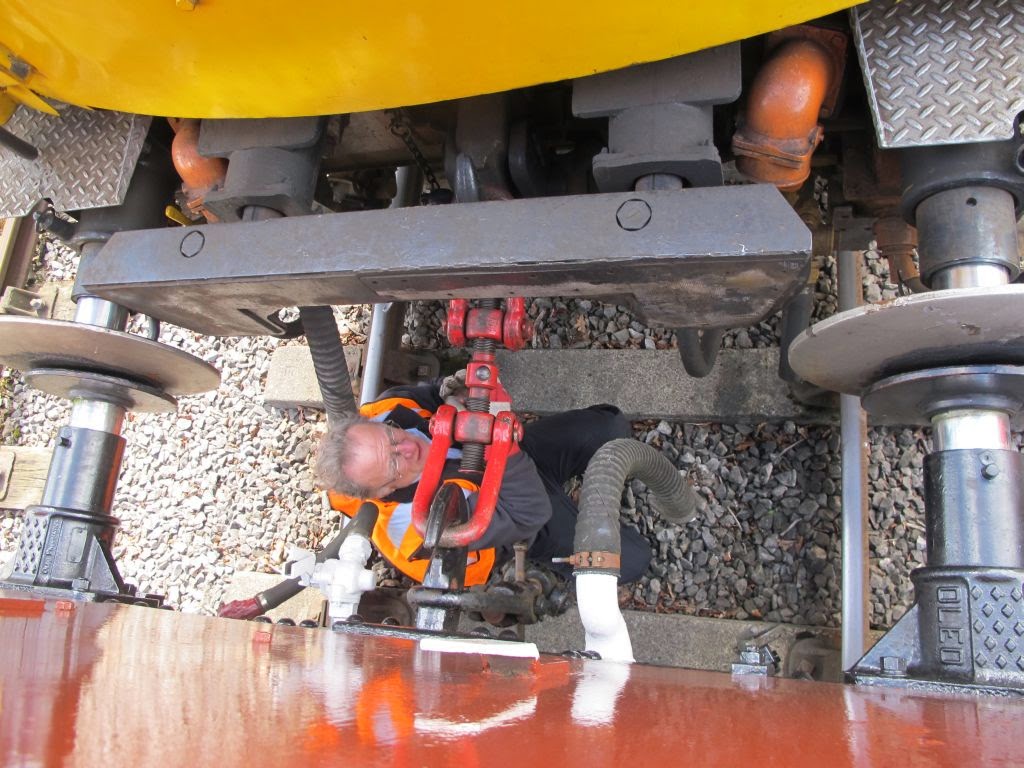
 Then, the screw coupling is hooked on and wound up to adjustment

I rode the train back to Consall to spend more time with Emma, Russ, and the new token system.


Sunday

This morning I drove to Cheddleton to travel to Consall on 'Sophie', with Emma.

Travelling down to Consall in Sophie's cab this morning

As yesterday morning, there was a problem switching in the box. Here Emma has the token machine case off to sort it while Sophie idles loudly outside with her distinctive irregular beat. 

The N7 approaches Consall box from Froghall 

The 'Titfield Thunderbolt' (the nickname for the weekend for the passenger train with a goods brake van) waits at Consall as the N7 runs in from Cheddleton 

A Wookie, a Darlek, and two Dr Whos at Consall 

This Wookie seems fixated on my facing point lock lever for the no.6 points

A storm Trooper and Darth Vader patrol the Consall platform 

Dave Gibson's picture of the N7 train in the valley 

Apparently there are pink female Daleks. Did they ever feature in Dr. Who? I think when I watched it decades ago it was in black and white!

 Nick, Sopie's driver, seems unconcerned at being challenged at Consall


So, a great weekend apart from iffy weather late on today, but a few problems with the new token system in switching the box in and out. It'll be interesting to see how that goes over the coming weeks.

And it's goodbye too to the N7. Not 'my kind of engine', but it's been a useful addition to the CVR fleet. 

I'll be glad when the S160 is back in service!

Here's a video I took yesterday from the brake van, of the N7 departing Consall for Froghall:

N7 leaves Consall

Sci Fi weekend, a selection of the Dramtis Personae
.


Saturday, 4 April 2015

Easter at Rudyard

The delightful little 10.25 inch gauge Rudyard Steam Railway woke up from its winter slumbers a few weeks ago. I was there last Saturday for the day and I've been down there volunteering again this weekend. I'm rostered all Easter from Good Friday until Easter Monday, and though yesterday was quiet because it rained most of the time today was far busier and Sunday and Monday will probably be busier still.

I spent yesterday on the footplates of Excalibur and Pendragon, two of the Exmoor Railway-built 2-4-2 steam locomotives with drivers Peter and Alan, getting to know the best firing technique for these little engines. It's not the same as 'Planet' or 'Agecroft No.1' at MoSI (see here as an example: Easter at MoSI 2 years ago ), much larger standard gauge locomotives on which has been most of my firing experience to date, but I'm pretty sure I'm au fait with it now.

As ever, please click on any picture for a larger image.

A scene of frenetic activity at Rudyard this morning as three 'Exmoor' steam locomotives are prepared for duty; Excalibur in black nearest the camera, Pendragon behind, and in the shed entrance Merlin. The diesel locomotive on the right is drawing empty coaching stock from the coach shed, and I spent some time driving it this morning. 

Today the weather was more like spring, and that was reflected in far more passenger numbers than yesterday. We had three 'Exmoor' locomotives in steam; Pendragon, Excalibur, and Merlin. We ran two trains, one every half hour from 11:00 until 16:00, the trains passing each other at Lakeside Loop.

 Matt prepares Pendragon.....

....Until waylayed by a playful Alex; "put me down or I'll polish yer nuts!"

It was so busy today that there was not time for practicing steam loco driving, though I did drive the diesel locomotive this morning hauling the coaching stock out of the sheds. Instead, I spent the day as guard on the half past the hour trains.

Alex with Excalibur at Hunthouse Wood station, the terminus of the line, on our first train of the day, the 11:30 from Rudyard 

The view from the guards van as we trundle up the valley past the lake on the 12:30 train 

 Pendragon runs around her train at Hunthouse Wood, ready for the return journey to Rudayrd. Note my guards van (the 'Dog Kennel') on the left.

Pendragon ready to return to Rudyard from Hunthouse Wood 

  Is that Alan's ciggie or Pendragon making all that smoke? Alan's (our driver's) legs can be seen sticking out of Pendragon's cab before departure back to Rudyard.

When the light is as it was this morning, this end of the lake can be quite delightful. The RLSR waggon in the foreground is used for carrying buggies, bicycles, or other bulky objects. It also houses an electrically-driven compressor for the train's continuous air brakes. 

Pendragon and the guards van which I dubbed the 'Dog Kennel' as its small, dark, you can't see out, and you have to bend double to get in and out

Driver Matt at Lake side Loop exchanges tokens with Merlin's driver. Lakeside Loop is where the hourly and the half-hourly trains pass each other.

I drove this last year! 0-6-2 locomotive King Arthur's boiler undergoing maintenance in the workshop.

Today was busy. I expect tomorrow and Monday will be busier still, especially if the pleasant weather continues.


.

Tuesday, 31 March 2015

Aerodynamic Centre, Centre of Gravity, and pitch stability in aeroplanes

A 'lively' discussion between me and Malc on pitch stability of aeroplanes led to a most interesting morning and early afternoon today at Salford University with my mate Thurai (Professor of Aeronautics).

Thurai freely gave his time to explain to Malc, Pete, and myself the lift force on the wing due to camber (always static in that its position doesn't vary) and lift force due to Angle of Attack or alpha (which moves fore and aft with varying alpha), and how these can be combined into a non-moving but varying total force called the Aerodynamic Centre (AC).

As I had tried to get Malc to accept, in order for the wing (therefore the aeroplane) to be stable in pitch (i.e. returns to trimmed alpha after a disturbance)  the AC has to be behind the Centre of Gravity (CG). The further behind the more stable is the aircraft in pitch, but also less maneuverable. If the CG ever got behind the AC, the aeroplane would be divergent in pitch rather than stable and therefore unflyable by a human pilot. And because the CG is ahead of the AC, a nose-down moment is induced which is countered by a downforce from the tailplane in the form of downward lift (the Americans call the tailplane the horizontal stabiliser which I think is a much better name - 'cause that's what it does!).

Generating lift generates drag (it's called Induced Drag) and drag uses more fuel, so the download on the tail is something it would nice to get rid of. What I didn't know until Thurai told us today is that some clever aeroplanes, such as the A380, can do just that.

With the CG carefully positioned at 35% of the mean aerodynamic wing chord the tailplane negative lift (downforce) can be reduced to zero. This requires that the aircraft has an intelligent 'CG shift' system, moving fuel fore or aft to achieve the minimum load on the tail, and hence the highest flight efficiency. This 'zero tail lift' is only possible to achieve while the aeroplane is in steady cruise. When any maneuvering is required, the CG has to be moved to the conventional position, and the tail download returns.

Thurai also went on to explain that of course it isn't only the wing that has an AC. Every part of the aeroplane has an AC; the fuselage, the tail, the engine pods, even the winglets on the wing tips. The average AC of the entire aeroplane is called the Vehicle Aerodynamic Centre (VAC) or Neutral Point.

And just as I pointed out to Malc that for longitudinal static stability the CG must be ahead of the AC, so it must also be ahead of the VAC, or Neutral Point.

After that intensive lesson in aerodynamic theory Thurai took us for a tour of the laboratories. He showed us research projects being carried out by his students, model aircraft used for research, wind tunnels, both subsonic and supersonic, and various aero engines from a 1940s Rolls Royce Nene centrifugal compressor jet engine developed in Barnoldswick (the 'B' in RB 211) to a giant General Electric CF6 turbofan engine from a DC10.

By now it was mid afternoon and time for a pint. Peter left us in Manchester to head off home while Malc and I searched out a cosy Holts pub for a couple of jars of excellent bitter. By late afternoon we were getting peckish, but a handy and remarkable value Chinese buffet restaurant across the road from the pub cured that.

Thank you Thurai for an excellent and most informative day!


.


Thursday, 12 March 2015

Bye bye to a faithful friend

The C90, no longer mine, in the hired van of its new owner this morning

Those who have followed these ramblings for the past three years will be familiar with K101 XMO, my lovely little C90. It has taken me on many 'little bike' adventures but a couple of months ago I bought a Honda Innova to replace it. The Innova is Honda's ultimate development of the Cub (which began life as the Honda 50) with the engine enlarged to 125cc and fuel injected, and four gears instead of the C90's three, so it is a bit more usuable. However, I doubt the Innova will ever be the classic that the C90 is. Honda's latest small bikes use a completely different engine with continuously variable belt drive instead of the Cub's conventional gearbox and chain drive, so are no longer 'Cubs'.

Some videos of the bike taken last Saturday. Malc is the pilot:

Start and ride away: http://youtu.be/Ss8a_fFHLOc

Ride past: http://youtu.be/zCCHgwPSdKc

Ride up and park: http://youtu.be/olMK69R-Vl0

Walk around with engine running: http://youtu.be/PU401CxO_zg

For a while I contemplated keeping the C90, but with the Suzuki Freewind 650 and Moto Guzzi Griso 1200, space in the garage is tight. Also, the Innova does everything the C90 was formerly used for so chances are the C90 would see very little use. So it had to go.

A mature chap from Longton, Stoke on Trent, came today to collect it in a hired van. He seems a sensible type, who I hope will give XMO the same level of care and attention it has received while resident in my garage.

My Honda Innova, which has replaced the C90


.

Tuesday, 10 March 2015

Winston Churchill's funeral train at the NRM


The great man died 50 years ago - January 1965. I can remember watching his St Paul's Cathedral funeral on black and white TV, and afterwards his remains were carried by special train from London Waterloo station to his place of burial in Oxfordshire. The train was hauled by Southern Region pacific locomotive bearing his name, and that locomotive together with the luggage waggon that conveyed his coffin have been cosmetically restored and are currently on display at the National Railway Museum's Great Hall in York. Today, Malc, Pete S, Pete A, John and me went to see them.

John, Malc, Pete A, and Pete S by the locomotive in the museum today

'Battle of Britain' class locomotive 'Winston Churchill'. Many of these engines were re-built without the air-smooth casing and with the removal of such unsuccessful features as chain-driven valve gear in an oil bath casing. When rebuilt they were considered to be much better locomotives fully realising their basic good design of boiler and running gear which had been hampered by Bulleid's (the designer) more eccentric features.

The locomotive's somewhat untidy cab

The restored luggage waggon which conveyed Churchill's coffin

This view of the locomotive shows its white 'Southern Railway' headcode indicators and the gap in the streamlined casing designed (none too successfully) to lift the smoke from the chimney clear of the boiler to aid the train crew's view ahead

Furness Railway 'Coppernob'  in the Great Hall at York 

Probably the first locomotive to travel at more than 100mph, the Great Western's 4-4-0 'City of Truro' 

Majesty in steam; LMS Stanier Pacific 'Duchess of Hamilton' displayed in its original streamlined condition. Many Duchess Pacifics were originally built in this condition, but all were later 'de streamlined' as the casing offered little aerodynamic advantage and added more than 3 tons of weight. 'Duchess of Hamilton' was re-streamlined some years ago, but is unfortunately not in working condition at the moment.  

Me 'driving' a top steam loco!

The view from Hamilton's driving seat 

The massive Duchess firebox. These locomotives were the most powerful steam engines to run in Britain. Their ultimate power output has probably never been realised as a fireman cannot feed this massive fire box fast enough to fully satisfy a Duchess in full cry. Nevertheless, Duchesses have put up efforts of power output, in service and in preservation, unmatched by any other British steam Locomotive. 

Duchess of Hamilton's cab 

Nearby in the Great Hall is the Great Western 'King', 'King George V' complete with the bell (not the original) it acquired when it visited the USA before WW2. These were designed by the GWR's then Chief Mechanical Engineer Charles Collett in the 1920s and were the most advanced steam locomotives of their time. The GWR never developed any main line steam locomotives to follow the 'Kings'. It was Collett's assistant at the GWR, William Stanier, who, when head-hunted by the LMS (London, Midland, and Scottish) Railway to develop a 'Super King' embodying much of Swindon's best practice and enhancing it. These were the 'Princess Royal' pacifics built at Crewe in the early 1930s. Stanier's development of the Princess Royal, the Princess Coronation or 'Duchess' class of the late 1930s and 1940s really was 'the ultimate in steam'.    

Another look at Princess Coronation 'Duchess of Hamilton' and its iconic art deco train 

In the NRM workshop is the boiler of the NRM's biggest embarrassment. 'Flying Scotsman' (4472) purchased many years ago without a thorough enough survey it has proved to be a money-pit, soaking up millions of pounds that could have gone to restoring other locomotives. And years later, it's still a long way from seeing service. 

Flying Scotsman's tender in the workshop 

'Evening Star', the last steam locomotive to built (in 1960) for British Railways. Perhaps if 4472 hadn't absorbed so much of the NRM's funds this locomotive could have been restored to working condition.

'Evening Star' is a BR standard class 9F, a freight locomotive. However, as she was the last Swindon gave her a name, a lined green paint finish instead of black, and a GWR-style copper-capped chimney  (the only 9F to receive these embellishments). Evening Star and many other 9Fs actually proved very capable engines on passenger trains, especially on hilly routes such as the Somerset & Dorset. But only in summer, as they were never fitted with steam heating apparatus to provide heat for the coaches.  

Back to the 1800s. A Midland Railway 'Single' in the Station Hall, our last look at the museum before returning home. By train of course!


.