Thursday, 10 May 2012

Whitby and the North York Moors Railway

On Tuesday I took the train to Whitby to visit the North York Moors railway. A Trans-Pennine Express took me from Manchester Airport to Middlesborough, from where I took the delightful Esk Valley line to Whitby. This must be one of the most scenic lines in Britain, single track with passing loops in the stations it initially climbs to Battersby then follows the valley of the Esk to the seaside town. Having checked into the B&B, I had a stroll round the town.

 Here's an old friend; Steam Bus 'Elizabeth' on her home turf in Whitby. On 15th October 2011 she was at the Runway Visitor Park, and driver Vernon allowed me to spend time as her fireman (see relevant entry in the blog). This time I was a fare-paying passenger.


Maker's plate showing 'Elizabeth' was originally a Sentinel Steam Lorry

Her owner and driver, Vernon ('Vern')

The church on the south headland by the Abbey

Harbour entrance, with the old Whitby Lifeboat giving pleasure trips

I noticed a boat offering trips for £2.50, so just had to have a ride. Here out of Whitby and heading for Sandsend, the next town.

After about twenty minutes, we returned to Whitby; the Abbey is visible above the harbour entrance.

Next came a pint of Copper Dragon at a pub overlooking the harbour. The yellow boat opposite was the one I took a trip on.

BR Standard Class 4, 'The Green Knight' is approved for running on Network Rail metals. Here she is at Whitby on Wednesday morning ready to take us up the valley towards Pickering on the North York Moors heritage railway. The NYM metals leave the Network rail Esk Valley line at Grosmont, about five miles inland from Whitby.

One of countless crossings of the Esk as 'The Green Knight' powers up the valley from Whitby

A couple of vintage tankers just outside Goathland 

North of Levishan 'The Green Knight' was detached from our train so it could work the next train north back to Whitby. It's the only locomotive in steam that day which has the equipment required to work on Network Rail metals. In the distance can be seen the smoke of that northbound train, and its engine will transfer to our train so we can continue south to Pickering.

....And that engine is 92214 (seen, above, at Pickering), a 9F ex-BR freight loco (though they also did sterling service on summer passenger trains - summer because they were never fitted to supply steam heating for the coaches). The only one of the class that carried a name was the last ever steam locomotive built for BR (in 1960), 'Evening Star', which was built at Swindon and therefore finished in Great Western green rather than black, and fitted with a GW copper chimney top. 92214 has been named 'Cock of the North' in preservation, a name which was actually carried by a Gresley locomotive of the London North Eastern Railway.

92214 as viewed from the leading coach of the train as she heads north from Pickering (working tender first; steam locos work just as well backwards as they do forwards). The sound was fantastic - the driver was working her hard and the staccato 2-cylinder bark form this immensely powerful locomotive was echoing off the valley sides making each mighty 'bark' a double one as the echos came back to my ears out of phase with what was emanating from the chimney top.

At Goathland I transferred to a southbound train (hauled by that most useful of locomotives, a BR Standard Class 4 Tank) back to Pickering. This is the view back from the rearmost coach.

This picture was grabbed as we passed the footpath that forms part of the Lyke Wake Walk, a long distance (40 miles) trek across the North York Moors, crosses the line. Back in the late 1960s I attempted this walk as a Venture Scout (with Alderley Edge troop) and the railway back then was an overgrown victim of the Beeching cuts. Restoration was still years in the future.

 Pickering, and having run-around the train our 2-6-4 tank engine (seen here from the rearmost coach) couples on to the northern end to take us back to Grosmont, where I changed to a train hauled by 'The Green Knight' again for the final leg over Network Rail tracks to Whitby.

On the journey north from Pickering I was leaning out watching the big tank engine sway from side to side as it barked its way up the valley when a deer dashed down the bank, skipped across the track just in front of the speeding loco, and scampered up the far bank. 

The final train from Grosmont to Whitby arrived in the seaside town at 17:00, so a full day on the railway had been enjoyed. If you like railways and steam it's a great way to spend a day; it might even become an annual event for me!


.

Sunday, 6 May 2012

This year's MCRUA trip - to Skeggy!

Yesterday was the annual outing of the Mid Cheshire Rail Users Association by train. The destination this year was Skegness. Well, it is so bracing, isn't it?

07:30, the leading class 66 diesel locomotive of our train (there was another on the rear of the 12 coaches) approaches Mobberley station, where we boarded

We travelled in a very comfortable ex-Virgin Mk2 fist class coach. Here, the train approaches Boston in Lincolnshire having travelled via Stockport, Standedge Tunnel, and Doncaster.

Boston Stump

Arrival in Skeggy. Some passengers had left the train at Lincoln for a look around that city, and some had done so at Wainfleet for a trip around the Batemans Brewery (in the light of subsequent experience of Skeggy, we should have done this!). Our train was 'The Lincolnshire Poacher' but the headboard says otherwise!

Amid occasional  gusty showers, we sought shelter in the lifeboat station

The lifeboat was available for public viewing, and the lifeboat house contained some interesting accounts of daring rescues at sea

The sandy, if bleak, beach

Looking back to the town from the beach

No business today for these beach donkeys as they huddle to find shelter from the wind and rain

The pervasive sound was the hollow popping of 2-stroke motor scooter engines. Skeggy seems to be a mecca for anyone with a Lambretta or Vespa - it took me right back to 1968 when most of my mates had one or the other.

The all pervading smell was that of chip fat. I have never seen so many fish and chip shops; there are four in this picture and a wider angle lens would show many more.

A brace of Lambrettas. Scooters were parked in all available spaces along the sea front.

Our rail journey took us through Lincoln (the return was by the same route as the outbound). Here is the famous cathedral on its hill. To make the picture perfect, there should be a Lancaster or Vulcan bomber in the sky above the iconic towers.


.

Thursday, 3 May 2012

Back to Broadway!

Chris and I have just returned from another trip to visit elder daughter Claire in the Cotswolds, where she works as a vet. The weather was not so kind as it was for us a year ago, but the B&B (The Windrush - http://www.windrushhouse.com/ ) was just as welcoming. We were there Monday until today.

Claire and some wisteria in Broadway High Street

 Tuesday was wet, and Chris and Claire went shopping in Cheltenham. I had intended to visit the Gloucester Warwickshire Railway, but discovered it was not running that day. By evening the weather had cleared up but was still misty. This is the view through the window from our table at the Mount Inn, overlooking the picture-book village of Stanton.

 Wednesday was dry, so we visited Hidcote Manor Gardens

 The view from the Manor House entrance


 In the distance is the National Trust guide who would later give us an interesting talk on the history of Hidcote and the gardens.

The gardens are arranged in a series of 'rooms'. Here are Chris and Claire in one of them.

 Claire in the 'Stilt Garden'

 Having spent Wednesday morning at Hidcote, after a pot of tea in the cafe there we drove to Winchcombe station on the Gloucester Warwickshire Railway, which was operating that day. Recently restored Great Western 2-8-0 no. 2807, a 1905 freight locomotive, enters Winchcombe with a train from Cheltenham Racecourse station

I had a word with the loco crew and secured a footplate ride on the engine while it ran around the train to position on the other end for the journey back to Cheltenham (Claire's picture)


 The view of Winchcombe yard from the footplate of 2807. The line north of here is temporarily severed by an embankment collapse, but the railway are proceeding with repairs and hopefully it won't be too long before trains can travel the entire length from Cheltenham to Laverton, and then on to the proposed extension to Broadway. The railway has plans to eventually link up with the Network Rail  main line at Honeybourne.
 Claire's picture of 2807 having run around the train using the track on the right, awaiting the points to change so she can advance down onto her train and be coupled on.

Claire catches a similar picture to one on the visit to the Keithley & Worth Valley Railway (see the blog October 2010). There I was climbing down from the cab of BR Standard Class 4 Tank Engine, here it's GWR 2-8-0 2807.

I make my way back to the platform, followed by the fireman and the driver

 The train, ready to depart back to Cheltenham

 Even though I didn't do any firing, it's thirsty work on a steam locomotive. So we enjoyed a drink in the afternoon sunshine outside The Swan Inn, Broadway.

That evening we had a lovely meal at the Horse & Groom in Bourton-on-the-Hill, bringing our few days in the Cotswolds to a pleasant ending.


.

Sunday, 29 April 2012

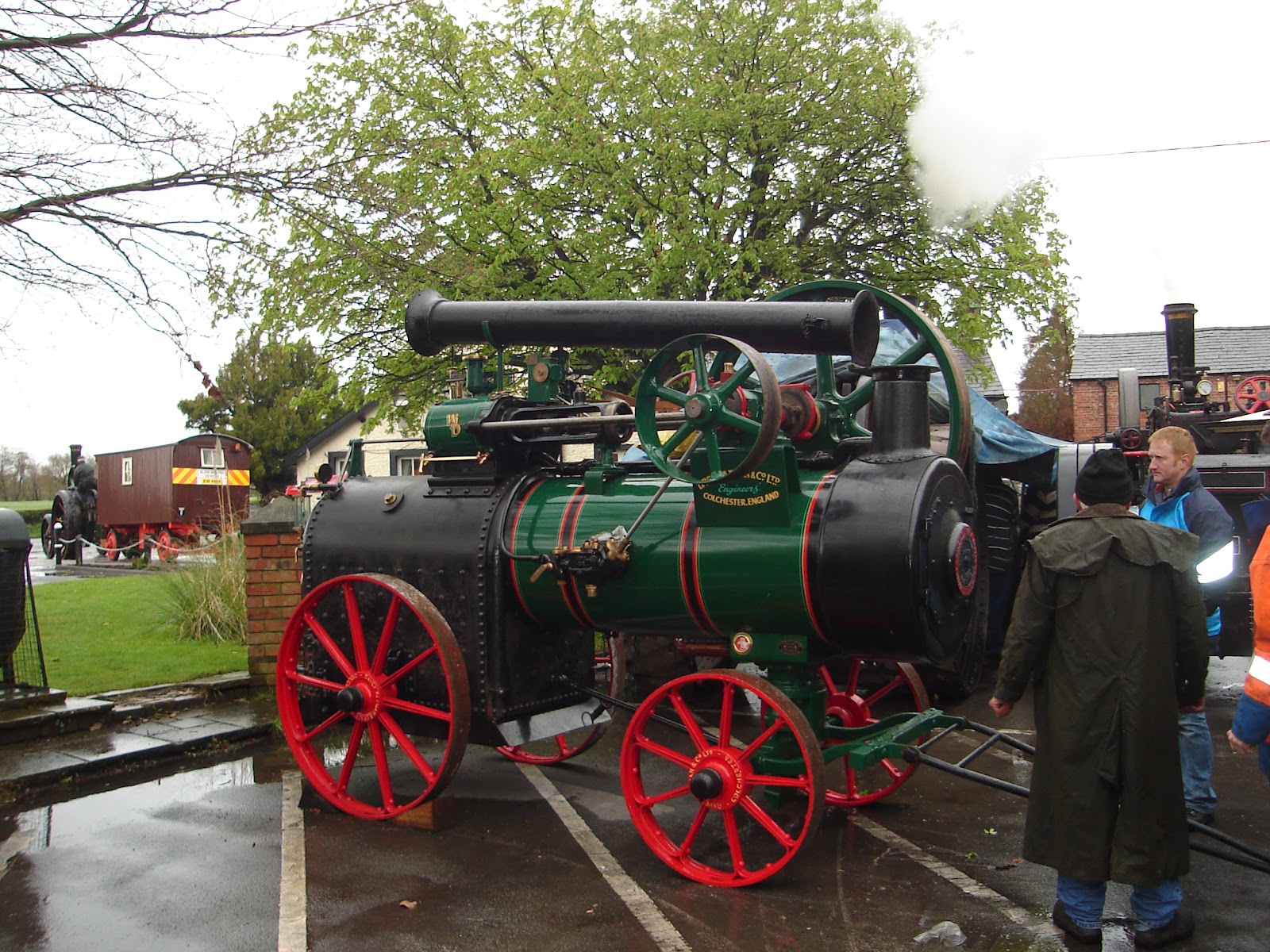
Traction engines at the Three Greyhounds

A wet morning at the Three Greyhounds

This weekend a meeting of traction engines that previously took place at Acton Bridge was held at the Three Greyhounds near Cranage, Cheshire. I couldn't get there yesterday as I was conducting tours on Concorde and Nimrod at the Manchester Airport Runway Visitor Park, and today the weather was awful; wet and very windy.

I arrived at lunchtime today to find many engines had already departed for home. Just a handful were left, and they, too, were in the process of preparing to leave.

An engine and living van leaves the pub, headed for home

A stationary engine in the car park

 A roller gets its tank replenished


.

Thursday, 26 April 2012

I met a WW2 Lancaster flight engineer today

It seems to have been raining for weeks, but we had some breaks in the rain today. Amazingly it stopped for long enough for me and my five guests to enjoy the outside part of the Nimrod tour I was conducting this afternoon for them without us getting wet. One of the guys (John) used to work on Nimrods at Woodford, but it wasn't until we were in the flight deck that his colleagues 'outed' him as a Lancaster flight engineer with 32 ops under his belt!

He was based, he told me, at Ludford Magna. They were one of the few stations with FIDO (Fog Investigations and Dispersal Operation - see http://en.wikipedia.org/wiki/Fog_Investigation_and_Dispersal_Operation) and he remembers returning from a raid and noting an orange glow on the horizon. "Birmingham, that? Or Manchester? Someone's getting a pasteing tonight" said the skipper.

As they drew nearer the glow remained on the nose - it was Ludford's FIDO! That night most of Bomber Command landed at Ludford and the airfield was jammed with aeroplanes parked nose to tail and wing to wing on every bit of available hardstanding. Took days to drag them out backwards with tractors and get them back to their bases! A missed opportunity for the Luftwaffe!

Over Germany one night a piece of shrapnel pierced the fuselage near the tail and jammed the elevator control rod. The skipper flew the aeroplane using the trimmer (in reverse sense, due the jammed elevator) until John managed to crawl back there and dislodge the shrapnel with an oxygen bottle.

I've met a few WW2 heros while conducting tours, including a few years back on Concorde the flight engineer of the Catalina that spotted the Bismarck. I'm always amazed how unassuming they are.

.

Tuesday, 10 April 2012

Gresley A4 pacific 'Bittern' at Crewe today

I nipped down to Crewe by train today to see A4 pacific 'Bittern'. She is back as herself having been masquerading as 'Dominion of New Zealand' for a while. She was en route from the Severn Valley Railway to pick up fellow LNER loco 'The Great Marquess' (a K4) from Crewe Heritage Centre and proceed to Barrow Hill (presumably for the upcoming gala there).

While awaiting 'Bittern' at Crewe, this Class 86 took my eye. These were once lead passenger locomotives on the West Coast Main line, designated AL6 when introduced in the late 1960s. Now many have been scrapped but some, like this example, survive in the freight haulage role.

 A Virgin 'Pendelino' rushes through the station non stop on the centre roads

 At last 'Bittern' appeared with her support coach, out of the yards south of Crewe and reversed into the station.

She was held in the station for the best part of an hour, before reversing north and onto the Chester line. The cylinder drain cocks are open after her long stand, wreathing her in steam but not obscuring her name.

A few minutes later 'Bittern' headed back to the station off the Chester line
.
 .....now switched to a platform road
.
Here she awaited being routed from the station to the Heritage Centre to pick up the K4. By now she was about two hours behind schedule, and I can only assume that she eventually completed her mission. She was still waiting in the station when I left for home on an afternoon train.


.