Tuesday, 12 June 2018

Abersoch Wedding

Katherine, The last of my three nephews / nieces to get married did so on Saturday 9th June. All three weddings have been in Abersoch, in a giant marquee on the headland just behind the Yacht Club. We missed out on the middle one, being away in Ireland, but the first and third were stylish affairs, and I'm told - so was the second!
Chris and I drove across to Wales on the Friday, having lunch in the Cliffs Inn at Morfa Nefyn as we used to do for years when the girls were little and The Cliffs was THE spot for al fresco lunch above the beach. Morfa is a lovely as ever, with that fabulous beach, but The Cliffs isn't what it was and the families who were there in its heyday are probably now all taking Easy Jet flights to the Med.
We paddled in the sea on that hot sunny afternoon before making our way down the familiar little lanes across the peninsula to Abersoch to our bijou B&B, Venetia, where we'd stayed for the first of these weddings seven years ago.
Here are some pictures of the wedding. Click on any for a larger image.

The wedding ceremony took place at the Catholic Church in Porthmadog. Two of these lovely old Routemaster London Transport buses transported the guests there and back from Abersoch.

The buses await their passengers in Abersoch Yacht Club car park 

My brother in law, John Nichols, brings Katherine down the aisle

"Are you ready for this?". "Oh yes!". "Let's do it, then!".

Porthmadog's answer to Bishop Michael Curry of Royal Wedding fame - the ceremony at the church. Katherine Nichols, Rob Kropp.

Kath signs the register

Mr & Mrs Kropp!

It's a lovely day outside the church as we await the newly weds....

And here they come, flower petals showering down, thrown by the guests

The wedding car 

Champagne celebrations and sandwiches on the bus ride back to Abersoch. Good job the bus was free. My bus pass doesn't work in Wales!

Very noisy with this lot chattering away at max volume...

London Transport was never like this

Our bus conductor was obviously into badges, big time

The champagne had run out by Cricccieth, so this lot got the driver to stop so they could purchase supplies at a petrol station.

The fresh supplies of booze are opened and distributed

Some beer, some G&Ts, and some cider...

The view from the marquee terrace at the Abersoch venue


Chris and I


While on the way to Porthmadog, there was a screeching roar and this overtook our bus rather exuberantly. It was Nephew James (of the wedding here seven years ago) in his Ferrari taking the groom to the church.

Margaret and Al on our table ("Virgin Atlantic" - all the tables were named after airlines)

The arrival of the happy couple (to ''Shut Up and Dance)

Here is a short video of the welcome as guests cheer and clap to 'Shut Up and Dance With Me'

Dave and Chris

Here is a short video of the Bride's father, John, being introduced

Here is a short video of part of John Nichols speech

A look at the menu

Each table had a nominated 'chef' to carve the beautiful Welsh lamb, and serve. Mr Murray looks a bit grumpy here, but then he always does before flooring everyone with a witty comment.

Enjoying dinner

Al was designated our 'table chef', and is here carving the superb Welsh lamb.

I'm ready for this!

Enjoying some after dinner air on the balcony

The happy couple with Rob's parents at 'top table'


Day moving into evening...

Cutting the cake

...Which we toasted with 'Cheeky Vimto', which apparently contains no Vimto

The new Mr & Mrs Kropp were first on the dance floor


The celebrations went on into the early hours...

....With a great live band that could be heard (we were told) all over Abersoch


Next morning - a BBQ at the Nichols house on the headland behind the wedding venue. Note the swapped initials.

My elder daughter, Claire, and Al

The previous night's venue, viewed from the garden of the house

There was even a bouncy castle for the little ones...

The house itself. Must be the finest location in Abersoch.


Relaxing in sun and shade


.


Thursday, 7 June 2018

'Lindow' has been fitted with an exhaust stack and horns for a while now. I think she looks better for it!

Before and after pictures below. Please click on either for a larger image.


As delivered

After the addition of exhaust stack and horns and radiator badge


.

Monday, 4 June 2018

Hot box!


It was a hot day in the signal box at lovely Consall yesterday. I had the windows slid open and the door open so the bit of breeze that was about helped keep it bearable.
I'm not sure why but though we started the timetable on time, we gradually got further and further behind with the train timing. Not really a problem for our passengers as there were plenty of trains running, but it did mean the last two trains ran after the end of the timetable and we finished about an hour late.
No cider for a working signalman, of course ;-(
Here are some great pictures by Dave Gibson

 Gronk pulls out of Froghall. With 4 Mk1s on, this wasn't a sparkling performer. The driver asked me to ensure I didn't bring it to a halt on the incline at Consall down home signal (normally only pulled off once the train appears on my track circuit), so I pulled that signal off early for him. "We've got 350 horses under the bonnet" he explained "but 327 of them have escaped".

Gronk at the new platform at Leekbrook Junction 

 No.6 pilots the Polski Tank into Froghall

Not for me (the BBQ I mean) - I ate my sandwiches in Consall ,box! 

 Consall, my box on the left, Station Master Howard standing on the foot crossing, me just visible in white shirt by the 33 on the right doing the token exchange

 I watch from the steps of my box as the double-headed up train pulls out of Consall for Froghall

 Another view of the 33s on the up train just leaving Consall loop

 An as-yet unpainted ghostly 33 runs into Consall

 33 on the main line at Consall, Polski Tank on Cosall loop, Black Lion pub, and a narrow boat on the Cauldon Canal

The painting of the Consall Coach continues....


.

Wednesday, 30 May 2018

Engine failure in a P51 Mustang

Here's a very insightful video based around Mark Levy's engine failure in P51 Mustang 'Miss Velma' at the Duxford Air Show last year. Steve put it down in a field and walked away uninjured, and there are an awful lot of interesting lessons that came out of the incident.


This video not only shows the incident from the cockpit, but more interestingly includes a lengthy interview with Mark where he considers what he did right, what he might have done differently, and some fascinating observations on how human being react to sudden emergencies and some of the psychological effects that have to be overcome if the outcome is to be successful. One thing I learned from watching it is that as a pilot becomes 'task saturated' (no more brain capacity left free) the first sense that is lost is hearing. Thus people could be saying all sorts of things to him on the radio but he just won't hear them. When I had my partial engine failure on take off in the Chipmunk some years ago I remember afterwards transmitting that I was making an immediate return to land, but could not hear the reply. I put this down to the noise from the badly misfiring engine banging and farting and jumping about, but after seeing this video it was probably me becoming 'task saturated'.


Some of the points Mark makes are:

Partial engine failure can be much more difficult to deal with than a complete engine cut. When the engine quits completely, the decision making processes are simpler.

Check lists are not really relevant in these sort of single pilot aeroplanes - a left to right cockpit check is best. It's certainly what I used in the Chippy & the Yak.

The 'startle factor' when something unexpected happens, and the 'fight or flight' natural human reaction to DO SOMETHING immediately. That MUST be overcome and time taken to ensure that what you do next is the RIGHT thing. He calls it 'caging the chimp'.

As Bob Hoover said "no.1 is "FLY THE AEROPLANE!". Never don't do that! And just as important, keep on flying it as far into the crash as you can.

Gear-up for an off airfield landing, always. And a retractable with the gear up will stop VERY quickly. You don't need that massively long field to put it down in that you'd need in a fixed gear machine. This greatly increases your choice of suitable emergency landing fields.

The video is quite long, but well worth watching all the way through.

https://www.youtube.com/watch?time_continue=914&v=BBpqvPujZgM


.

Saturday, 26 May 2018

Smallwood Vintage Rally

I saddled up the little bike and headed into deepest Cheshire today to the Smallwood rally. Despite some ominous looking cloud build-ups, it stayed dry and even sunny for most of the day.
Click on any picture for a larger image.

 The little 125cc Innova (nearer to camera) tucked right by the entrance to the rally field.
Nice route to the event via Great Warford, Chelford, Jodrell Bank, Lower Withington, Trap Street, Somerford Booths, Newbold Astbury, and Brownlow Heath.

 A steel band does 'blondie' . Video here: 


A bit 'bangy and crashy' for me. I think I prefer the traditional fairground steam organ.

 A very nice miniature and trailer.

....And another 

A gaggle of miniatures

Togetherness.... 

 There were far more vintage commercial vehicles than steam engines at this rally, and the commentator was an expert. He knew every vehicle type and could tell what engine it had in it by the sound. He also knew the owners and former and current operators of many of them

He is a vintage commercial enthusiast himslef and has restored and is restoring many such vehicles. Not really a 'steam man', though. 

Nonetheless I found his commentary fascinating as he really knows his subject inside out.

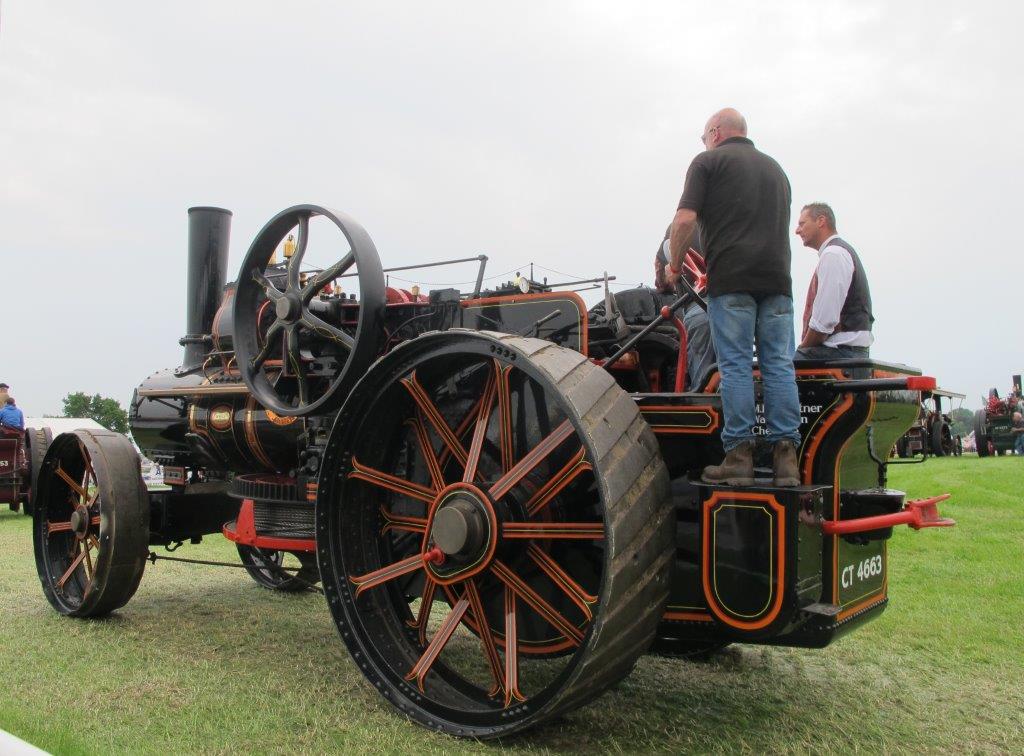
 Matt Jodrell's roller 'Britannia' was the first to enter the arena. I know Matt from the Churnet Valley Railway where we both volunteer.

 The steam commentary was a bit lacking in detail and bit disparaging of steam, both on the railway and on the roads and land.

Our commentator's heart has diesel fuel pumping through it, I think!

An early steam lorry, used for hauling trailer loads 

We saw this, and Matt's engine, and several others that were there today at the Ashley Hall Steam Rally a couple of weeks ago, and at Astley Green last week.

But you can never see too many steam engines, or see any steam engine too many times!


.

Monday, 21 May 2018

Wilmslow U3A visit to Rolls Royce Derby

A couple of months ago Wilmslow U3A hosted a presentation by Luke Logan,  Chief Engineer for Civil Aerospace Rolls Royce plc. Today we followed that up with a visit to Rolls Royce at Derby.

Our coach left the Coach and Four (former New Inn) in Wilmslow at 11:00 for a lunchtime arrival in Derby, where Rolls Royce provided us a light sandwich lunch. Over Lunch, Andrew Davies, Deputy Chief  Financial Officer for Civil Aerospace and Finance Director for Civil Operations gave us an overview presentation of Rolls Royce business directions. This was followed by a technology presentation by Mike Whitehead, Engineering Technology Director.

Mike's fascinating talk was on future engine technology, which for as far ahead as one can see will be gas turbine based as no other power source has anything like the power capability for the weight and size of power unit needed in aerospace use. We won't be seeing electric airliners for a very long time yet, if ever. A modern turbofan airliner could power a city, such is the energy they generate. As an example of the level of technology in today's turbofan engines, he mentioned that a single turbine blade in such an engine is smaller than the human thumb, sits in a gas flow where temperatures are similar to the surface of the Sun (many times the melting point of the metal the blade is made of), and extracts from the gas flow more power than a Formula One car develops.

To prevent it melting, the blade is cooled by a cooling system that could keep an ice cube firmly hard frozen in a domestic gas oven at gas mark 9.


RR Trent conventional 3-shaft engine. Note how the casing for the low pressure fan turbine at the back of the engine restricts the thrust-producing bypass air flow from the fan.


But the big upcoming development in gas turbine technology is the Ultra Fan. Conventional Rolls Royce engines  are 3-shaft: that is, there are 3 concentric shafts running the length of the engine's centre. The outer one connects the high speed turbine to the high speed section of the compressor, the intermediate one does the same with the intermediate turbine and compressor, and the inner one connects the fan turbine to the thrust fan on the front of the engine. The high speed turbine runs the fastest and is a relatively small diameter, and the fan turbine runs the slowest and is of  a large diameter. All 3 shafts are free to run speeds which produce optimum efficiency, but the shaft driving the fan has to run at a compromise speed. Also, its large diameter turbine case causes unwanted constriction to the bypass air duct (this can be seen in the picture of the Trent engine above).

The compromise of the turbine driven fan is that the engine designer wants the turbine to run at as fast a speed as possible for more efficiency and smaller size (less weight and less constricting of the bypass duct). He wants the fan, however to run as slowly as possible so it can be larger to move a bigger volume of air, with as much of the fan as possible remaining subsonic for best thrust efficiency and quieter running (the buzz-saw whine you hear from a Turbofan engine at high power comes from the shock waves generated as the fan blades go supersonic).


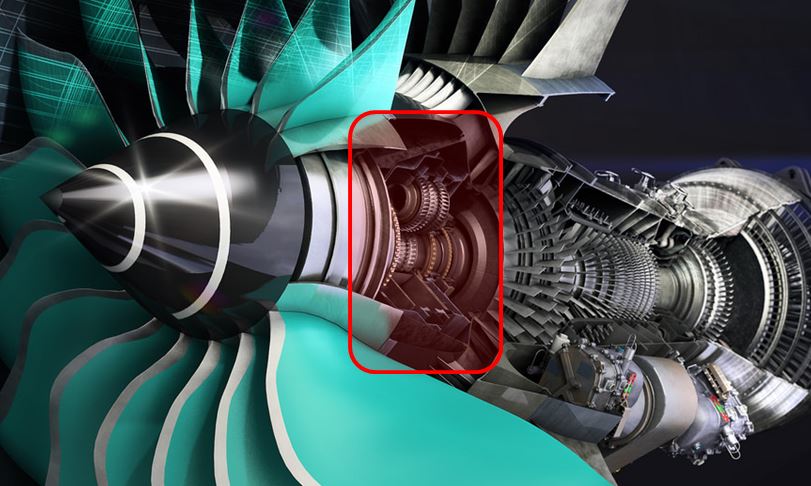
The Ultra Fan uses a gear box. It does away with the fan turbine and the fan drive shaft, making the engine 2-shaft, not 3. Instead of being driven by its own turbine, the fan is driven through an epicyclic reduction gearbox with a ratio of 3.8 to 1, from the intermediate shaft. This gear box has to be around 97% efficient (pretty much unknown for gear boxes up to now) to reduce excess heat generation, it has to transmit up to 100,000 hp, and it has to weigh no more than a ton. Rolls Royce have built a plant in Dahlewitz, Germany, to build and test the gearbox. Use of the gearbox allows the fan to be of larger diameter (so it shifts more air) and running more slowly than on current generation engines, with just the fan tips being transonic, and non of the fan operating in the supersonic range.


Ultra Fan gear box replaces the LP turbine and fan drive shaft

Some of the challenges faced in developing the gearbox were explained. For instance the gear teeth are accurate to about 3 microns (a human hair is about 75 microns diameter). However, the forces the teeth are transmitting and the centrifugal forces due to the planetary gears' high speed rotation distort the gears by up to 100 microns in use. 

It might seem obvious that gear oil would be used to lubricate the gear box, but that was found to be to viscous, and also carcinogenic; not good when one considers the gearbox runs so fast that it cannot use conventional seals. Instead, air seals are used which means (since compressed air from the engines is used to pressurise the passenger cabin) minute amounts of this oil may be present in the cabin air.

Instead, the gearbox is lubricated by engine oil, whose main jobs are to prevent metal to metal contact of the gear teeth, and to carry away the heat (the gearbox runs at about 80 degrees Centigrade and must be cooled - not easy if the aeroplane is taking off at perhaps Dubai with a 50 degree ambient air temperature).

A final thought on this remarkable gear box; each pair of teeth transmit more power than an entire grid of Formula One race cars - about 20,000 hp.

-----------------------------

We re-boarded our coach for the short trip to the Rolls Royce Trust Heritage Centre, where volunteer guides Tony Ruff and John Plant showed us around.

 Rolls Royce's first commercial 3-shaft engine, the RB 211. Note the straight fan blades with strengthening ring at about half blade span. This engine was originally designed with a carbon fibre composite fan, which proved too fragile (failed bird strike tests). Launch customer Lockheed planned to put it into the L-1011 TriStar, but the failure of the RB 211 bankrupted Rolls Royce.

The government rescued Rolls Royce, a titanium fan was developed, and Lockheed got their engines. 

The prototype 3-shaft engine, developed for a Fairchild aircraft that didn't make it to production

A closer view of the straight fan blades and strengthening ring 

A demo RR Merlin engine mounted on a trailer, here showing the control panel 

The next generation of RB 211 engine had wider chord, curved, fan blades and no longer required the strengthening ring. Another innovation is the rubber tip on the fan spinner (being pointed out here). Previously, complex hot air or electric heaters were used to prevent ice forming in the tip of the spinner (ice forming here could build up and then break off, being sucked into the engine causing damage). The rubber tip is a far simpler solution; as the ice begins to form the tip becomes unbalanced and wobbles, and the ice breaks off before it has chance to accumulate to a dangerous size.

Latest fan blade shape, here on the Trent 900 

 The first production Rolls Royce jet engine, the Welland (with a cowled Griffon piston in the background)

One of Rolls' most successful engine, the Dart turboprop. Used on the Viscount, Fokker F27, Argosy, and HS 748 among many other aircraft, it has a dual centrifugal compressor which gave it its characteristic whistle. 

This isn't a RR engine, it's a de Havilland Ghost engine as fitted to the Comet 1. The Comet 1 suffered some tragic crashes caused by metal fatigue. This was exacerbated by the airframe being built of thin aluminium to save weight, as the Ghost engine had insufficient power for an airframe of conventional weight.

The Comet re-appeared as the Comet 4, powered by RR Avon engines. Its technical problems were behind it, but by then the American Boeing 707 had taken the market.


Many thanks to Luke Logan, Andrew Davies, and Mike Whitehead for giving us their time today, and to Tony and John for hosting us at the RR Trust Heritage Centre.


.