Tuesday, 14 April 2015

A visit to the site of Mellor Mill

Mellor Mill before it burned out

Eight of us, members of Wilmslow Local History Group, today visited the site of mill entrepreneur Samuel Oldknow's Mellor Mill. We enjoyed a fascinating morning being shown around the site by Bob Humphrey-Taylor, who visited our group in November dressed in character as Samual Oldknow (see the blog at Open day at Marple Locks).

Bob as Samuel Oldknow at Marple locks last year

The morning was topped off by a pleasant al fresco lunch at The Midland in Marple Bridge. The warm sun sparkled on the fast flowing adjacent River Goyt (which powered Oldknow's mill), the river's subdued roar providing a pleasant background to our conversation.


Some information on Samuel Oldknow and his mill. As with any picture here please click on it to make it larger.

We parked on the Strines road and walked down off the ridge to cross the River Goyt at Roman Bridge. It isn't Roman but was built as a packhorse bridge in the 1700s. 

Running next to the river is this road, built by Samuel Oldknow  and intended to be the main turnpike. It never developed beyond the unmetalled track it remains today. The Strines road along the ridge top became the turnpike instead. Here Mike, who founded the Group, discusses with Bob, our guide, the technique used in building this.....

.....The railway viaduct over the Goyt. And Oldknow's failed turnpike road.  

The 'turnpike' toll house 

The wier, above which water is taken from the river along a leat to the first mill pond. There are three mill ponds at Mellor; two the river valley fed by the river, and one higher up in the hills fed by streams. When the mill burned out in 1892 a lot of people lost their jobs, including the mill manager. Being an enterprising sort, he turned the two lower mill ponds into leisure lakes, naming them 'Roman Lakes', a name they retain to this day. Roman Lakes became a popular weekend 'resort' especially when the railway arrived at Marple, a short distance away, enabling people to travel from a wide area to visit the attraction.  

Bottoms Hall became the Apprentice House for the mill, where mill apprentices were housed. 

In the 1920s the remains of the mill were demolished and the rubble filled the basement areas. The first job the archaeologists had to was to excavate the site, a task which is ongoing. Here is the wheel pit of the Wellington Wheel in the mill basement. Like the wheel at Styal it was a breast-shot suspension wheel, with the drive taken off at the rim, not the axle. It was 17 feet wide and 22 feet in diameter. The Great Wheel at Quarry Bank is 32 feet in diameter and 21 feet wide.

 The diagram on the plan on this information board (click on the picture to enlarge it) shows the three wheels at Mellor. The Wellington in the mill basement, the Corn Mill wheel in the southern wheel house, and the later Waterloo Wheel which was housed in an external building and driven by the combined tail races of the first two wheels. Power from this wheel was conveyed tom the mill by shafts running in underground tunnels.

Bob stands on the area in front of the mill which used to be beneath the entrance hall. It was a 2-horse stable for 'servicing' the horses of important visitors to the mill.

The northern section of the mill is still being excavated. The mill was six stories tall, but only 33 feet front to back. This was typical for cotton mills, and allowed two rows of machines each by a window on an external wall (for light), and a central aisle. The small arched brick culvert centre left are for ventilation, carrying heated damp air from the wheel chamber along each 'wing' of the mill, and up to each floor. A warm damp environment was essential for cotton spinning. 

This is where the tail races of the Wellington Wheel and the Corn Mill Wheel combine to be fed to drive the Waterloo Wheel in its separate wheel house  

Here is the as-yet unexcavated wheel pit for the Waterloo Wheel. Click on the picture to enlarge it and you should be able to see the exit tail race tunnel centre right. After passing over the first two wheels, then used at a lower level to drive the Waterloo Wheel, the water level in this tail race was too low to enter the river. As at Styal, an extended tail race tunnel was dug downstream to a point where the river had descended enough to allow the tail race water to be fed into it. 

Oldknow's turnpike bridge over the Goyt. His mansion, Mellor Lodge. was near here on the 'mill' side of the river.

 The site has many tunnels. Some of these housed underground drive shafts, some were ventilation tunnels, but this one led from the 'turnpike' bridge to the cellars of Oldknow's house. His servants could carry provisions directly into the cellars through this entrance to a lengthy tunnel system to and under the house.


The weather was superb and we had a most enjoyable morning. A walk back up the Goyt to Roman Bridge and then up the hill to the Strines road brought us back to our cars, and on to that pleasant lunch in Marple bridge.

Thanks to Mike for organising today, and to Bob for being such a knowledgeable and enthusiastic guide.


Sunday, 12 April 2015

Three events in one at the CVR this weekend

Well, 2 events and a 'behind the scenes' first. It was Churnet Valley Railway's Sci Fi weekend, resident N7 tank locomotive's last time in passenger service for probably a very long time. And the first time electric token machines have been used in Consall signal box and at Cheddleton ground frame.

I went down to the railway yesterday to learn something of the electric token system while Rus was rostered signal man. I was keen to do that as today I was rostered signalman. On both days, Emma, the railways signalling engineer, was in Consall box to 'baby sit' the new system.

All the while Consall was in Sci Fi mode, with Daleks, Storm troopers, Cybermen, and a Wookie among other Sci Fi characters abroad in the lovely valley. And the N7 tank engine was in charge of one of the two trains running all weekend, its last day in passenger service before its boiler certificate expires at midnight on 18th April, after which it will return to the East Anglian Railway Museum (who own it) as a static exhibit.

Please click on any picture for a larger image.

Saturday

I drove to Consall to join Emma and Rus in the signal box for a run-though of operation of the electric token system.

The electric token machine in Consall 'box.

As I've described previously on the blog, on two-train days the railway between Leekbrook Junction and Froghall is divided into two sections - Consall / Leelbrook and Consall / Froghall. There is a 'token' for each section, and only a train in possession of the relevant token may operate on the relevant section. This ensures that on our single track railway trains will not meet head-on. When only one train is running, it carries both tokens locked together as one so it can operate the entire length of the line. When two trains run, each has the appropriate token for the section they are running on, the trains 'cross' each other in Consall loop, and the tokens are exchanged there. 

The first train of a two-train day used to arrive at Consall from Cheddleton yard with both tokens (locked together), and would include both locomotives. The token would then be split using a key in Consall signal box, Consall 'box opened (it's 'switched out' when not in use) using the tokens, and one token was given to each driver. One driver set off to Froghall with his train to commence the train service from there, the other returned to Cheddleton to commence service from there. So there was a 'wasted' movement of a train from Cheddleton to Consall and back just to enable the tokens to be split and the signal box opened.

With the electric token system, only the Froghall train needs to travel to Consall using a token for the Cheddleton / Consall section taken from the machine at Cheddleton ground frame, together with the traditional Consall / Froghall token. On arrival at Consall the electric token from Cheddleton is inserted into the machine at Consall enabling a further token for the Cheddleton / Consall section to be extracted from the machine at Cheddleton for the second train to travel on that section (the placement of the first one into the Consall machine having electrically proved the section is no longer occupied by a train). Meanwhile the first train continues to Froghall using the traditional token for that section.

This not only eliminates the wasteful Cheddleton - Consall - Cheddleton movement of the 'old' system, but there is an equivalent saving at the end of the day.

Emma and Russ at Consall yesterday

The N7's driver leans out to check the injector has 'picked up' as he tops up the boiler water level (if it had't, water would be pouring from the injector drain instead of being injected into the boiler)  while Les guards the crossing to prevent passengers crossing when the train departs

With two trains running, and one brake coach in the carriage shed at Cheddleton undergoing restoration, the Class 33's diesel's train sported a goods brake van. Not being on duty on Saturday, I was free to have a ride up and down the line in it! Note the chimney indicating a cosy fug  from the pot-bellied stove inside!

The view looking forward from the rear veranda of the brake van as we set off up the valley. The 4-wheel van bumps along magnifying every uneven track joint but you do get an unrivaled view of the line from the open veranda at either end of the vehicle.

  The view backwards between Consall and Cheddleton

Surreal effects in Leekbrook tunnel

It's surprising how dark it is in there considering once out, you can see through it

33102 'Sophie' runs around her train at Leekbrook for the return journey down the valley 

 Hutch guards the road crossing as a crew member climbs down from Sophie's cab to operate the ground frame so the 33 can re-join its train

Sophie advances onto her train 

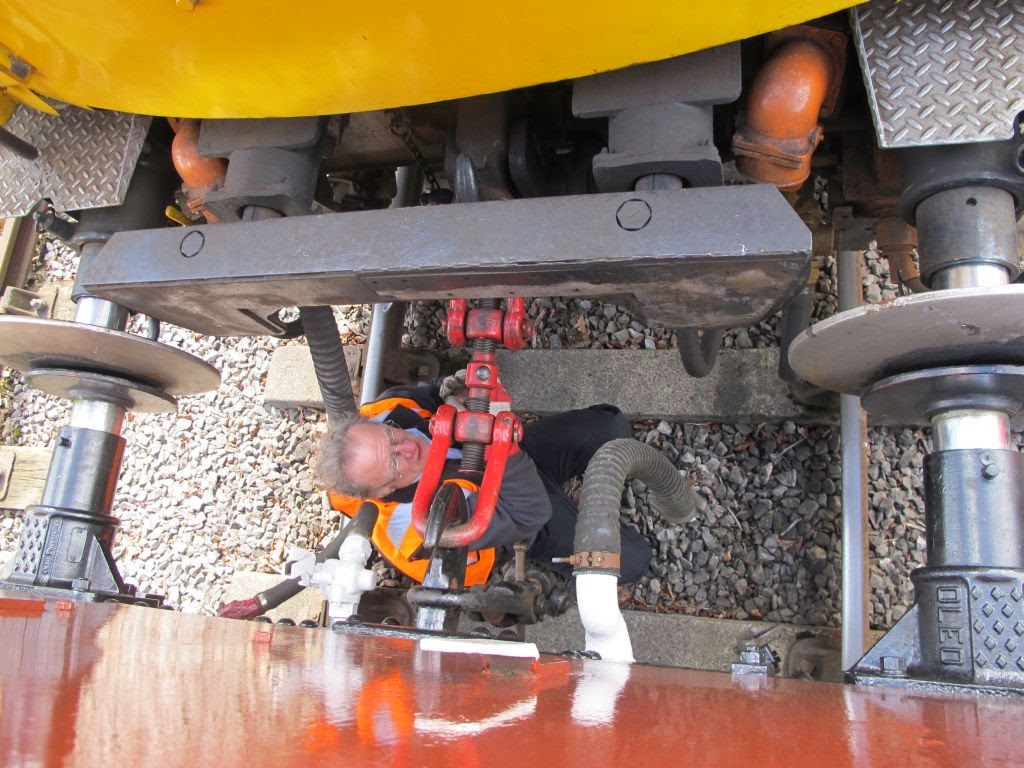
 There was a bit of a struggle to release the vacuum brake pipe on the 33. A large screw driver used as a lever eventually did the job. 33102 is fitted with 'push pull' gear so has a rubbing plate and extra pipework, all making this job more difficult in the even more confined space available.

 Then, the screw coupling is hooked on and wound up to adjustment

I rode the train back to Consall to spend more time with Emma, Russ, and the new token system.


Sunday

This morning I drove to Cheddleton to travel to Consall on 'Sophie', with Emma.

Travelling down to Consall in Sophie's cab this morning

As yesterday morning, there was a problem switching in the box. Here Emma has the token machine case off to sort it while Sophie idles loudly outside with her distinctive irregular beat. 

The N7 approaches Consall box from Froghall 

The 'Titfield Thunderbolt' (the nickname for the weekend for the passenger train with a goods brake van) waits at Consall as the N7 runs in from Cheddleton 

A Wookie, a Darlek, and two Dr Whos at Consall 

This Wookie seems fixated on my facing point lock lever for the no.6 points

A storm Trooper and Darth Vader patrol the Consall platform 

Dave Gibson's picture of the N7 train in the valley 

Apparently there are pink female Daleks. Did they ever feature in Dr. Who? I think when I watched it decades ago it was in black and white!

 Nick, Sopie's driver, seems unconcerned at being challenged at Consall


So, a great weekend apart from iffy weather late on today, but a few problems with the new token system in switching the box in and out. It'll be interesting to see how that goes over the coming weeks.

And it's goodbye too to the N7. Not 'my kind of engine', but it's been a useful addition to the CVR fleet. 

I'll be glad when the S160 is back in service!

Here's a video I took yesterday from the brake van, of the N7 departing Consall for Froghall:

N7 leaves Consall

Sci Fi weekend, a selection of the Dramtis Personae
.


Saturday, 4 April 2015

Easter at Rudyard

The delightful little 10.25 inch gauge Rudyard Steam Railway woke up from its winter slumbers a few weeks ago. I was there last Saturday for the day and I've been down there volunteering again this weekend. I'm rostered all Easter from Good Friday until Easter Monday, and though yesterday was quiet because it rained most of the time today was far busier and Sunday and Monday will probably be busier still.

I spent yesterday on the footplates of Excalibur and Pendragon, two of the Exmoor Railway-built 2-4-2 steam locomotives with drivers Peter and Alan, getting to know the best firing technique for these little engines. It's not the same as 'Planet' or 'Agecroft No.1' at MoSI (see here as an example: Easter at MoSI 2 years ago ), much larger standard gauge locomotives on which has been most of my firing experience to date, but I'm pretty sure I'm au fait with it now.

As ever, please click on any picture for a larger image.

A scene of frenetic activity at Rudyard this morning as three 'Exmoor' steam locomotives are prepared for duty; Excalibur in black nearest the camera, Pendragon behind, and in the shed entrance Merlin. The diesel locomotive on the right is drawing empty coaching stock from the coach shed, and I spent some time driving it this morning. 

Today the weather was more like spring, and that was reflected in far more passenger numbers than yesterday. We had three 'Exmoor' locomotives in steam; Pendragon, Excalibur, and Merlin. We ran two trains, one every half hour from 11:00 until 16:00, the trains passing each other at Lakeside Loop.

 Matt prepares Pendragon.....

....Until waylayed by a playful Alex; "put me down or I'll polish yer nuts!"

It was so busy today that there was not time for practicing steam loco driving, though I did drive the diesel locomotive this morning hauling the coaching stock out of the sheds. Instead, I spent the day as guard on the half past the hour trains.

Alex with Excalibur at Hunthouse Wood station, the terminus of the line, on our first train of the day, the 11:30 from Rudyard 

The view from the guards van as we trundle up the valley past the lake on the 12:30 train 

 Pendragon runs around her train at Hunthouse Wood, ready for the return journey to Rudayrd. Note my guards van (the 'Dog Kennel') on the left.

Pendragon ready to return to Rudyard from Hunthouse Wood 

  Is that Alan's ciggie or Pendragon making all that smoke? Alan's (our driver's) legs can be seen sticking out of Pendragon's cab before departure back to Rudyard.

When the light is as it was this morning, this end of the lake can be quite delightful. The RLSR waggon in the foreground is used for carrying buggies, bicycles, or other bulky objects. It also houses an electrically-driven compressor for the train's continuous air brakes. 

Pendragon and the guards van which I dubbed the 'Dog Kennel' as its small, dark, you can't see out, and you have to bend double to get in and out

Driver Matt at Lake side Loop exchanges tokens with Merlin's driver. Lakeside Loop is where the hourly and the half-hourly trains pass each other.

I drove this last year! 0-6-2 locomotive King Arthur's boiler undergoing maintenance in the workshop.

Today was busy. I expect tomorrow and Monday will be busier still, especially if the pleasant weather continues.


.