Each year we visit our daughter at Broadway in the Cotswolds. This is our fourth visit, and we stayed for the first 2 nights in our usual (excellent) B&B in Broadway... this time in a room with a four-poster bed. In a couple more years we'll have tried all the rooms!
Please click on any picture for a larger image.
Not the 'real thing', but unusual and surprisingly comfortable nonetheless
The first evening we had a meal at the Fleece Inn at Bretforton, an ancient wood-frame building owned by the National Trust. Unfortunately the Trust doesn't run the pub or I'd have been able to use my National Trust Volunteer Card to claim a 20% discount!
The Fleece, at Bretforton
The next morning the ladies went to Oxford for a look around while I stole a day away on the Gloucester Warwickshire Railway (GWR). The Railway was running two trains (one DMU and one steam-hauled) passing at Winchcombe. By careful scrutiny of the timetable I was able to maximise my ridership by making several between-trains changes at Toddington and Winchcombe. I left Toddington on the first train of the day at 10:00, and arrived back there again on the last train of the day at 17:24.
An unusual departure for the Great Western, these 15xx pannier tanks (actually built by BR in 1949) had outside Walchearts valve gear and no running plate; far easier to maintain. They were used mainly on empty stock workings in and out of London Paddington. This loco was one of several which had taken part in the GWR's 'Back to Black' steam gala which took place the weekend before my visit, and was about to be loaded onto a road vehicle for transport back to its home railway.
Our loco for today is more typical of Great Western practice, with inside valve gear and a low running plate typical of older designs where simplified maintenance was not a high consideration, because labour rates back then were low.
The side tanks protrude back into the already small cab, making it even 'tighter' for the engine crew. Crew comfort was not a serious consideration when these locomotives were designed.
A wet Winchcombe. The station buffet staff (click on the picture to get a larger view) await their first customers. My first trip of the day was the full length of the line both ways - Toddington to Cheltenham Race Course where the loco runs around the train, back up the line to the temporary northern terminus at Laverton loop, then down to Toddington again.

The Prairie runs around its train at Laverton loop. In the not too distant future the railway will be extended north from here into the town of Broadway; the funds are almost complete and contracts to repair the intervening bridges will soon be let. Next stage after that will be Broadway to Honeybourne, where it will connect with the Network Rail 'Cotswold line' so trains will be able to run onto the GWR from the main line railway network. The trackbed all the way to Honeyborne is unobstructed, and when Network Rail put right BR's vandalism of making the Cotswold main line single (among many others to which they did the same) by re-doubling it recently, they laid in a junction at Honeybourne for the GWR connection!
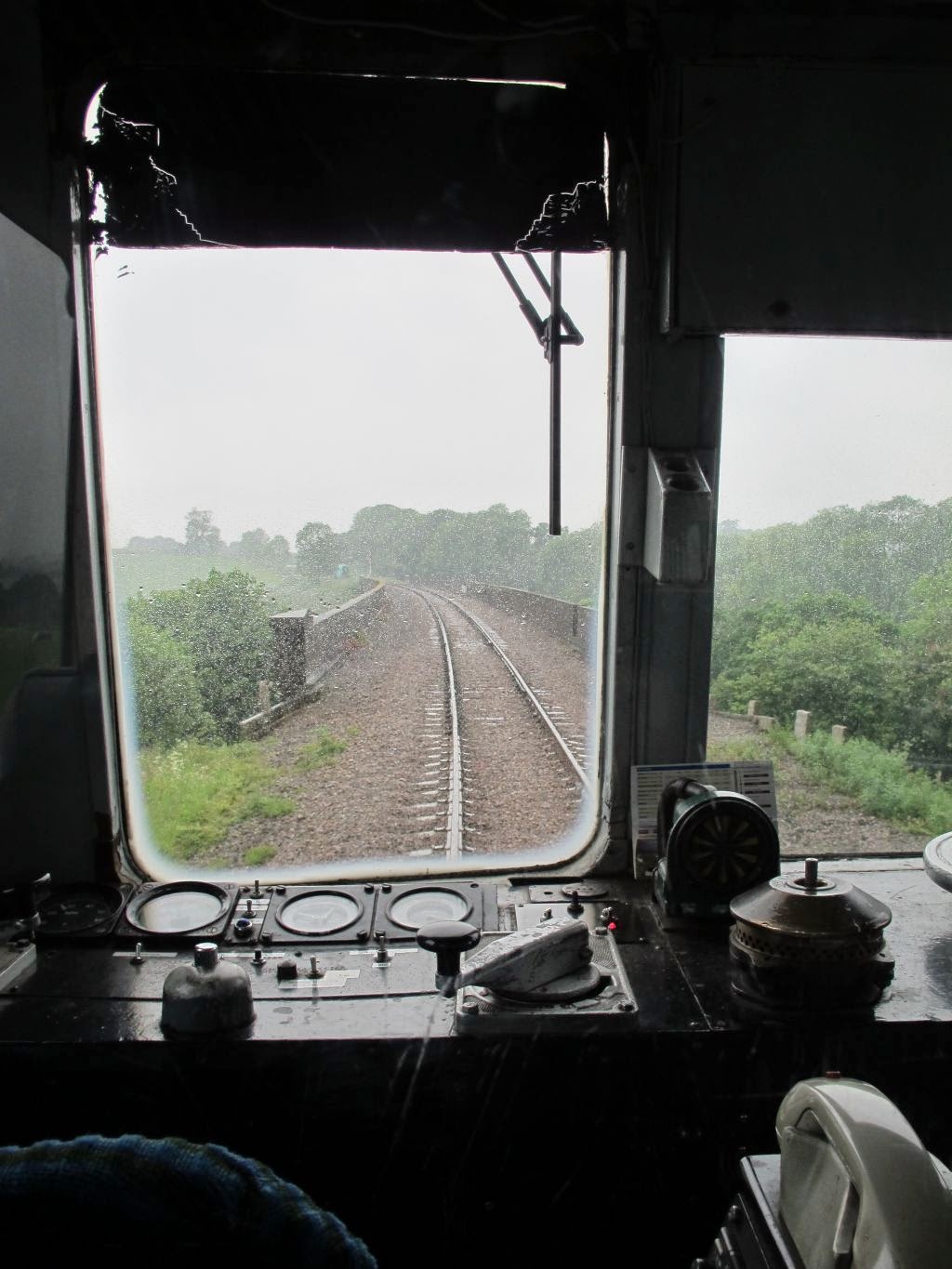
At Toddington I transferred to the DMU (Diesel Multiple Unit). Here's the damp view from the rear cab as we leave Toddington for Laverton Loop. Nice collection of semaphore signals!
The major structure on the line is Stanway Viaduct, seen here from the DMU's rear cab as we head for Laverton
There is no platform at Laverton as it's a temporary terminus until the extension to Broadway is in place, so passengers are reminded not to try to alight here!
The DMU in use on the day, seen at Toddington
From Toddington I took the steam train again down to Cheltenham Racecourse Station. Here a member of the footplate crew re-positions the running lights before the loco runs around for the return journey.
Having run around the train, the loco waits for the signal to run forward to couple on again. There's construction work on the Racecourse site with heavy lorries carrying earth away, and their access is across the level crossing by the signal box above. The two characters in orange hi-viz getting wet are there to control these lorry movements when trains pass the crossing.
A wet Prairie at Cheltenham Race Course Station
I made several further trips finishing on the last train of the day, a DMU turn from Cheltenham Race Course to Toddington. That evening we dined at the Broadway Hotel just up the road from the B&B, and the following morning we strolled around the beautiful town of Broadway before driving to daughter's house in Evesham for an afternoon visit to the county town of Worcester.
The magnificent cathedral in Worcester
Interior view. Quite a roof!
There are some lovely stained glass windows here
Back in Evesham that evening we had a great Thai meal at our daughter's favorite Thai restaurant. Next day was earmarked for a visit to the Cotswold Falconry Centre at Batsford park, near Moreton in Marsh. The Centre uses the old estate stables and surrounding land, with aviaries for the birds and a display ground and field to 'fly' them. It was an interesting place, but what brought it to life and made it a special place to visit were the flying demonstrations.
The young man giving the demonstrations was highly knowledgeable about how each bird type (owls, falcons, vultures, eagles etc) survive in the wild and what drives them to fly (or not!). No bird of prey flies for fun, they do it to find food, or a mate. Many raptors are great at soaring updrafts but at the expense of having a limited ability for powered 'flapping' flight; maybe only a few minutes or so at a time.
Owls tend to sit still listening (they have excellent hearing but poor near eyesight) for prey, on which they can silently pounce . They have large wings for their weight giving a low 'wing loading', which, together with soft wing feathers, makes for quiet flight to catch prey unawares.
Other birds of prey soar at height (having gained that height on thermals of rising air, like glider pilots) using their superb eyesight to spot lower-flying birds on which they prey and on which they can dive at very high speed, or, in the case of scavengers such as vultures and buzzards, dead animals on the ground on which to feed.
American Bald Eagle
This chap, a Chilean Eagle, managed to soar on what looked to me like a totally unsoarable day. In the still, damp, stable air he managed to search out a thermal or two and, as glider pilots say, 'was able to to scratch around in zero sink for a while'.
The stables and aviaries at Batsford
An eagle owl visits the customers
Those tufts are just that; his ears are at each extremity of the face, the hollows around the eyes collecting and concentrating the sound
Our demonstrator whirls the 'lure' for a falcon
He ensures the birds only get rewarded by catching the food if they put in the effort to 'catch' it, just as in the wild
The bird gets the reward, as the demonstrator points to where he'd like to see his charges soar to
Golden eagle
Barn owl. She does have two legs, but likes to perch on just one.
Some young owls were being hand-reared in the stable
The barn owl ready to fly
The Chilean Eagle
A vulture approaches
A Vulture on the tower, contemplating flight
A Kite uses its large tail like a rudder...
...And tucks in and sweeps its wings for minimum drag in a high speed dive
That evening we attended a 300 year old traditional annual event - Robert Drover's games at Chipping Campden, otherwise known as 'The Cotswold Olimpiks'. I've never seen anything like it. It's held in a natural 'bowl' in the Cotswold ridge, and was a bit like primary school sports day or 'It's a knockout' until the shin-kicking started!
A Scottish pipe band... from Cheltenham. How much will they cost next year if they get their independence?
Traditional sack race
Get in the barrow, get pushed to the other side of the site, pick up your jigsaw pieces, return in the barrow to your side to fit the pieces into the jigsaw, first team to complete the jigsaw is the winner!
Tug - o - war
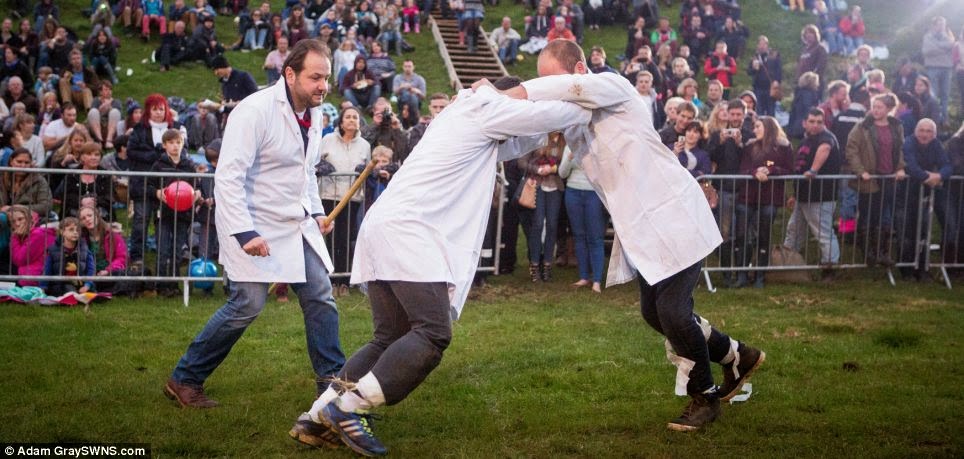
The highlight of the evening - shin kicking! Two contestants at a time in heats, then a final. The guy with the stick is the 'Stickler', a sort of referee. Said to be the origin of the that word.
It even made the Daily Mail! The following five pictures are from their website.
This event is said to have been traditional among Cotswold shepards
The only protection is straw-stuffed socks and trousers
'Fill you water bin' game. The plastic sheet is lubricated with liquid soap as contestants try to run with holed buckets of water from a bin of of water at one end of the sheet, to fill their own bins at the other end (fullest bin wins). Speed, therefore, is essential (and slipping on the soap is mandatory!). As is cheating, such as tipping over your opponent's water bin!
At the start, 'Robert Drover' and his 'special friend' open the games
After the games there's a torchlight procession a mile or so down the hill into Chipping Campden. Claire, Chris, Dave (Claire's partner) about to set off.
The procession heads down the hill
In Chipping Campden there was a great band, street dancing. and much celebration!
.