Wednesday, 10 October 2012

Wow! The Vale of Rheidol - probably the best narrow gauge line in UK

Arriva Trains Wales have re-introduced their 'Club 55' tickets this autumn; travel anywhere on their network for £19 return (£18 with a senior railcard and even cheaper booked on line). Peter De La and I went to Aberystwyth today, catching the 07:46 from Wilmslow to Shrewsbury. From there the mid-Wales line took us via Welshpool and Machynlleth (where the train divided for Pwlhelli or Aberystwyth) to our destination arriving 11:25.

Here's our itinerary for the day:

Green = Ariiva Wales train (club 55)
Purple = Vale of Rheidol train

Wilmslow dep
07:46
Shrewsbury arr
08:37
Shrewsbury dep
09:27
Aberystwyth arr
11:25
Aberystwyth dep
14:00
Devil’s Bridge arr
15:00
Devil’s Bridge dep
16:00
Aberystwyth arr
17:00
Aberystwyth dep
17:30
Shrewsbury arr
19:26
Shrewsbury dep
19:51
Wilmslow arr
20:40


As ever, click on the picture for a bigger image

Aberdovey seen from our train across the salt marshes of the Dovey estuary 

Our train, on arrival at Aberystwyth station

We went to Aberystwyth to travel on the Vale of Rheidol Railway, and it was just fantastic. I'd no idea it would be this good - the scenery starts off quite tame on the lowlands inland from the sea at Aberystwyth, but commences a spirited climb up the side of the deepening valley all the way up to Devil's Bridge. The line clings to the high valley side, many hundreds of feet above the river as it twists and turns its way up for an hour.

But before that, we discovered the Aberystwyth Cliff Railway.

The Cliff Railway bottom station

The down going car helps to pull up the up going car

The top station

The view from the top over the town

Looking north, a Coastguard radar head 

 We head back down to the town

Aberystwyth seems a prosperous well kept town, unlike many Welsh coastal resorts which are feeling the pinch financially

We walked back through the town for a fish & chip lunch opposite the railway station. The terminus for the Vale of Rheidol Railway is right next to the Network Rail station and we were there in plenty of time for the afternoon departure at 14:00.

Our locomotive, No.8, 'Lywelyn', arrives at Aberystwyth with the train from Devil's Bridge. She was built by the Great Western Railway at Swindon in 1923, hence her rather nice GWR colour scheme. The big ugly arrangement in front of her right hand tank is a steam-driven air pump for the train's air brakes.

The coaches are all enclosed, except for this one with open sides and marshaled immediately behind the locomotive

At Nantyronen the loco took water. The fireman can be seen 'putting the bag in' in this view from our coach through the loco cab windows.

The line climbs steeply for many miles up the side of the Vale of Rheidol. It is the most spectacular railway I have travelled on, and Red Kites and Buzzards soar out from the valley sides out over the Rheidol river.

Not only is the line steep, it has tight turns and in places passes through woodland which makes the track damp. Several times during this long climb our loco 'lost her feet' as she slipped on the greasy rail.

Nearing the top at Devil's Bridge, and now well above the valley

This plate shows that the loco was rebuilt in 1996 at Pant by the Brecon Mountain Railway workshops

No.8 at Devil's Bridge gets some well earned attention from her crew after her one hour climb up from the coast

No.8's footplate

While Peter went for a walk, so did I; to find the local pub in Devil's Bridge, some distance from the station. I enjoyed this rather nice pint of Evan Evans CWRW bitter.

The train stayed at Devil's Bridge for an hour before returning down the valley at 16:00

On the journey down, our open coach was now at the back of the train, giving us views back along the line

And looking forward on sharp curves, the loco at the head of the train could be seen

Cwm Rheidol Reservoir is about 1/3 of the way down the 12 mile line from Devil's Bridge

Capel Bangor passing loop

The lower 1/3 of the railway near the coast is relatively flat compared to the steep climbs of the inland 2/3

The train arrived back in Aberystwyth at 17:00, in plenty of time for us to catch the Arriva Wales train to Shrewsbury. Here we approach Dovey Junction where the line from Pwlhelli and the Cambrian Coast comes in from the north to join ours.

At Shrewsbury we caught another ATW train home to Wilmslow, arriving there at 20:40. While waiting for that train at Shrewsbury this Network Rail 'Sandite' train arrived. We are just beginning the leaf fall season, and this train traverses the network at night blasting the rails with a substance which removes the slippery leaf residue. Might it make more sense to cut back the lineside vegetation as the railway did decades ago to not only negate the need for such expensive measures as this but also to allow the passengers a view of the passing countryside rather than have them travel in an almost perpetual green tunnel? The Vale of Rheidol Railway does it so much better, with tree-free unobstructed views across the valley.

By the way, I asked the driver's permission before taking this flash picture of the locomotive.


So we arrived back at Wilmslow almost 13 hours after we left. What a super day!

Here are some videos of the railway:

No.8, working hard, loses her feet
 http://www.youtube.com/watch?v=TU7rv5D7tN0&feature=channel&list=UL

The arrival at Devil's Bridge:
http://www.youtube.com/watch?v=5yv-OJcFFxE&feature=channel&list=UL

The the last couple of miles back into Abersytwyth videoed from this excellent railway:
  http://www.youtube.com/watch?v=yPWuCCgtHzg&feature=channel&list=UL


.

Sunday, 7 October 2012

Leekbrook again

At least the weather was nice, once early morning fog had burned off leaving weak but surprisingly warm sunshine, however Leekbrook Junction is not known as 'Siberea' for nothing. It is located at the northern end of the Churnet Valley line and has two junctions onto that line; the branch from Stoke on Trent, and the branch up to Cauldon Lowe, all worked by hand-operated points and locks with 'Stop Boards' (no signals). As I've noted on the blog before (see entry for 22nd September 'Diesel gala at Churnet Valley'), there are no facilities there save an unheated wooden hut.

I was there today with Howard and we were operating 'staff and ticket' working as the DMU was working beyond the Churnet Valley line up onto the moors to Cauldon Lowe, while the Class 33 diesel worked its train up and down the valley. An explanation of staff & ticket working will be included here when I have time. We only had two trains up to Cauldon so it was a short day for us. No steam though, as the N7 tank engine was unserviceable and the big S160 is still not ready for service.

We had a visit from Nick A. who is the guy who'll check me out as a qualified signalman at Consall Box (and to work Leekbrook on my own). Unfortunately the railway has rationalised the timetable between now and the end of the year so the Consall Box session I was hoping to earmark for my passing out later this month isn't going to happen. Apart from a night session at Halloween there are no more Consall Box sessions at all this year. "Never mind', said Nick. "We'll get you checked out first sessions next year". That'll be the Steam Gala in late February; fingers crossed!


.

Saturday, 6 October 2012

Acton Bridge steam-up 2012

This event is on today and tomorrow at the Leigh Arms, Acton Bridge near Northwich. I rode there on the Freewind today in dry and sunny autumn weather.


My first port of call after locking up the bike was to go across the road and down to the Weaver Navigation to see the visiting steam tug 'Kerne'.

She's based in Liverpool and has been coming to this event for about 40 years

A diagram of the boiler; firebed below, combustion chamber at the RH end, tubes above, then up the flue to the 17' tall chimney

The twin firedoors of her Admiralty boiler. It's a bit claustrophobic down in the coal hole here where the boiler is stoked.

She has a propeller nearly 8 feet in diameter and draws 11 feet

The 3-cylinder triple expansion compound steam engine. Steam is delivered to the HP cylinder at 180psi, and there's a condenser in the bilge to provide still more power.

The wheelhouse

She was built in Motherwell, Scotland in 1913 before entering Admiralty service at Chatham Dockyard until 1948, whereupon she was sold into private ownership

Engines fill the pub car park

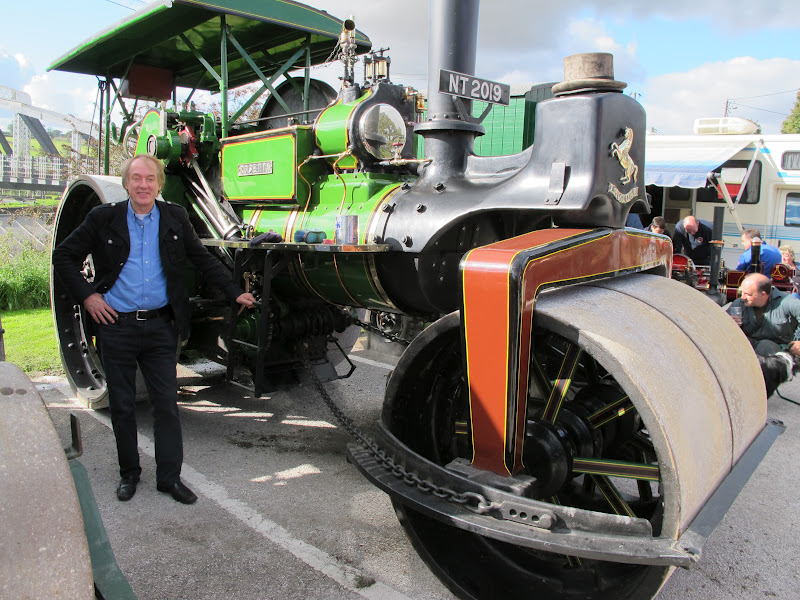
Mike poses with his beloved Rosetta

Rosetta's owner, Julian with the glass. To Julian's left, the proud owner (and builder) of the 1/3 scale 'minature' engine they are leaning on is Clive; it took him a mere 15 years to complete during which time he also acquired a wife and 2 children!

My pint (or what remains of it) on the forks of a handy roller

My steed tied up to the railings

Beer, coal smoke, and steam! Ah!

The steersman's view from Rosetta's footplate

I really think Mike should get one of these of his own!

Click on this for a typical soundbite of this afternoon...

http://www.youtube.com/watch?v=Rzpiv8NtIfU&feature=youtu.be


.

Friday, 5 October 2012

A visit to Cosford Aviation Museum and RAF Cosford

Fellow Concorde guide John H and I visited the Cosford Aviation museum this morning, and in the afternoon joined a private tour of the hangars at RAF Cosford, where RAF aircraft technicians are trained.

The recently delivered Nimrod R1. Unlike our sub-hunting MR2 at Manchester, the job of this version of the Nimrod was electronic intelligence-gathering

Bristol 188, supposedly a Mach two aeroplane built to investigate an airframe made of advanced materials (stainless steel in this case) to overcome the problems of airframe dynamic heating at high supersonic speeds. Unfortunately it only managed Mach 1.88 and didn't have the fuel capacity to remain at high speed for long enough to gather any meaningful data.

TSR2. Cancelled by a Labour government when on the cusp of entering service, controversy still reigns as to just what we missed though its loss. Those involved insist it was years ahead of anything else in military aviation, others that with such a small wing its low speed performance (for short field landing, one of the design objectives) and its manoeuvrability in flight must have been questionable (the Starfighter had similarly tiny wings and was pretty useless except in a straight line).

The Prone Meteor. With a safety pilot in the conventional cockpit, the front cockpit housed a pilot laying on his stomach to minimise the 'blood draining to the legs' effect of sustained high 'G'. Its purpose was negated by the invention of 'G suits'; trousers which inflate under high 'G' to preclude that effect.

The Rolls Royce (originally Bristol Engines) Olympus, as used in the Vulcan bomber among other aeroplanes, developed with re-heat for the TSR2. On cancellation of the project, this Olympus development was continued by the Concorde team to produce the 40,000lb thrust Olympus 593 for that fabulous aeroplane.

One of the Avro 707 delta research aircraft which helped the firm to develop the mighty Vulcan bomber

You can't usually sit in any of the Cosford aeroplanes, but one of the guides had recently been on one of my Nimrod technical tours so opened up the Jet Provost for us to sit in!

How do you service a Catalina's engine when it's so high off the ground, or moored at sea? You use this demountable platform that allows access from the top of the wing.

The Lightning in typical pose... blasting vertically skywards on the massive thrust of its two re-heated Avons

An aeroplane (Gloster Javelin) that perhaps belies the old saw 'if it looks good it flies good'. It looks good, but it didn't live up to expectations as an aeroplane.

After lunch we joined a guided tour of RAF Cosford's hangars. Here, young RAF apprentices learn the trades of airframe, engine, and avionics maintenance. They mostly use the now-retired Jaguar fighter, and some Gazelle helicopters (like this one) and a few Jet Provosts.

A general view across one of the many hangars of Jaguar airframes now used for maintenance training

The last Jag to land at Cosford (so the last ever to fly) was 'Echo Delta' (ED), known as 'ED the Duck'. It carries a suitable piece of nose prose.

Out on the airfield several Jags are kept in taxiable condition for the training of marshallers and of 'taxi pilots' (technicians qualified to start the engines and taxy the jets on the ground to position them for maintenance). The 2-seater is used for initial taxy training before the students transfer to the single seaters.

2-seater in the foreground, single seaters behind

This Jag's nose art indicates it took part in the Gulf War

Jag office

Gazelle office

I didn't expect to find a Christen Eagle among all these warbirds! Someone's nice toy!

A Jag out on the pan.. one of the taxyable machines

A Jag showing its true colours.....

 Out on the airfield some old JPs await their fate. Civvy street or the scrap man?

Here are some Jags taxying past. Click on the link.

http://www.youtube.com/watch?v=yPYQ0kZ0EeA&feature=youtu.be

http://www.youtube.com/watch?v=bVQ92fOIh-U&feature=youtu.be


.

Thursday, 4 October 2012

Nice day for a ride!

A rare sunny autumn day today, with no commitments at Concorde or Education Tours or anything else, so I took the opportunity of a bimble out on the Bonnie (my 1979 T140D Triumph Bonneville). I forgot to take my camera so had to use my ancient phone to take the pictures - apologies for the poor quality.

I headed for the Peak District, through Macclesfield and up over the Cat & Fiddle, Axe Edge Moor, Longnor and Crowdecote, Hurdlow, to Monyash. The Bonnie was a delight on such a day; yes, the clutch is heavy, the bike vibrates, the brakes are inadequate and it's not as quick as a modern performance bike but it oozes character, handles well, and sounds lovely. It's the motorcycle equivalent of the dH Chipmunk!

 
The Bonnie by the village green in Monyash today

The Monyash café, a haven for bikers. My Bonnie in the foreground, a T Max scooter behind, and an Enfield and BSA in the background. A BMW R1200 GS Adventure has just vacated the gap between the Bonnie and the scoot. The scoot owner from Macclesfield, and the BSA owner from Rotherham, are by the café.


At Monyash there are usually a few bikes, and today's collection when I arrived comprised my Bonnie, a BMW R1200 GS Adventure, a new-looking Royal Enfield, and an old BSA machine. The Bonnie attracted much favourable comment, particularly its unrestored yet tidy condition, and its originality.

 The smart looking Royal Enfield and the BSA

As well as being sunny today, the visibility was gin clear. The views from the high places such as The Cat and Axe Edge were stunning for their clarity and the distances one could see. In particular looking towards the Dragon's Back Hills near Earl Sterndale from Axe edge, the fields and hills dappled in sunshine and cloud shadows, was memorable.

One feels privileged to be able to be out and about, on a characterful vintage motorcycle, on a lovely day like today.

.