This charity weekend open day was held today in Crewe, so I hopped onto a Virgin Pendelino from my home station of Wilmslow and paid it a visit. The Heritage Centre is on the site of the former LMS yard, part of Crewe Railway Works. It is located just north of Crewe station, but it is a fair walk through the town to reach it. Locomotives of many types were on display, but none 'in steam' unfortunately.
First, a little rant about the APTResident at the Centre is the Advanced Passenger Train (APT) a tilting train developed by British Rail engineers in the '80s. It showed considerable promise for high speed use on the West Coast Main Line (WCML), but was cancelled through lack of funding. The 'tilt' technology was sold to the Italians, who developed it into the Pendelino which today provides Virgin's high speed service on the WCML.
Gerry Bates, a development engineer on the project, had strong feelings about the premature cancellation of what was undoubtedly a sound technical proposition. On 13 July 2001 he had the following letter published in
The Guardian:
"My blood boils when the myth is propagated that British Rail's advanced passenger train was a failure (Tilting at time, July 10). The only failure was the PR.
"The embarrassing inaugural run was forced on the development team by BR's senior management when there were still problems to be ironed out. There were complaints from members of the press that the tilt system made them feel nauseous, but there is some suspicion that liberal hospitality may have made a contribution to this.
"After the media demolition job, APT development continued and the train began to show promise. As a member of the BR research team responsible for measuring the effect of high-speed trains on the overhead power collection system, I was usually trackside during APT tests, but I grabbed the chance of a ride on one of the test runs.
"On the sinuous section of the west coast main line from Gretna to Beattock, on a rising gradient, the speed was held at 155mph. To describe the experience as exhilarating would be wrong - it was without fuss and I felt none of the ill-effects earlier commentators alleged they had suffered.
"The APT holds the UK rail speed record of 162.2 mph, achieved on December 20 1979. Britain's present fastest train is the Eurostar, which daily reaches 186mph in service, but this speed won't be achieved in Britain until the first section of the Channel tunnel rail link is opened.
"APTs went into service, with no fanfare, replacing ordinary electric services on the Glasgow-Euston run, but the BR board lost its nerve and funding was withdrawn. If it weren't for this we could be selling tilting trains to the world rather than the other way round."
To view any of the following pictures full-size, as usual please click on it twice.
 The APT viewed from the old Crewe North Junction signal box balcony.
WCML to Preston and the north to the right. Driver's console in the APT
.
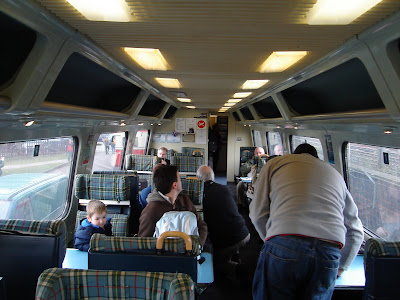 APT interior, showing that (unlike the Pendelino) a tilting train for use on WCML does not have to have small windows and a claustrophobic feel.
Back to the Heritage centre
The Centre repairs and restores main line locomotives, and some, famous and not so famous, were on display today showing the level of work carried out here.
 Ex-LMS 4F from the Nene Valley Railway. According to that superb book 'Mendip Engineman' by Peter Smith (an ex fireman and driver on the erstwhile Somerset & Dorset Railway), these were poor performers with no redeeming features!
 David Shepherd's magnificent BR Standard Class 9F 2-10-0 'Black Prince', usually resident on the Gloucester Warwickshire railway, apparently undergoing firebox repairs. In contrast to the 4F above, these were superb locomotives (Peter Smith's book agrees) and aquitted themselves very well not only on the S&D, but on all parts of UK rail system. They were designed for, and usually headed, heavy freight trains, but put in some sterling performances on passenger turns as well.
 It's not all steam, however. Was there ever an uglier locomotive that this, the very latest type to operate in UK, hauling freight trains? Is there really any excuse for these Class 70s to be quite so unpleasant to look at?
 6100 'Royal Scot', the first of a numerous class originally designed by Henry Fowler in the late 1920s, then re-built by William Stanier in the 30s with many improvements, notably a taper boiler in place of the original parallel boiler. 6100 was recently restored, but suffered many post-restoration problems which the Centre is working on. This picture shows some bits and pieces in the locomotive's left hand (of three) cylinder.
 The APT having been thrown away, the class 87s (latterly in Virgin colours) were for many years the mainstays of WCML traction before being ousted by the tilting Pendelinos . They could run at up to 110mph, hauling from the front or propelling from the rear in 'push-pull' mode their rakes of supremely comfortable Mk3 coaches. .
 Control desk of 87 035 - just like driving a big tram!
 Perhaps the star of today's event, recently restored by the Centre, and resplendent in untypical black, no. 70000 'Britannia', the first of the BR standard class of express passenger locomotives designed by Robert Riddles in the early '50s that were collectively known as 'Britannias'. An addition to the locomotive fitted during her recent restoration is the Westinghouse steam-driven air pump, just visible behind the right hand smoke deflector and shown in the picture below. This will allow 'Britannia' to haul modern air-braked stock. She is still minus her nameplates
.

Close-up view of the Westinghouse steam driven air pump installed on 'Britannia' so she can operate air braked stock. The steam power cylinder is mounted atop the finned (air cooled) air compressor cylinder.
 The 'Midge Bridge', or all that remains of it. This is the approach ramp that took a narrow gauge railway over the Chester main line to Crewe station, to transport goods and parts between the works and, via the station, the rest of the network. That link would be useful today, obviating the lengthy walk through the town between the station and the Heritage Centre.
 There is an excellent view of traffic on the WCML from the balcony of the now-disused
Crewe North Junction signal box. Here, a Super-Voyager heads north out of Crewe station on an Edinburgh service. Looking south from the same viewpoint, a Pendelino leaves Crewe station for
Manchester, a London Midland Liverpool to Birmingham service occupies platform 5 in the station, while a class 323 electric multiple unit waits to enter the station to form a local stopping service to Manchester. The 'Crewe Arms' hotel is in the background. The Manchester-bound Pendelino 390 039 seen in the picture above this one passes the Heritage Centre.
 Shortly afterwards, another member of the class heads into Crewe off the Manchester line. This service, from Manchester Piccadilly to London Euston, stopped at Stockport and Wilmslow, leaving Wilmslow at 11:11 and will run non-stop from Crewe to London, the Wilmslow to Euston journey time being just 1 hour 47 minutes!
 An Arrive Wales Class 175 leaves Crewe and takes the Manchester branch of the WCML with a South Wales to Manchester service.
 Inside the old Crewe North Junction signal box, the levers and panels are still in place and are operated by volunteers to demonstrate how the signal box used to be operated until it was replaced in the mid 1980s by an electronic control centre nearby.
 Looking rather the worse for wear, the cab of Gresley A4 Pacific 60009 'Union of South Africa', indicating that the rest of the locomotive is here somewhere, undergoing restoration.
 A locomotive boiler showing the firebox, the inner copper lining located to the outer steel structure by many stays through the water-space between. Forming the base of the firebox in the foreground, from which the steel outer and copper inner rise, is the foundation ring
.
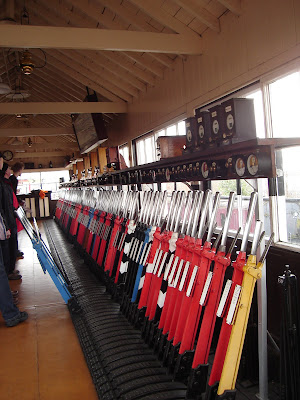 Re-located to the Heritage Centre is this old fashioned lever-frame signal box from Exeter West. As with the Crewe North Junction box, this one is operated by volunteers, simulating working trains through the box's area of control.
 Beneath the floor of 'Exeter West' box are the mechanical interlock frames. These ensure that conflicting routes cannot be set up and signalled by the signalmen who are operating the lever frame in the main part of the box, upstairs from here.
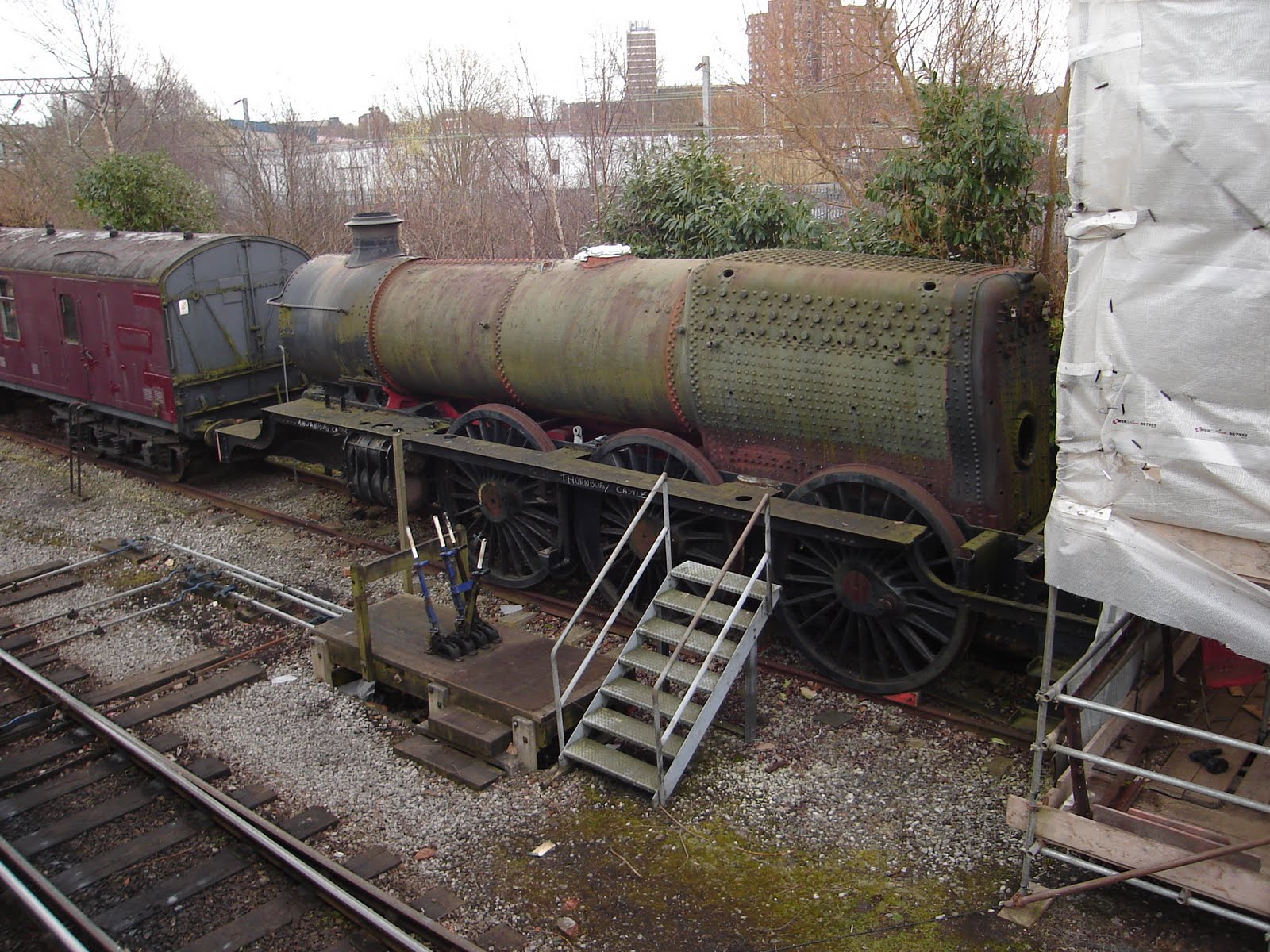
 Seen from 'Exeter West' box, former Great Western 'Castle' class 'Thornbury Castle' looks like it needs a bit of TLC before it sees service again.
 Finally, a look into the right hand cylinder of a BR Standard Calss 4 Tank locomotive, showing the piston some way down the bore.
 The classic 'out of the P1 window' shot
 The happy couple emerge from the aeroplane after the ceremony
 They pause on the steps
 Time for the confetti!
 ....And Canopés care of Ringway's Restaurant
 The families' gathering!
 It was, of course, Red Nose Day!
 Slightly unusual wedding car but on this sunny afternoon, entirely appropriate