Sunday, 17 April 2016

Even better weather today at the park.

Some of Jason's great pictures from today at Urmston. Let's hope this weather bodes well for summer:

(Click on any picture for a larger image)

Start of a glorious day

Keith with The Beast, ready for passengers 

Alfred stops for water 

This is lovely; BR standard 9F 'Evening Star', Jim Moyle's 5" gauge model of the last steam locomotive built (in 1960) for British Railways, commemorated by the plaque beneath the nameplate.  

Fellow Manchester Locomotive Society member and ex-BR steam loco driver Eddie (left) with his green Black five. Note the compressed air driven 'blower' in the chimney to raise steam. 

Joe Nixon with his lovely model of another 5" gauge BR 'standard'; 7P Britannia class 'Tennyson' 

Tennyson's flight deck 

Eddie's green Black Five. But Black Fives are black? Well, yes, except for a few which, at nationalisation in 1948, were experimentally painted various shades of green. This one is in LNER green and was based at Crewe North, and driven by Eddie, hence his modelling of this unusual prototype. 

Allan disappears behind a blast of steam from his blowing-off  5" gauge Bagnall industrial loco 

Malc stops 'Alfred' so I can check those cylinder oilers are doing their job 

Me and my loco! 

During a stop to top up the tender water tank the right hand injector initially fails to pick up, blasting steam from the water overflow. It picked up OK on the second attempt. 

So with the injector having topped up the boiler water level, I can top up the tender water tank 

'Tennyson' blows off in the station 

The pleasant weather has attracted plenty of passengers  

The track at Urmston is dual gauge, 3.5" and 5", hence three rails 

The lovely 9F 'Evening Star', Dave driving and about to fire the loco, the owner, Jim Moyle, standing by in the light blue boiler suit 

Spring has come to the park 

Plenty of visitors to our railway 

Another loco whose RH injector hasn't picked up; 'Evening Star' issuing steam from the injector water overflow 

Passengers queue for the trains 

'Evening Star' with a fairly full train, including, second from the back, James from whom I bought 'Alfred' 

Ah! The whiff of steam! Me on Alfred.


.

Sunday, 10 April 2016

Lovely day at our usual Sunday haunt..

The sun is shining, the locomotives are out, and so are our visitors who want train rides!

Pictures, as usual, from that talented lensman, Jason. Please click on any one for a larger image.


Busy prep bays this morning, Me, Malc, and Alfred on the right 

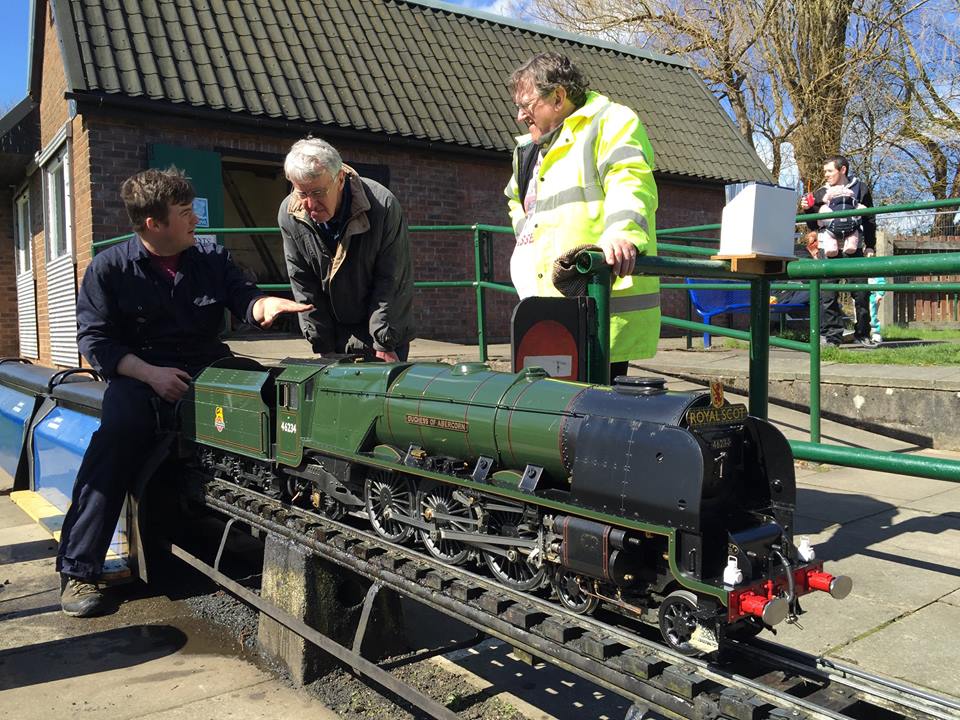
This was the star of today's show - 'Duchess of Abercorn', a 5" gauge model of my favorite locomotive type in the colour I turn when I see it! 

We tend to Alfred on his prep bay...

...And once steam was up, we puzzle over trying to get the oilers to make sense

Alfred's footplate 

Me tweaking the oiler adjusters... but they just won't do what they should 

Out on the track.... but still those oiler glasses are not behavng

'Duchess of Abercorn' makes short work of fifteen adults on 4 carriages. She didn't slip once. Makes makes you wonder what her limit is. 

"Look Ma, no hands". Malc enjoys running round the track on 'Alfred'.

Picnics in the park 

Duchess Discussions 

I did three runs around the big track on 'The Beast', with Keith on the jump seat 

Fred takes the money as visitors queue for a ride 

Picnics in the park, take two 

The lovely weather ensured queues of potential passengers at the Abbotsfield Park station.


Malc enjoys a ride behind 'Alfred'


.

A passenger ride to Ipstones on the Churnet Valley Railway

Occasionally the Churnet Valley Railway operates services not only up and down the valley, but also up onto the Ipstones line in the Staffordshire Moorlands. This line originally ran to Cauldon Lowe stone quarry and also to nearby Waterhouses where it made an end-on connection with the Leek & Manifold Valley Light Railway narrow gauge line to Hulme End.

Co-incidentally, Malc, Ivan and I rode our little bikes to Hulme End in the lovely Derbyshire White Peak on Friday, and had lunch in the cafe there which is the former L&MVLR engine shed.

The CVR is currently operating one of Greg Wilson's two mighty S160 2-8-0 USA locomotives, No.6046, which is off to the North York Moors Railway soon, on hire. His other S160 is still in the workshops at Cheddleton and won't be in service for some time yet. So yesterday I decided to take the opportunity to ride behind 6046 the length of the valley, and up the 1 in 40 curving gradient out of Leekbrook en route for Ipstones.

One of the privileges of being a CVR volunteer is I was able to ride in the empty stock from Cheddleton to Froghall, from where the service commenced.

 The S160 at Froghall awaiting the 'off'

S160 cab, firehole doors open to provide some 'top air' to reduce smoke 

The River Churnet after several days of rain 

Just north of Consall station, crossing the Caldon Canal 

I had this supremely comfortable first class compartment all to myself in the BR Mk1 coach, with its side corridor the other side of the sliding door

The first of three Dave Gibson pictures of our train up and out of the valley, on the Ipstones branch. The S160 sounded superb climbing the 1 in 40 bank out of Leekbrook onto the branch, with six on. 

 Dave's second picture shows 6046 in Moorlands country on the way to Ipstones 

His final picture is of 6046 completing the run-round of its train in the loop at Ipstones, ready for the return to the Churnet Valley and stations to Froghall


.

Saturday, 9 April 2016

The learning curve continues - Alfred's lubricators

Last Sunday while running 'Alfred' at Urmston we noticed a problem with his cylinder lubricators.

Steam locomotives have to supply oil (heavy grade thick steam oil) to their cylinders to provide lubrication for the piston in the bore. These lubricators can either be mechanical (effectively a pump driven off the locomotive's motion) or 'displacement'. 'Alfred' has displacement lubricators with the added refinement of sight glasses. This combination is sometimes known as a 'hydrostatic' lubricator. But how do they work?

Under 'Alfred's footplate is a brass vessel we keep topped up with steam oil. A fine capillary copper tube supplies boiler pressure steam via a condenser (turning it to water) to the vessel. The water pressurises the vessel, and the oil floats on the water. A second pipe allows the pressurised steam oil to leave the vessel and feed two glycerine-filled sight glasses mounted on the inside front wall of the loco cab. The sight glasses have an adjuster each to regulate the incoming oil to one drop every several seconds, which one should be able to see travelling through the clear glycerine from the bottom of the glass to the top. From the sight glasses, the oil is fed by two copper pipes, one to each of the two cylinders.

What we have noticed recently is the sight glasses have become discoloured with oil, especially the left hand one. This may be because until we did some extensive research we didn't really understand how these lubricators work, that the sight glasses contain glycerine, or that there is a definite procedure to follow for the lubricators when lighting up or disposing the locomotive.

We'll be following that procedure in future!

So I decided to remove the sight glass assembly, clean it thoroughly, and refill the glasses with fresh glycerine.

The sight glasses, discoloured with oil, can be seen next to the boiler pressure gauge on 'Alfred's cab front wall

The footplate with the sight glass assembly and the pressure gauge removed. I removed the latter to allow enough room to gain access to the gland nuts securing the oil feed pipes to the back of the sight glass assembly. 

The other side of the cab wall, showing the two oil feed pipes to the cylinders and the empty holes where the connections to the externally-mounted elbow piece for the oil pipes pass through, and for the fixing screws for the removed components 

The condenser coil for the steam supply from the boiler to the steam-oil vessel. Air blowing in through the open window will help with the condensation process. 

On the right is the now cleaned sight glass assembly, while to the left is the 90 degree elbow piece which sits externally on the front face of the cab and connects each sight glass to its cylinder lubrication pipe. The threaded caps have been removed from the top of each sight glass to aid cleaning and I'll use a syringe to fill the sight glasses with glycerine before replacing them.

Removing the footplate floor reveals the steam-oil vessel (bottom right) with its hex-headed filler plug on top   

 Job done! Everything back in place, with fresh clean glycerine in the sight glasses.

We'll find out if the lubricators now work correctly tomorrow at Urmston. Once steam pressure is up I'll open the steam feed to the oil vessel, and adjust the adjustors on each gauge glass for one drop of oil every 30 seconds to pass through the glycerine, bottom to top.

Fingers crossed!


.