Sunday, 6 September 2015

Churnet Valley Railway 1940s weekend

I was rostered in Consall 'box as duty signalman for both days of the weekend. Each day I was at Cheddleton early to ride to Consall in the rear cab of the class 33 diesel 33102 'Sophie'. I usually drive direct to Consall but on 'special' weekends such as this there are many tents, marquees, and activities going on there so parking is limited.

Yesterday (Saturday) I was in the box all day with a trainee signalman, Mark. Today I gave the morning session in the 'box to Howard and took the opportunity to travel the line (beginning with the ride in the 33 'light engine') before taking over as signalman after lunch, though another trainee, Thomas, did most of the work.

Please click on any picture for a larger image.

'Sophie' at Leekbrook seen on an earlier occasion

There was music from bands and singers at Cheddleton (above), Consall, and Froghall stations all weekend 

Armoured cars on a flat waggon at Cheddleton 


A miniature traction engine was giving rides at Cheddleton

 This morning, Sophie's engine room as the big straight 6 Sulzer diesel engine deafens me (when I open the engine room door) with its lazy but loud tickover as we await departure from Cheddleton

My rucksac rests on Sophie's hand brake wheel in the back cab as we wait at Cheddleton this  morning

A view out of Sophie's cab side-window as the Polish Tank, cylinder drain cocks open in the crisp early morning air, moves forward in the shed yard

Polish Tank prepares to reverse down onto the coaling stage at Cheddleton 

The view out of the back cab was we rock and roll down the valley from Cheddleton to Consall 

At Consall I left my rucksac with Howard in Consall 'box and joined Sophie's crew in the front cab for the run down to Froghall. Here's Emma in the co-pilot's seat. 

'Captain' Dave is in the P1 seat 

At Froghall an RAF pilot with a ukalayli belts out an Andrews Sisters number....  


 ....While 'Captain Mainwaring'  and his entourage wait on the platform 

I travelled from Froghall to Leekbrook and back to Consall in the brake van of Sophie's train. Here's the view back from the brake van veranda to Cheddleton as we head for Leekbrook.  

The brake van had been making a few odd noises so the oil in the relevant axlebox was topped up during the Cheddleton stop on the way back south down the valley

A ferret at Consall  

The view from Consall Box as the Polish Tank 'makes smoke' as it sets off for Froghall with 5 coaches (including the Sunday Dining set) and the armoured cars on their flat waggon  

A particularly good jazz band playing at Consall this afternoon 

Ferrets in their racing runs 

Today's trainee, Thomas, collects the token from the Polish Tank's driver 

Sunday lunch being enjoyed in the dining car during its Consall station stop (click on the picture for a larger image) 

These air pumps seem quite troublesome; viewed from Consall signal box steps a member of the tank engine's crew nurses it back into life with a hammer!  

That jazz band again, with the 'box in the background 
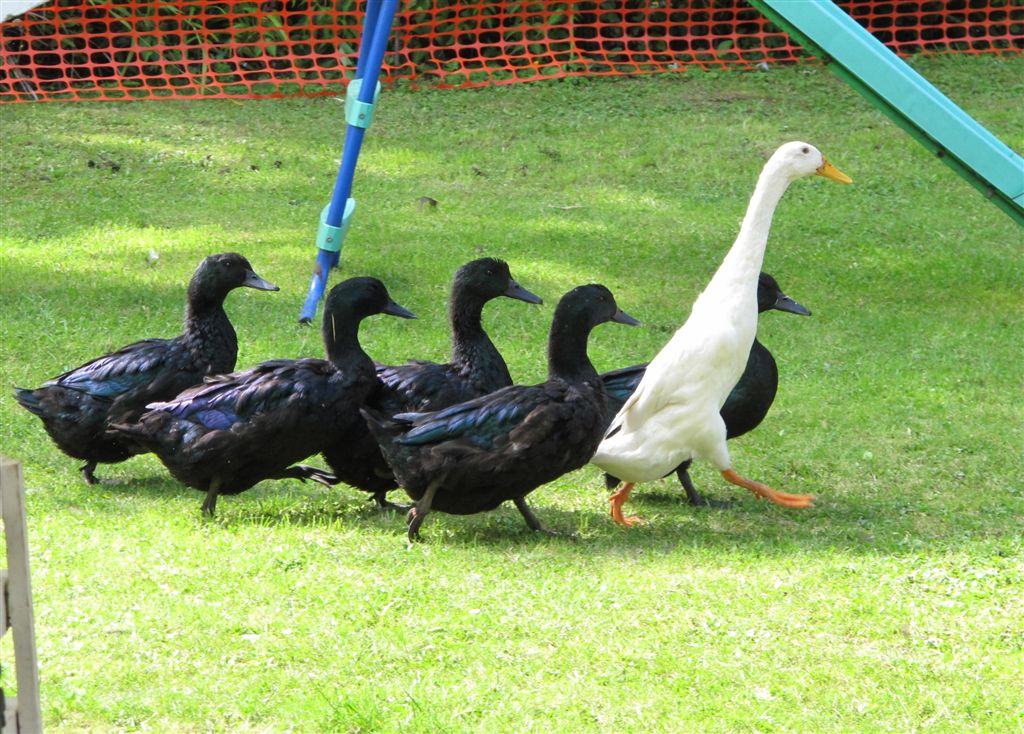
An Indian Runner Duck leads the pack of  Cayuga ducks.... 

....As they are herded by a sheep dog from Foxt (near Froghall)

We had a few problems this morning in the 'box, including a snapped signal wire to the up home signal, necessitating the drivers phoning in from that signal so I could verify the route set  (or not!) and authorise them (or not!) to pass that signal at danger. The problems meant the last trains ran about 25 minutes late, so it was after 6pm before I was able to close down the box, climb into the cab of the adjacent, waiting, clattering and thrumming Sophie,  and rock and roll up the valley accompanied by a 'Sulzer symphony' to Cheddleton and my waiting car.


.

Saturday, 15 August 2015

The Avro Heritage Museum hosts its first event

Although the Museum is not scheduled to be open to the public until October this year, as a special favor we today hosted the Vulcan Motorcycle Association.

Please click on any picture for a larger image.

The Vulcan Motorcycle Association's bikes at the Museum today

They arrived about lunchtime from their camp site in the Peak District, parked the bikes (mostly Kawasaki 'Vulcan' cruisers in the Harley Davidson style, hence the club name), and after meeting us they were given a presentation on the history of Alliot Verdon Roe and the company he founded, Avro. After a snack lunch they had a look around the as yet unfinished Museum interior and exhibits, and enjoyed conducted tours of the nose section of Vulcan XM602, which is located within the Museum. 

Being the Vulcan Motorcycle Association a photo call with the bikes under our resident Vulcan bomber XM603 was next on the agenda.

The bikes arranged in front of our resident Vulcan 

603 can no doubt expect more of this sort of attention once the Museum opens later this year 

Some interesting textual messages on the bikers' jackets 

With the Museum building in the background, XM603 looks favorably on the Vulcan Motorcycle Association's bikes

During a last look around the Museum one lady in the group told us her first husband had been tragically killed in a Vulcan accident. It happened in 1968 at RAF Cottesmore when Vulcan XM604 on an overshoot (go-around in today's terminology) of the airfield suffered a mechanical failure in no.2 engine. A compressor disc broke free and cut its way through the fuselage and bomb bay, disrupting the aircraft's flying controls rendering the aeroplane uncontrollable. The co-pilot ejected promptly, before it banked to about 110 degrees whereupon the pilot ejected having tried to keep the Vulcan in the air long enough for the four crew members in the back (who had no ejector seats) to bale out, but in the limited time available that wasn't possible and they all perished in the ensuing crash (Vulcans normally carried three in the back, but this sortie included an extra crew member).

The co-pilot suffered a broken leg during the ejection, but the captain had a remarkable escape. Although he had ejected with the aircraft at very low level and banked over the vertical, way outside the survival envelope of the ejector seat, his parachute caught in some overhead power lines, shorting out two, the arcing 'welding' the nylon of his 'chute to the wires and leaving him suspended a few feet above the ground. He hit his parachute release buckle and dropped unharmed onto Terra Firma!

I don't know if the lady realised it but the nose section we have that she wanted to climb up into so she could see where her late husband would have been sitting was from Vulcan XM602. The Complete Vulcan the bikes had been parked under was XM603. The aircraft her husband tragically died in that January day in 1968 was XM604.

While I was researching this incident I came across a report by a member of the recovery team sent to Cow Close Farm, Cottesmore, where the Vulcan crashed, that they had to dig quite deep in the farmyard to recover some of the wreckage. During recovery of XM604 they came across a WW2 B17 bomber door and some other unidentifiable wreckage. When they questioned the farmer he told them this was the fourth aircraft to crash in that location!


.

Friday, 31 July 2015

Lovely ride in the Peak District today

I had a 'spare' day today and the weather was perfect - so I fired up the new Kawasaki W800 to take it for a trip around our local part of the Peak District. Out through Alderley and Macclesfield, and up the infamous Cat & Fiddle. I'm far to old to behave like some loonies on bikes do on 'The Cat', and took time to enjoy the unfolding views as we climbed.

Please click on any picture for a larger image.

Not the highest pub in Britain, but at almost 1,700 feet, still pretty high - the W800 at the Cat & Fiddle 

Looking the other way at The Cat, with the Cheshire Plain in the background, the radio telescope at Jodrell Bank prominent near the horizon 2/3 of the way across the picture, left to right  

Ashford-in-the-Water, by the Wye bridge (picture taken 11 August on a subsequent ride)

From The Cat we continued to Buxton, Harpur Hill, Brierlow Bar, Taddington, Ashford-in-the-Water, Sheldon (past Magpie Mine), to Monyash. Beyond Monyash we took 'The Rake' which just before it joins the Buxton - Ashbourne road affords this splendid view of the cutting south of Parsley Hay on the long extinct Buxton to Ashbourne railway

Here's a closer look at the cutting. The railway from Buxton to Parsley Hay utilised the (modified) trackbed of the 1831 Cromford & High Peak Railway. That railway was built rather like a canal, with flat sections joined by inclined planes with cable haulage by stationary steam engines being the equivalent of a flight of locks, and the section of the C&HPR from Parsley Hay to Cromford survived in its original form until closure in the 1960s. Today it forms the High Peak Trail, a walking and cycling way. The section of 1899 the Buxton to Ashbourne railway line from Parsley Hay southwards was newly constructed in 1899. In this picture Parsley Hay is off the picture to the right, the C&HPR to Cromford (now the High Peak Trail) follows the dry stone wall across the middle of the picture where it exits on its way to Cromford, right to left, while the 1899 line to Ashbourne (now the Tissington Trail) ran through the cutting on its way to that town.

The village pond in Hartington

From Hartington we took the lovely high road on the ridge top between the valleys of the Manifold and the Dove. The land falls away to the Dove on the right (above) and to the Manifold on the left.

Coming off the end of the ridge, above Longnor. The 'Dragon's Back' hills are in the background

At Glutton Bridge, beside the Dragon's Back hills; Parkhouse Hill to the right of the bike, Chrome hill behind it. These two distinctive razor-back hills are former coral reef formations and were off limits to walkers until the 'right to roam' opened up access. They make an interesting if challenging scramble, especially in wet weather when the grass and the exposed limestone are slippery!

Time for a pie and a pint at 'The Quiet Woman', in Earl Sterndale. The pub's sign depicts a headless woman! The lunch menu is somewhat limited - pork pie or... pork pie. These used to be very good last time I was here, but at the time of this visit were typical 'supermarket' pies; cellophane wrapped,  bland and tasteless, with soggy pastry. But the beer was still good!

From Earl Sterndale we headed south back to Longnor, then west to Royal Cottage by the Winking Man, then south east up onto the ancient ridgeway, past the old 'Mermaid Inn', overlooking The Roaches (visible in the background, above). Click on the picture to enlarge it and you can clearly see the old GPO radio tower on the horizon, on Croker Hill near Bosley.


Mermaid Pool, above Upper Hulme (picture taken 11 August on a subsequent ride)

Looking down from the ridge Jodrell Bank radio telescope can again be seen on the Cheshire Plain, with the long escarpment of Bosley Cloud on the left horizon

In the near distance, the Pecforton Hills in West Cheshire with the distinctive Beeston Hill at the righthand extremity of the range. In the background are the Welsh mountains.

Visibility was excellent today and once again Jodrell Bank is clearly visible. Click on the picture for a larger image and the cooling towers of Fiddlers Ferry power station near Warrington are just visible on the horizon.

Dropping down off the ridge we crossed the Buxton to Leek road and passed the end of Tittesworth Reservoir, looking very low, to Rushton Spencer and on up onto the ridge between Biddulph and Rudyard Lake. Here's the view north from there including again the Former GPO radio tower on Croker Hill, seen from a different direction. This tower used to be adorned with distinctive microwave waveguide horns, but these have been removed making look a bit 'sparse' as an almost naked concrete column (it does still carry some communications antennae). It's a pity they couldn't have left the horns on to retain the tower's characteristic shape. These days of course the data that used to be transmitted by microwave radio links goes by underground fibre optic cable, which has a far higher bandwidth so can carry more information.


Looking back the other way the ridge leading up to Mow Cop was visible


From this ridge (which is on one of my regular routes to Rudyard and the Churnet Valley) we dropped down into Congleton and back home along the A34.

The W800 is a great bike for a ride out like this; easy to ride, relatively light to manoeuvre comfortable with its upright riding position, good handling, and fast enough for grabbing overtaking opportunities without drama. It thrumbs along with an engine and exhaust note not unlike that earlier parallel twin I used to own, the old Triumph Bonneville. It really is a modern version of that bike, but without the oil leaks, maintenance overhead, and unreliability. The hundred miles I did on it today bring its mileage so far up to about 270. Soon be ready for its first service!


.

Sunday, 19 July 2015

The Pitts Special is 70 years old.

This diminutive biplane, originally designed by Curtis Pitts as a home-built single seat aerobatic machine, is 70 years old this year. Over the years many variations of Pitts Specials have been manufactured, some home built and some factory built machines. The basic designation is Pitts S1 for the single seat variant, and S2 for the tandem 2-seat aeroplane.

Pitts S1-T at Sleap today. This factory built variant is a single seater with symmetrical wing profiles and 4 ailerons. Built by Aerotek it has a 200hp Lycoming engine and the top wing is moved forward compared to the classic S1 for weight and balance reasons (to compensate for the heavier-than-standard engine).

Pitts Specials initially enjoyed great success in aerobatic competitions, having a high power to weight ratio for the time, and being extremely maneuverable. The drawback was, and still is, that the aeroplane's diminutive dimensions make it difficult for competition judges to accurate mark maneuvers as it's quite difficult to see exactly whether a vertical really is vertical, a roll properly axial etc, compared to larger aerobatic aircraft.

Aerobatic competitions are today dominated by bigger monoplane designs such as German-made Extras, Russian Sukhois and Yaks, and French CAPs. The little Pitts is a bit outclassed these days, but still competitive at Standard level.

The British Aerobatic Association this weekend hosted a Pitts Special aerobatic competition and fly-in at the Shropshire Aero Club's Sleap airfield, near Wem in Shropshire, and I rode down on the mighty Griso to have a look.

The view from the control tower balcony over the airfield 

My big Moto Guzzi Griso 1,200 parked behind the control tower 

 Three visiting Pitts Specials on Sleap's grass apron

It was good to meet some old faces today I knew from flying. In particular Bob, the proprietor of Sherlowe strip which was a regular destination for me in our Chipmunk. Bob is now the CFI (Chief Flying Instructor) at Sleap. 

Another blast from the past was Steve, who used to be in our Chipmunk group many years ago at Barton but who now judges aerobatic competitions for the British Aerobatic Association. Steve wasn't judging today but was giving a commentary on the ongoing aerobatic competition.

There was a barbecue with hog roast offering light lunches, so I bought a hog roast bap and settled down in the sunshine to watch a few competitors run through their sequences before heading the mighty Griso homewards.


.