Tuesday, 15 October 2013

Kelham Island Museum

The 'River Don' steam engine has long intrigued me. Billed as the most powerful operating steam engine in Europe, it was a 'must' for a steam buff like me to visit. It was one of four such engines built by Davy Brothers of Sheffield in 1905 and reputed to develop 12,000 horse power. It ran at Cammell's mill for almost fifty years before being transferred to British Steel's River Don works where it rolled steel until 1978, whereupon it was moved to Kelham Island Museum, Sheffield, for preservation.

Malc and I traveled by train from Wilmslow this morning via Stockport, and then a bus and a short walk to the museum. The run from Stockport to Sheffield through the Peak District via the Hope Valley is (apart from some long tunnels) one of the more scenic railway lines in UK, especially the section from Chinley to Grindleford past Edale and Hope.

As ever, please click on any picture for a larger image.

Me outside Sheffield railway station, with a rather good water feature called 'Cutting Edge'. Read more about it here: Cutting Edge Water Feature

Malc at the museum 

This Bessemer Converter is located just outside Kelham Island Museum

This area used to be buzzing with Sheffield's main industry - steel. Now it is a combination of run down ex-steel mills, new housing, and of course the museum. The 'island' is man made and this picture looks from it across a greenery-infested narrow waterway to the disused steel mill on the south bank of the River Don. The much wider River Don proper runs between the island's north shore and the north bank of the river.

The River Don engine in the museum. It is a 3-cylinder engine of 12,000 horse power, which seems an awful lot despite its size. It used to drive a steel rolling mill so has the unusual property of being able to be reversed almost instantly even when working at high speed so the steel billet could be rolled repeatedly backwards and forwards through the rollers of the mill. 

Here is a video of the engine running today. It is run twice a day for just 2 minutes, at 12:00 and at 14:00. The engine ran at 160 pounds per square inch steam pressure when it was in use, but the museum runs it at just 100 PSI as it is not under load these days. At the end of the 2 minutes the boiler steam pressure is down to about 20 PSI. It takes about ten minutes for the gas-fired boiler to regain 100 PSI. and as you might imagine gas is the major expense of the museum.

In this video, watch out for the rapid reversal of the engine controlled by the driver using a foot pedal:

General view of the engine


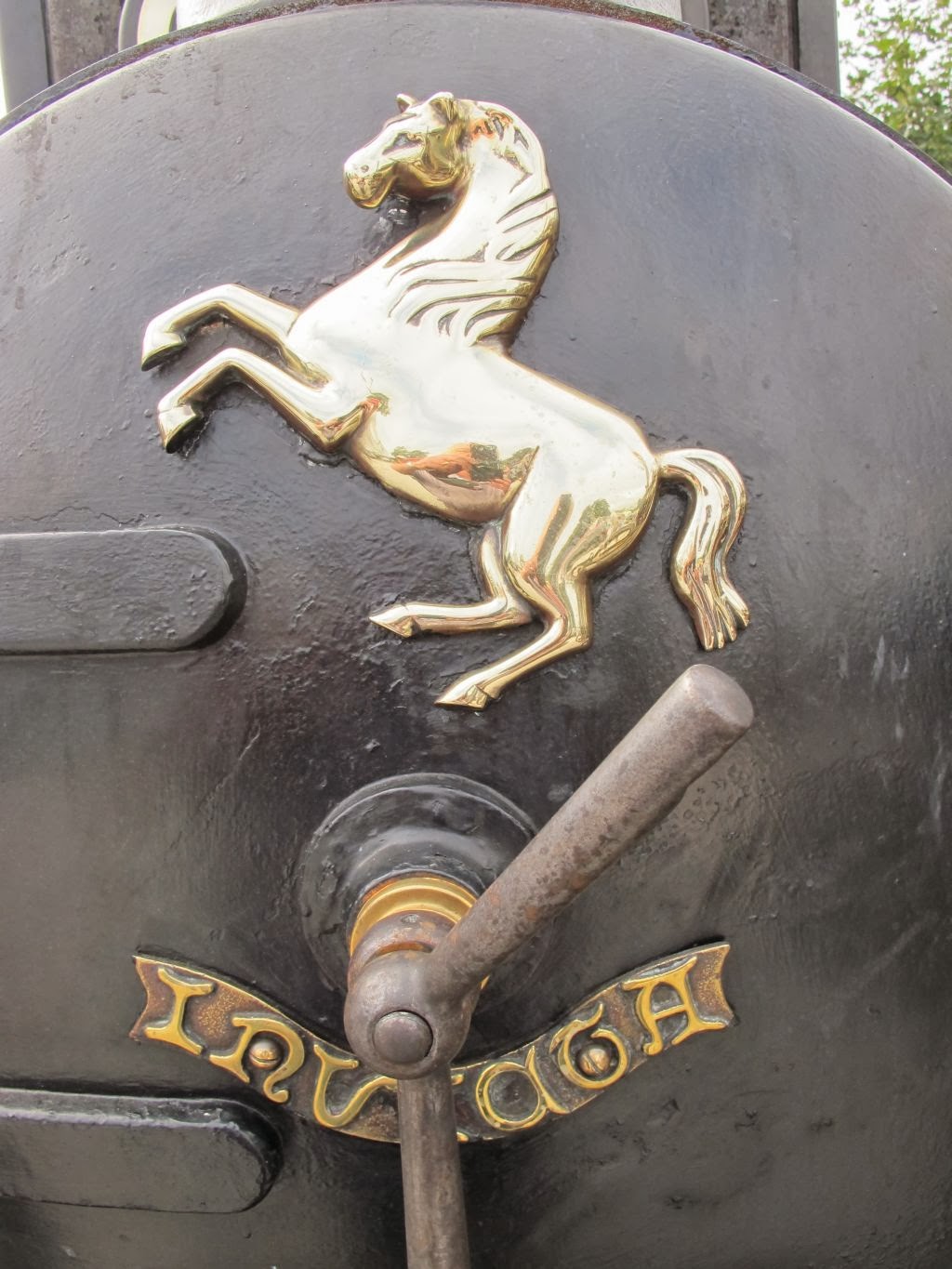
An end-on view of the engine showing the maker's plate on the rails of the lower of two access galleries and the valve gear, with its reversing mechanism, on the right side of the engine 

This video is of the 14:00 running session, complete with a large group of young school children. Note particularly the engine's reversal, implemented by a hydraulic ram (out of sight on the other side of the engine) which re-positions the levers seen on the right of the engine to change the fulcrum point of the simple valve gear piston rods to reverse the direction of the engine:


This is a crankshaft for a Rolls Royce Merlin aero engine, with the un-machined 'blank' below 

The museum also boasts a Crossley gas engine from a rod rolling mill. It was built in Manchester, but unfortunately it isn't running by gas at the museum but is driven by an electric motor. 

Malc isn't getting fresh here; the dummy's clothing has 'lift-up flaps' with explanatory notes underneath 

A Co-Op milk float; specially for Ivan (don't ask!) 

Something a little more up to date (well, 1950s anyway). A Rolls Royce Avon jet engine, this mark of Avon is as used in the de Havilland Comet 2 airliner but Avons powered all the Comets, the Lightning fighter, Caravelle airliner, and many other aircraft of that era. Sheffield industries provided some of the special metals required for building jet engines.

'Little & Large'  - a full size traction engine and a miniature in the museum's workshop / storage area

This isn't an airliner cabin as you might think at first glance, but a train. We returned home by an East Midlands Norwich to Liverpool service to Stockport, then this crowded Cross Country Manchester to Bournemouth Voyager to Wilmslow (above). There were no unoccupied seats so Malc sat in the vestibule on his portable chair while I perched on the luggage rack at the end of a coach from where I took this picture. Thankfully Stockport to Wilmslow is only one stop taking just a few minutes so the discomfort is of little consequence.


We repaired to the 'Bollin Fee' for a pint or two of good ale and something to eat, where Ivan met us. Unlike me and Malc he still works for a living, poor lad so had been unable to join in our day out!


.

Sunday, 6 October 2013

A fine autumn day marks the end of the season for me at Consall....

Today was my last for 2013 rostered as signalman in Consall box. The box will be in use at the end of the month for Halloween trains with Howard as signalman, but after that no more 2-train days on the Churnet Valley railway this year, so no more need to open Consall box until the spring.

I decided to take a few 'farewell to Consall 2013' pictures today, which can be enlarged by clicking on them.

Just after 09:00, and the sun is too low to penetrate the valley. The box is still switched out until the 'combined staff' arrives on the 'combined train', hence the up main starter signal being 'off'. 

 Looking north, with the promise of a fine autumn day. Down main starter signal is off, too, because Consall is as yet switched out.

The King Lever (the brown and white striped one) is forward, and all the 'main line' signals are 'off' in both directions, showing the box to be switched out. The windows are all steamed up with dew, so I've opened the far one and the door in an attempt to clear them. 

Just before 10:00 the 'combined train' arrived to be split at Consall (class 33 diesel leading five coaches with the N7 tank engine on the back, coupled to the DMU). After I'd split the staffs, opened the box, and dispatched the 33 and N7 with their train to Froghall, I shunted the DMU to the loop. Here it is in the loop while Chris starts the engines manually from outside because the air reservoirs are at low pressure. Starting the engines will re-charge them

Later in the morning the DMU returned from Cheddleton. The sun was now high enough to penetrate the valley, and the buzzards were mewing. They were impossible to ignore so I went outside for a look. 

I counted eight though there may have been more; six exploiting the rising air as they thermalled over the valley round and around and ever upwards in the rising air, wings outstretched. And two much higher up; these were the most vocal. They were circling around each other for position then diving in on intercept headings like dogfighting aircraft. They slowed and flicked  inverted as they passed. Occasionally just the lower one rolled inverted so they passed breast to breast.  Periodically, on meeting, they stopped still in the air, talons to talons. They seemed able to do this with no noticeable loss of height. As a pilot, and former glider pilot I was jealous of their aerial freedom and their amazing glide performance. Delightful to watch. If re-incarnation is real, I want to come back as a Buzzard!

Mid-day, and the valley is looking lovely in autumn sunshine as a narrow boat approaches on the Caldon Canal. Consall's up loop starter signal is on the left of the picture, the up main starter on the right.

When the 'combined train' arrived this morning, John the guard on the Cauldon Lowe dining train lent me this book to read in the quiet periods between trains. I don't know if he was taking the whatsit, but actually it's a very good book and I shall order a copy.

Glamour in the box! Mike, a friend of mine, arrived with his girlfriend who is 'into' all things steam, and all things railways. Here she is pretending to operate the down loop facing point lock lever.

So that's it for my signalling fun for 2013. I checked out as a qualified signalman at Consall early in the year, and so have been able to enjoy almost a full 2013 season in this lovely location. Roll on next year!


.

Saturday, 5 October 2013

Acton Bridge Steam up, 2013

The annual gathering of steam traction engines, steam boats, various engines, vintage motorcycles etc at Acton Bridge in Cheshire is always worth a visit. It's a compact meeting on the car park of the Leigh Arms pub hard by the River weaver, hence the marine contingent's attendance. But it always attracts the most interesting of visiting exhibits and people. Today, Malc and I fired up the little bikes and headed through the Cheshire lanes in pleasant weather; Marthall, Peover, Lach Dennis, Davenham, Hartford, Weaverham, to Acton Bridge. Ivan was ensnared by domestics, and couldn't join us.

As ever. please click on any picture for a larger image.

Today's route

Malc's T80 and my C90 at the Acton Bridge gathering

This very nice Rudge Whitworth from the mid 1920s took its proud owner five years to restore 

Note the hand-operated gear change 

This Harley Davidson sports a big single SU carburetor 

An Aveling steam roller enters the site 

 This lovely example is a Burrell

A couple of traction engines 

This roller, 'Rosetta', is sometimes steered by our mate, Mike. Note the Thames Trader lorry in the background. 


A contrast in front ends 

One of the marine contingent - a steam-powered narrow boat (as they all should be!) on the adjacent Weaver Navigation. 

The Weaver Navigation and Acton swing bridge. Steam tug 'Kearne' usually moors here, but maintenance on one of the downstream Weaver swing bridges means the bridge can't be swung, so 'Kearne' could not get up river to Acton Bridge. 

There are always lots of 'miniatures' (small scale working traction engines) at these meetings 

Malc has one of these Velocette Venoms in his garage in bits. We'll have to persuade him to get it fettled so we can have a ride! 

A bit of Italian style in Cheshire - a lovely Gilera

A 2/3 scale replica Lister Railtruck, available in kit form if you fancy one! 

Ivan joined us for a pint at the Bird in Hand, Knolls Green, not far from home on the return journey 

Ivan's Honda Vision, Malc's Yamaha Townmate, and my Honda C90 at the Bird in hand


.

Saturday, 28 September 2013

Milling course, Cann Mills, Dorset

I have completed almost a full season as a guide at Nether Alderley Water Mill (see here in the blog) and the National Trust decided to send me on a course to learn something more of the art of milling grain and become a miller, as well as a guide. Initially four volunteers were sent on this course last year and have been working as volunteer millers at Nether Alderley this season. The Trust decided to increase the number of trained millers to six, so Bob and I went down to Cann Mills, near Shaftsbury in Dorset, to attend the one-day course yesterday. The course is run by SPAB (Society for Protection of Ancient Buildings) once a year; last year was in Cumbria, but Bob and I had a little further to travel to attend this year's course, held on Friday 27th September.

Bob lives in Macclesfield and I'm in Wilmslow, and on Thursday we each travelled by train to London Euston where we met up, caught the Tube to Waterloo, a train from there to Gillingham in Dorset, then a taxi to our hotel in Motecombe, near Shaftsbury. The total journey time was about five and a half hours.

As ever, please click on any picture for a larger image.

The Coppleridge Hotel, our home for the next two days. The bar (with excellent real ales) 
is on the left. 

The comfortable rooms are in 'chalets' arranged around the courtyard

There's even a friendly hotel cat!

On Friday morning we took a taxi to Cann Mills. John Cook of SPAB comes out of the house to welcome us. John runs a windmill (Fosters Mill) near Cambridge, where he mills flour commercially. Cann Mills is run by Michael Stoate, whose family has run this mill and others before it for several generations.

Some bagged flour at Cann Mills

Grain and flour is moved around the mill by air power (blown or sucked), and by vertical bucket elevators. Here is a grain hopper.

Michael Stoate is working on one set of stones, and has removed the plastic cover from them. These covers (known as 'furniture') are traditionally made of wood. Note the flour stuck to the inside of the cover. This happens when the stones are run for long periods (as Michael's are) and the heat generates condensation. Plastic 'furniture' is less prone to condensation than is wood, which is why Michael uses it. 

Michael has several traditional milling stone sets, remarkably similar to what we have at Nether Alderley; surprising for a modern commercial mill. Though all of Cann Mills output is stone ground, some is milled in modern 'Euro Mills' rather than these traditional stones. The picture shows the grain falling from the shoe, which is shaken by the damsel, just as at our mill. 

Cann Mills is powered by electricity and by this overshot waterwheel

This is a modern electrically-powered 'Euro Mill'. But it works exactly as do traditional mill stones, but using composite man-made mill stones rather than traditional stone.

Here is a typical mix of grains for one of Michael's flour blends

This is a sifter, which separates the fine white flour from 'semolina' brown flour. The semolina is sifted again to extract more fine white from it. 

At lunchtime we enjoyed some lovely egg, ham, and cheese sandwiches, the bread made with Cann Mills flour of course. These were washed down with some delicious elder flower cordial. Opposite on the right is Bob, my fellow Nether Alderley guide, and next to him is Ursula and Brian from Clyston Mill, Devon. Ursula and Brian recently enjoyed one of my tours at Nether Alderley (very much enjoyed, they said!). Standing, with his back to us, is Michael Stoate. 

Other mills represented by course attendees were Heckington Windmill near Sleaford, Clodock Mill in the Welsh Borders, Oldland Windmill in West Sussex, and The Gower Heritage Centre Mill.

One of Michael's French burr stones (the top one of the pair, the 'runner stone') removed for dressing. This restores the 'milling' surface by opening out the 'eye' where the grain enters and sharpening up the radial cutting edges. The traditional tool (an adz) is top left, but an angle grinder (centre right) with a diamond tipped disc is quicker and more effective. Note that Burr stones are not made of one piece of stone, but several 'segments' fitted together and held by a shrunk-on iron band at the periphery.

Michael's Adz is tungsten-tipped. The length of wood is used with red oxide marker to show any high points on the stone which will need to be smoothed down. 

This device on the perimeter of the stone is the 'sweeper', which collects the milled grain ('meal') as it falls of the edge of the stones, and pushes it round until it reaches the chute out of the 'furniture' to the collecting sack or hopper

The runner stone is supported above the bed stone (the bottom stone, which does not rotate) by the vertical drive shaft. The shaft bears on this metal insert in the stone known as the 'rind'. The drive is transferred from the shaft to the rind by the 'mace', the steel component resting on the stone in the picture. It can be seen how the slot in the mace engages with the rind, and the mace is rotated by the drive shaft and therefore rotates the runner stone in turn.

The wooden 'level' is constructed to minimise warping

A man-made 'composite' mill stone

French Burr, showing the segmented construction

Next to the composite and the Burr, nearest the camera, is a gritstone mill stone. These tend to shed more stone dust into the flour than does Burr, hence Burr replaced gritstone from 19th century onwards.

General view of Cann Mills. The concrete building replaced an older structure burned down in the 1950s. The 'tin cap' upper storey was added recently.

Some of our group in the courtyard. The building on the far side of the yard is the grain store.

Cann Mills mill pond

Our hotel yesterday evening, in better weather than Thursday's

The view across Blackmore Vale from the hotel


This morning, in the Dorset rain after breakfast, Bob and I travelled by taxi to Gillingham from where we returned home by train. We both agreed the course far exceeded our expectations, filled a lot of gaps in our milling knowledge, and extended that knowledge into areas we had previously little or no knowledge of, such as flour and grain types, minimising pest occurrence, food hygiene, and stone dressing techniques.

I look forward to putting as much of my knowledge as possible into practice at Nether Alderley not only as a miller but also as a better-informed guide, as I'm sure Bob does.

UPDATE: On Thursday 24th October 2013 I did my first rostered turn as 'Miller' at Nether Alderley Mill.


.