Sunday, 26 May 2013

First solo in Consall 'box

Less than a year ago (see this blog 10th July 2012) as a member of  the Churnet Valley Railway I considered volunteering on the railway with the ambition of becoming a signalman. About a month ago I qualified in that role in Consall signal box (see entry for 27th April on the blog). Today I got to exercise that privilege, rostered as unsupervised signalman at Consall for the very first time.

First time as rostered signalman at Consall

But when I switched on the 'box this morning, it threw me a curved ball. All indications on the instruments were normal, except track circuit '5'. That showed 'Line Occupied', although clearly there were no trains running yet and I could physically see down the line that the section was unoccupied. Track circuits show the signalman the whereabouts of trains under the control of the 'box, and if they fail they 'fail safe', detecting a train that isn't there rather than failing to detect one that is. T5 had clearly failed.

The problem for me was.... the track circuit also informs the 'box's electrical interlocking of the whereabouts of trains. The interlocking therefore 'thought' there was a train in that section, and so would not allow me to clear any signal to allow 'another' train in. The critical signal I would not be able to clear was the up loop starter, signal 9. Oh, and the up main line starter; but that signal would not normally be used today so that wasn't a problem.

The Consall 'layout' (please click on the picture for a larger image). Track circuit 5 is shown as 'T5' in this diagram, and when it is 'on' it is indicating that the orange section of track adjacent to T5 on the diagram is occupied. Signal 9 is the up loop starter, and signal 13 is the up main line starter. With T5 occupied, neither of these signals can be cleared (moved from the 'stop' position) as to do so would allow a train from the up main or up loop lines to enter the occupied section. Note also 'point 6' which controls the route at the 'up' end of the layout. In normal operation, we accept 'down' trains from Kingsley & Froghall (left hand end of the layout) to the main line platform, and dispatch 'up' trains from the loop line platform to Kingsley & Froghall. So signal 13 is not normally used, but signal 9 is crucial.

Since I was unable to clear signal 9, I had to advise drivers of trains about to depart to Kinsley & Froghall that "I am authorising you to pass signal 9 at 'danger', but please visually check that point 6 is correctly set as you approach it since it is no longer protected by the signal" (normally, if point 6 is incorrectly set for an 'up' loop departure, signal 9 would not be able to be cleared. But I've just told the driver to ignore signal 9, so we need to be very careful about point 6!). 


Indicators and lever frame at Consall. T5 track circuit indicator is on the extreme left of the row of instruments above the levers.


Close up of T5 track circuit indicator. It is showing 'Track Clear' (no train present). When a train is present (or the indicator has failed) the black bar swings horizontal exposing the text 'Track Occupied'. That's how it was this morning when I switched on the 'box!


Signalmen are wary of over-ruling the interlocking by authorising train movements that the interlocking is prohibiting. In so doing, you are literally 'unprotected' from making a mistake. On the same day that I passed out as a signaller at Consall about a month ago, a signalman on the Great Central Railway found that he could not clear a signal. He authorised the driver to pass the signal at danger. Click on this link to see what happened:

Derailment at Great Central railway

It seems the reason the signalman couldn't clear the signal is that the point and the trap point it was protecting had not been set. The driver whistles to acknowledge he is passing the signal at danger, but he hasn't visibly checked that the trap point is correctly set.

I certainly didn't want my first day as a qualified signalman to end like that!

The track circuit problem fixed itself by lunchtime, so I was able to take full advantage of the protection provided by the electrical and mechanical interlocking and fully enjoy my first ever day as a Consall signalman!

Just under a year ago, on my first visit to this railway as a potential volunteer, I wrote on this blog:

 Now I have to decide - can I commit enough time to volunteering at the Churnet Valley Railway to make a go of being a signalman there, alongside my volunteering at MoSI and Styal Mill and my tour guide and education work at the Manchester Airport Runway Visitor Park, alongside all my other interests? Today has been a bit of a jolly - a look at the operation as an outsider, enjoying the valley on a gorgeous summer day, riding on the trains, and even a footplate ride on the steam loco. And I got to go home early as well!
The reality will be some turns as trainee, then qualified crossing keeper with fairly long days before getting the opportunity to train in a signal box. The weather will not always be warm and sunny, and in winter it will be dark at both ends of the day and the journey to and from home might be problematical in bad weather.

However, it really would be good to end up a qualified signalman working Consall 'box!

Food for thought!


Well here we are less than a year later - a qualified signalman working Consall box! It took a bit of commitment achieving all the steps along the way (anything worthwhile always does, and it's all on the blog). But hats off to the CVR for supporting me in my ambition, particularly Kevin and Knotty Ted (the rosterers) who gave me the opportunities. Daz on Cheddleton and Apesford crossing training, Pete on checking me out on those and on 'the rules', which enabled me to start signaller training. Howard (especially Howard!), Roger, and the other signalmen who gladly shared their 'box at Consall and their knowledge to train me, and Nick for checking me out in the 'box. I'm so glad I persevered and did it about as quickly as it could be done, I think!


Please click twice on this picture for a fuller image (apologies for the poor quality - it was taken on my phone; but it captures the day!).
It was a lovely summer's day in the valley today; cyclists and walkers on the towpath of the Cauldon Canal making their way to and from the Black Lion pub, the occasional narrow boat on the 'cut' itself, a couple of canoes gently paddling by, and the soothing sound of water tumbling over the weir from the canal into the gently flowing River Churnet. In between train movements I could sit out on the steps and enjoy the peaceful scene; just the thing to maximise enjoyment of my 'first turn' in the 'box!


.

Monday, 13 May 2013

More grist to the mill


Stretton Watermill
(click on any picture for a larger image)

Last weekend was ' National Mills Weekend' and Stretton Watermill south east of Chester celebrated it with 'Enthsiast Days' on Saturday, Sunday, and Monday. On the last two days, guest millwright Malcolm Cooper was present. I was occupied with Nimrod and Concorde tours at the Runway Viewing Park all day yesterday, so went to Stretton today to meet the millwright to pick up some knowledge about dressing mill stones, and anything else Malcolm could impart. My mate, also named Malc, came with me.

The mill building showing the external overshot waterwheel. There is another such wheel in the opposite end of the building.

The mill pond is formed by the dam, which also acts as the back wall to the mill building

Mill guide Kate Harland explains the operation of the Pit Wheel (the gear attached to the water wheel axle) and the Wallower (the gear that meshes with the Pit Wheel). The large gear at the top of the picture is known as the Great Spur Wheel; it transfers the drive to the mill stones via the small pinions on the Runner Stone drive shafts (the upper, rotating one of the two mill stones in each grinding set). These small pinions are known as Stone Nuts. The frame that contains this mechanism is the Hurst frame; ours at Nether Alderley is relatively new and made of cast iron, whereas this one above is wooden.

The other water wheel at Stretton; this one is inside the mill building and was replaced in the 1800s, so uses cast iron in its construction

One of two sets of stones (inside their wooden encasement, or 'furniture') with a 'horse' frame on top supporting the grain hopper. The stones are driven by the internal water wheel. There are two more sets driven by the external water wheel, though these are not in use at present.

A  mill stone, showing the pattern of cutting grooves in the surface. The stones are used in pairs, the bottom or 'Bed Stone' does not rotate, while the upper or 'Runner Stone' does. The grain is fed into the centre of the Runner Stone and works its way to the edge, getting ground steadily finer as it goes. The surface of the stone is concave, being about 1/4 of an inch lower near the centre than at the edge. This forms a 'reservoir' for the grain to be poured into and 'dressing' the stones (a skilled job done by the Millwright) is mainly concerned with cutting out this 'reservoir', which gets shallower as the stones wear. The outer section of the stones generally wears to match the other stone of the pair and the Millwright will not wish to lose this ideal 'interface', but will perhaps deepen and sharpen the edges of cutting grooves in the stones .

Kate demonstrates the Sifter, which separates the white flour from the courser components of the the output from the mill stones

Two Malcolms! Millwright Malcolm Cooper explains the finer points of the mill's gears
to my mate Malc.

Malc and Malcolm discuss the dressing of mill stones. The length of wood that Malcolm is holding is used to find 'high points' on the stone's surface.

Here's a video of one of the sets of stones in action. The grain is fed in down the 'shoe' which is agitated by the 'damsel' (a 4-sided 'cam' device).
Mill stones working

This video shows the sack hoist in operation. This lifts the sacks of grain to the top of the mill where they can be loaded into the grinding hoppers.
Sack lift in operation

It has been a most informative day out, and enjoyable, too. Thanks to Kate of Cheshire West Council (who run the mill) and to millwright Malcolm Cooper for imparting their knowledge. I know I'll find that useful in my work as a volunteer at our local Nether Alderley Mill (see 16th March 2013 entry on this Blog).

Today was one of cumulus cloud build ups and isolated but heavy showers, so we had left the bikes at home and driven to Stretton in my MX5. We had the top down in lovely sunshine for the outward journey, especially lovely as we went the pretty way through Peover, Lach Dennis, Whitegate, and over the Peckforton hills to Broxton and Stretton. By the time we were coming home, however, the heat of the sun had kicked off the showers and we kept the roof up.


.

Saturday, 27 April 2013

Checked out on the Churnet!

After several sessions of training in Consall signal box since late last summer following checking out as crossing keeper, on this my second session in the 'box this year Nick, our signals inspector, was available to check me out to run the 'box. Nick is a professional signaller examiner on Network Rail, so he knows his job!

He observed my handling of the 'box for most of the day, and examined me on points of signalling rules and 'what if' situations. He must have been happy as he gave me this!


So now I'm a qualified signaller on the Churnet Valley Railway. An ambition achieved! What I need to do now is get a few 'turns' in charge of the 'box under my belt as rostered signalman. I suspect this is a job which you really start to learn as you do it for real... on your own!


.


Saturday, 20 April 2013

The little bikes go racing

Well OK, not really. Ivan and I whizzed down to Oulton Park today to watch a friend of Ivan's compete in a Ducati Sport race as part of the Hottrax Motorsport Club Championships. It was a lovely day, and while motorcycle racing isn't a great interest of mine, it made for a good day out.

The ride to Oulton Park from home took us through some lovely Cheshire countryside. Real 'Heart of Cheshire' scenery, through Allostock, Peover, Lach Dennis, Davenham, Oakmere, Whitegate, and Little Budworth.

Click on a picture for a bigger image.Twice, for an even larger one!

Ivan's SS50 and my C90 at the famous Cheshire circuit

The start line. One advantage of going to Oulton for a small racing event is that there are no queues, no crowds, and you can just walk through the garages and across the pit lane to watch the start of a race.

Knicker Brook; from here the bikes could be seen going through the corner, and then again along the top straight

Ivan's mate, Alan Ball, in the Ducati race

Alan's bike by the pits

Ivan chats to Alan and his daughter; our bikes in the foreground

We watched a couple more races, met some interesting and friendly competitors, then set off for home stopping for a cup of tea at Ivan's boss's house in Whitegate. The tea was good, but the visit was turning into a work progress meeting between the two of them, so I gave him a prod that time was passing, and we hit the road for home!


.


Friday, 19 April 2013

Llangollen Railway Spring Steam Gala - with the Railmotor and Autocoach

Lovely spring weather today for the Llangollen Railway Spring Steam Gala. Peter and I visited by train from Wilmslow via Crewe, Chester, and Ruabon. Unfortunately the national Rail network no longer reaches Llangollen, so the last leg was by bus; for which we had to pay! English bus passes don't cut it in Wales!
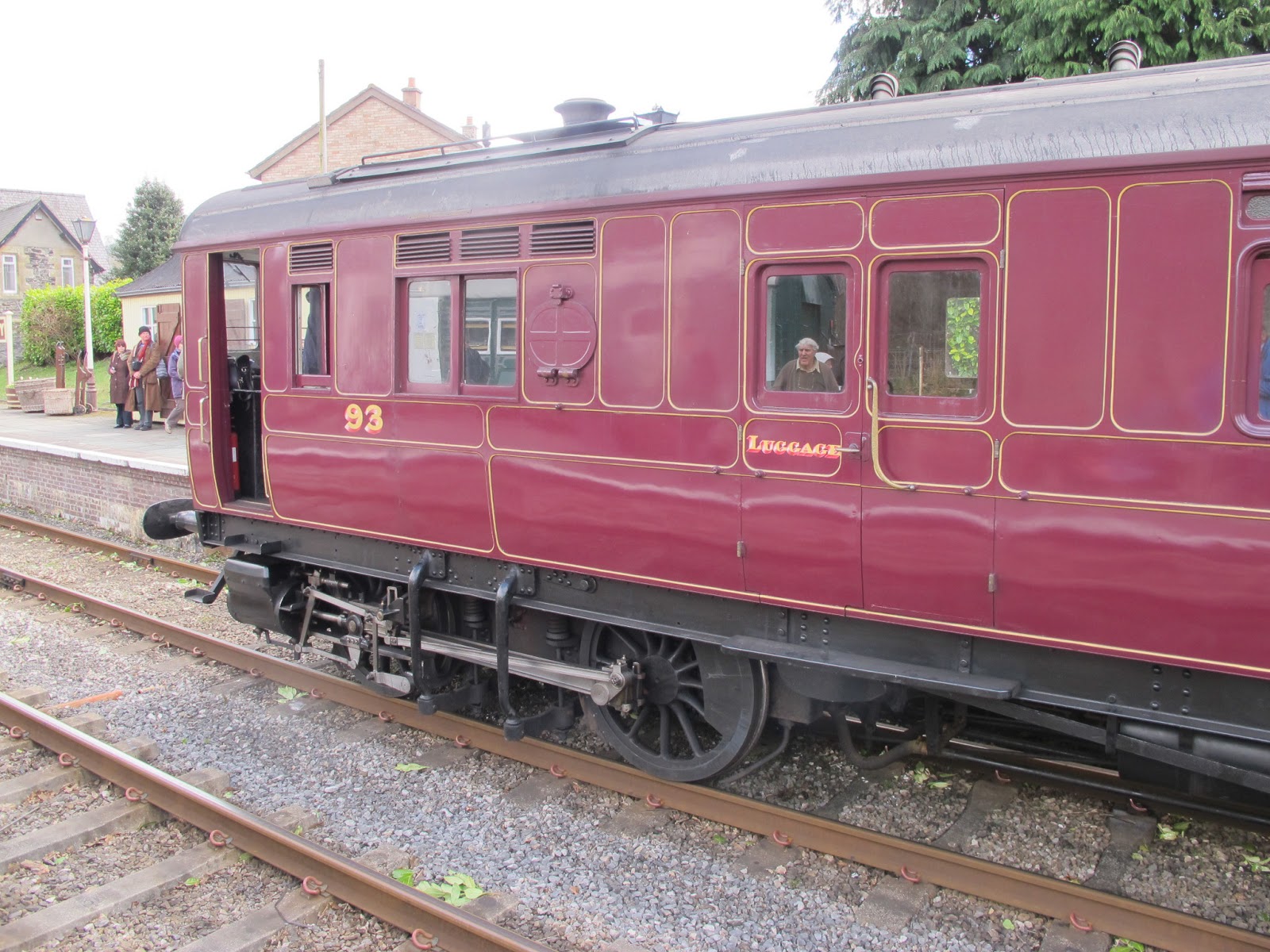
This is a railway I had not travelled on before, and today's trip not only put that right, it also allowed us to see and travel on the unique Railmotor and its Autocoach, both of which were restored at Llangollen. The Steam Railmotor (No.93) was built at Swindon in 1908 and worked until 1934. It was restored in 2011 and is normally resident at Didcot Railway Centre. The Autotrailer (No.92) was built in 1912 and worked until 1957. It was restored in February of this year. This is the first occasion on which the Railmotor and the Autocoach have worked together

Click on a picture for a bigger image. And again for an even larger one!

Our first train on the railway today was hauled by this ex-BR Standard Class 4MT 2-6-4 tank locomotive No. 80072. These were one of several 'Standard' designs by Riddles, and was based on the Stanier LMS 2-6-4 tank. It was built in Brighton in 1953 and withdrawn from service in 1966. It was rescued from the famous Barry scrap yard in 1988 and restoration was completed at Llangollen in 2009. The 'Standard 4' tanks are excellent locomotives much sought after on heritage railways.

Another view of this rather handsome locomotive

Our first stop was Deeside Loop, where 'Foxcote Manor' passed us heading down the valley

The lovely Dee valley on a glorious day. The valley of the Dee has been declared an SSSI (Site of Special Scientific Interest) and is home to protected species such as otter.

At Glyndyfrdy we crossed with the Rail Motor, and left our train to join it on its journey back down the valley to Llangollen. Here is the view from the cab windows of the Autocoach.

Looking down the valley from the Autocoach, the Railmotor leading

This first day of the Gala is popular with rail enthusiasts. Here, the Autocoach is populated mostly by 'gentlemen of a certain age'!

The Horseshoe Falls, where the River Dee feeds the Llangollen canal

The Chain Bridge Hotel, near the falls. The river was quite swollen by recent rain, and up and down the river many canoeists were taking advantage of the conditions.

The Railmotor was being fired by Matthew, our Railway Officer at the MoSI Railway (see elsewhere in the blog). He invited me onto the footplate to have a close look at the vertical boiler in this unusual machine. 

Matthew is a highly experienced fireman, but he was having great problems firing it as the tubeplate is immediately above the firehole doors; if he opened the doors while the engine was working, to put some coal on, it would draw cold air through the doors instead of hot gasses from the fire up the boiler tubes, and kill boiler pressure. For the same reason the blower could not be used effectively when the doors were open. So there were a few unscheduled stops while it was fired with the regulator closed and the blower off, followed by a wait for a rise on the pressure gauge. Luckily there was enough slack and therefore recovery time in the timetable to allow this without cumulative slip of the day's events.

The red reversing lever is prominent in its quadrant, and the (also red) regulator lever has two 'legs'; one is the conventional handle for when the Railmotor is being driven from this cab, the other can be connected to a rod operated by either the regulator in the opposite end cab of the Railmotor, or the regulator in the cab of the Autocoach when that vehicle is in use. The coal (the same Daw Mill coal as we use at MoSI) can be seen in the window bay on the right of the picture.

Here is a closer view of the rod (with a chain on it) which protrudes from the floor and can be connected to the arm on the regulator. The rod is operated by the remote regulator in the cab of either the Autocoach or the non-powered end of the Railmotor, so that the train can be driven from either end just like a modern diesel or electric multiple unit.

Matthew, holding the tea can, stands next to the Railmotor

A view through the side of the cab, showing the vertical boiler

Alongside the coupling between the Railmotor and Autocoach can be seen the connection to enable the regulator in the cab of the Autocoach to operate the regulator lever in the powered-end cab of the Railmotor

Here is the driving cab of the Autocoach. The driver has little more than a regulator handle (hanging vertically in the centre window), a vacuum brake lever, and a hand brake lever.

Peter walks past the Autocoach cab

The interior of the Railmotor is similar to that of the Autocoach

Another look at the superbly restored interior of the Railmotor. In order to keep it pristine, the railway does not allow and food or drink to be consumed on board.

Another of the locomotives in steam today is Foxcote Manor. a 4-6-0 tender engine designed by C. B. Collett of the Great Western Railway. It was built at Swindon in 1950 and withdrawn from service in 1965 but is another 'Barry survivor' like the 2-6-4 tank loco. It was rescued from that scrapyard in 1974 and has been in service on this railway since 1988. the 'Manors' had a light axle loading so were ideal for routes such as Ruabon to Barmouth, of which this, the Llangollen railway, is a preserved section.

The Railmotor's power bogie; effectively a 2-cylinder 0-4-0 steam locomotive with a vertical boiler

This is as far as the line goes at present. The last station westbound is Carrog, and trains can proceed from there a mile or so to the point shown above, then reverse back. A couple of miles beyond here is the town of Corwen, and the railway hopes to be operating to there later this year.

A view of the 'Standard 4' tank, without the platform hiding the running gear

A member of 80072's crew has climbed into the bunker to shovel coal forward where it can be reached by the fireman on the footplate

There were four locomotives in steam on the railway today, and this was the one that hauled our last train of the day. 6430 is a Great Western pannier tank locomotive built at Swindon in 1937. She was withdrawn from service in 1964 and sent to Cashmoore Ltd for scrap. She was rescued from there almost immediately by the Dart Valley Railway as a source of parts for other locomotives. She survived this and was restored to enter service on the railway in 2004.

6430's cab, showing the same 'remote regulator' fittings so she can be used with an Autocoach in a similar manner to the Railmotor


A final view of our final steam locomotive today, as we left Llangollen to catch the bus to Ruabon for our train home. At one time we could have gone to Ruabon by train from here; maybe one day that will be possible again.

Here are some videos I took today.

Here  the Railmotor, filmed from the Autocoach, descnds the valley though Deeside Loop.

Here  the Railmotor moves slowly along the platform at Llangollen, with fireman Matthew in the cab ensuring no spectators are in the way.

Here Foxcote Manor sets off from Glyndyfrdwy with a train for Llangollen.


.

Wednesday, 10 April 2013

Easter on the MoSI Railway

Our railway at the Manchester Museum of Science & Industry usually only operates at weekends, but at school holiday times it operates during the week as well. I was rostered as fireman on Friday 5th April and Monday 8th. The driver was Jan Ford, who took some pictures on the Friday which she has published on her blog at Jan Ford's World. Here are some of them, copyright Jan.

Our loco, 'Agecroft No.1', in the MoSI station (Liverpool Road East). This loco was built in 1948 (so it's a year older than me) at Robert Stephenson Hawthorn in Newcastle and spent its working life at Agecroft power station hauling coal trains, and was restored at MoSI a couple of years ago from scrap condition by volunteers and staff. 'Agecrofts' 2 and 3, the entire fleet at the power station, still exist. Only No.1 is serviceable at present.

I look back, keeping an eye on the train, as we leave the station

David, our guard, gives the 'right away'. The grey brake van is not part of our train today, but will be from Monday 8th onwards as the blue coach with the guard's seat will be at Beamish (see below).

Our train comprises a North London Railway coach hired in from The Furness railway, and one of our two blue open coaches which were built at the Museum as contemporary stock for our replica 1830 'Planet' locomotive 

David on the guard's seat in the rear coach

I look back as Jan photographs us passing the 1830 warehouse

 The train heads away from the Museum to cross the Water Street bridge, and followed by Stephenson's original stone arch bridge over the Irwell, into Salford. We are an Inter City Railway!
A nice view of the North London Railway coach

Nice pictures! Thank you Jan.

On Monday 8th when I was firing again, 'Planet' and the two blue open coaches were loaded on to two low loaders, one for the coaches and one for 'Planet' and tender. They are off to Beamish Museum for a while leaving 'Agecroft' as our sole locomotive at MoSI. That's why the North London Railway coach has been hired in, as otherwise we would have no coaching stock on site.

On the Monday our train comprised the North London Coach and the grey brake van in the third picture down. We need that in the consist as the coach has no guard's compartment or guard's emergency brake.

On the Friday, Jan and I had noticed that 'Agecroft' wasn't steaming quite as well as she usually does, and when I fired her again on the Monday it was no better. A faulty blower was diagnosed and we nursed the engine through to complete the day's work. On inspecting the front end after the last train had run and the fire dropped, it could be seen that the blower pipe had split and was issuing free steam into the smoke box and little draught up the chimney. When I left for home at about 5pm, she was being worked on to get her back in traffic for the next day's operations.

I'm firing her again next Friday, and looking forward to it!

Update Friday 12th April:   Bev was nominated driver today, and me as fireman. I lit her up from cold and prepared the engine as usual while Bev oiled round; the usual crew duties. Once we were ready to run at about mid day I returned from collecting my packed lunch from my bag in the railway cabin to find Bev on the fireman's side of the cab. "You're driving" he said. And I did - all day!

Thanks Bev!


.