Monday, 1 April 2013

The April Fools on Chat Moss! And some Barton memories

Time to take the little motorbikes for a run again today. We fancied the Astley Green Colliery Museum, and to see if we could get there and back using the dirt roads across Chat Moss. Malc lead on his Honda 50cc 2-stroke City Express step-through as he had a GPS. I followed on my Honda C90 as I had more power (well, a bit more anyway). The air temperature was only a few degrees Celsius with a bitter east wind, and I missed the heated hand grips my Suzuki Freewind motorcycle is fitted with; no such pampering on the little C90! We routed through Ashley, Dunham, and crossed the Manchester Ship Canal over Warburton high level bridge.

Warburton High Level Bridge over the Manchester Ship Canal
.
There is a toll of 12p to pay here; not to cross the impressive high level bridge, but to cross a tiny stone bridge over what used to be the River Mersey until that river was diverted to fill the Manchester Ship Canal. However, today the toll keeper simply waved us through.
.
The intention had been to cross Chat Moss from here to the museum, but Malc's Garmin GPS resolutely stuck to tarmac roads, and took us through Culcheth to the A580 East Lancashire Road, and thence to Astley Green. 

The pit head gear at Astley Green Colliery Museum
.
The Colliery Museum was closed but we stopped anyway for a hot drink from our flasks, and to thaw out. Directly south from the museum is a road that heads towards Astley Moss, part of the infamous Chat Moss that George Stephenson had such a problem with in laying the world's first inter city railway across it (the Liverpool to Manchester Railway) in 1830. After crossing over the Bridgewater canal we soon came to that railway, at Astley Moss level crossing where to the east, the overhead line masts for the in-progress electrification of the line could be seen in place.

Astley Moss level crossing. The gates are opened and closed by road users, but when a train is coming they are locked shut by the signalman in the adjacent 'box.

Astley Crossing signal box
.
The gates here are operated by road users, but only when the signal man in the 'box unlocks them electrically, which he will only do if no trains are coming along this busy line. We had to wait for an Arriva Wales unit to pass on its way to Manchester, feeling the peat bog of the moss bounce up and down as the train rushed past. 

Beyond the crossing, the road deteriorated to a dirt track, with pot holes and ridges. Eventually we turned off this onto an even more rutted track called 'Twelve Yards Road'. Movement of the peat bog had caused the pitted surface to collapse in places, yet it still had some quite harsh speed bumps!


One of the smoother sections of Twelve Yard Road across Chat Moss

It was slow progress along these dirt tracks across Chat Moss, but eventually we emerged onto the main road not far from Barton Aerodrome (now named 'Manchester City Airport'), so we headed there. Barton was my playground from the late 1970s to the end of the 1990s, when the airfield (which had been leased for many decades by Lancashire Aero Club) was sold by Manchester City Council to Peel Holdings. I'd learnt to fly at Barton in 1978, and our dH Chipmunk group was formed there the following year, of which I was a founder member. The group is still going strong, but now based at Liverpool John Lennon airport.

Back when it was our playground, Barton would have been buzzing with activity on a bank Holiday Monday. Aeroplanes queueing to take off, several in the circuit to land, queues of aeroplanes at the fuel pumps,owners busy pre-flight checking aircraft, or working on them in the hangars or on the apron, the apron itself a cacophony of aircraft engine noise as aeroplanes came and went.

Today it was dead. We saw a handful of movements in the hour or so we were there, with just a couple of aeroplanes parked on the apron. How times have changed! Where are all those keen young aviators of decades past? Where are the 2013 equivalents? Are they all at home playing flight simulator on computers and games boxes? Do they know what they missing!

 Barton Airfield in busier times

 A typical Barton event during the golden years. Our Chipmunk, in its red livery, can be seen just in front of the Antonov AN2 (the large white aeroplane).

Our Chipmunk in its blue colours at Barton in 1979, the year the group was formed. It is standing on the site where the Brian Harbett Hangar was later built.
.
Me in our Chipmunk 30 or more years later, At Liverpool John Lennon. The aeroplane is in its third (black) livery since the group purchased it.

What used to be the Lancs Aero Club clubhouse with its casual furnishings of scattered tables and chairs is now a smart cafe and bar. Gone are the multitude of flyers telling tall stories or taking the mickey out of each other, the nervous student pilots studying charts and checklists, some with instructors briefing them on their next lesson, or de-briefing afterwards. One couple, Saturday after Saturday, spent ages planning in detail some relatively short local flight. "How's it going", we'd ask. "What's the Target For Tonight!". All that flying fun and banter is gone. There's no aviation activity discernible here today; instead elderly and middle aged couples are ordering Roast Sunday Lunch in a hushed atmosphere from their high-backed leather upholstered chairs.

We went out to the Control Tower, where the first floor balcony forms a viewing terrace for the public. But it was cold in the biting east wind, so I nipped down to reception and phoned the guys working in the Tower. I managed to wangle us an invitation, and we climbed the external staircases to the welcome snug warmth of the big glass control room atop the tower.

The control tower at Barton Airfield - the oldest still-working control tower in the world, and now a listed building

Retired BA pilot (Vanguards, 1-11s, 737s, 747s, 767s) Malc chats to the duty AFISO (Aerodrome Flight Information Service Officer) in the Visual Control Room atop the Tower at Barton. AFISOs are a sort of half-way house between Air Traffic Controllers and Air / Ground radio operators.


A view across the almost deserted airfield from the Tower. How different it used to be!
.
After thanking the AFISOs for their hospitality and allowing us to eat our sandwiches in warmth of their control room, we fired up the bikes and headed home. Back over Warburton Bridge (and having to pay the toll this time), we retraced our route of this morning except at Ashley we headed down the lanes to Mobberley, where we called in at the 'Railway Inn' for a pint of their superb 'Big Tree' bitter from the local Dunham Brewery.

So we still haven't visited the Astley Green Colliery Museum. That'll be something to look forward to on another day. Hopefully, when the weather's a bit warmer.


.

Wednesday, 27 March 2013

Mid Cheshire passenger counting, a special day for Northwich Station, and a significant rail anniversary

I was out passenger counting on the lovely Mid Cheshire Railway today as a volunteer for the Mid Cheshire Rail Users Association (MCRUA). It was cold and sunny as I left Wilmslow Railway Station on a local electric service to pick up my first Mid Cheshire train at Stockport. I travelled to its terminus at Chester General Station (this line used to run to Chester Northgate station, but that station and its connecting lines were closed in 1969 - of which more later) and came back down the line on its return journey, as far as Northwich. The line between Greenbank and Mouldsworth climbs and crosses the Mid Cheshire Ridge, and the few hundred feet of altitude meant that the recent snow falls were still in evidence in and around Delamere Forest. Indeed on this return journey it was snowing up on the ridge.

Delamere Station in the snows of late March!

Snow in the forest

But once off the ridge, no sign of snow at all. At Northwich I stopped for a bacon butty and mug of tea at 'The Bean' cafe on the station. Recommended!

 A few miles away, no snow as we cross Leftwich Viaduct over the locks 
on the Weaver Navigation

Sitting at the counter in 'The Bean' was Sally Buttifant, the Mid Cheshire Rail Community Partnership Officer. Sally explained she had just been involved in celebrating the 150th anniversary of Northwich Station, built in 1863, which is of course the same year the Cheshire Midland Railway arrived at Northwich from Altrincham. The West Cheshire Railway later extended the tracks to Frodsham and Chester.

Here's a report from the MCRUA site:  http://www.mcrua.org.uk/chairmansblog/2013/03/28/northwich-station-celebrates/

Sally also mentioned that today is the 50th anniversary of the publication of the Beeching Report in 1963. That report led to the closure of significant parts of Britain's rail system.

I left 'The Bean' on the next Chester train to continue my passenger counting (we are doing this to get accurate ridership figures in support of the case to double the service to half-hourly, instead of hourly as the often overcrowded trains run at present). The snow over the Mid Cheshire Ridge had stopped, and on my return from my second visit to Chester today the sun was shining most of the way back to Altrincham, where I left the train to catch the bus home to Wilmslow.


.

Saturday, 16 March 2013

First session as a guide at the newly-opened Nether Alderley Mill


It's great that the National Trust has restored the fabric and the machinery of this unique tandem-wheel water mill. The restoration was carried out by specialised craftsmen using traditional materials, and to the highest standards. See this blog http://vinchad.blogspot.co.uk/2012/09/nether-alderley-mill.html for the story of the restoration.

Newly-restored Nether Alderley Mill

This afternoon I led my first tours of the mill for visitors. We're open Thursday, Saturday, and Sunday 13:00 to 16:30.

It's a tardis! Far bigger inside than it looks from the outside. When the miller opens the sluice to allow water through from the mill pond behind the mill the splat, splat, splat of the inrushing flow onto the elm wood water wheel buckets brings the sleeping mill to life. As the wheels start to rotate, the floors shake underfoot. Giant wood and iron gears take power from the water wheels to drive the mill stones. One's nose senses the distinctive tang of fresh-milled grain in the air, confirmed by a milliard flour motes highlighted in the shafts of sunlight streaming through the roof vents. It is a magical place, a microcosm of local history, and we are so lucky to have it on our doorstep.

Come and see us soon!


.
Tuesday, 12 March 2013

A visit to Manchester Piccadilly Signalling Centre

Adrian, one of my fellow volunteers on the railway at the Museum of Science & Industry in Manchester used to work at the Manchester Piccadilly Station Signalling Centre. Tonight he arranged a trip around the centre for about fifteen of us, meeting on the station concourse at 6:00pm.

I decided to devote the day to one of my several volunteer activities; passenger counting for the Mid Cheshire Rail Users Association on the lovely Mid Cheshire line, finishing at Piccadilly in time for the tour of the Centre.

As ever, please click on a picture for a larger image.

Somewhere on the Mid Cheshire line this morning; a lightly-loaded class 142 Pacer unit making for an easy journey as far as my passenger counting is concerned

The Pacer at Chester General station....

....And later this afternoon, a similar unit at Manchester Piccadilly station, photographed just before we met up for the tour of the Signalling Centre

After signing in and getting our identity badges, the first port of call was the announcement room. Most of the announcements for train departures etc. are automatic, but the operator (in the blue shirt) can manually select on his PC screen any announcement he wants the system to broadcast, or he can make manual announcements using a microphone.

The Station Manager explains how the system works

Maps of the railway layout, with the position of trains on it, can be displayed so that announcers can update themselves on whether services are running to time. The trains are the boxes on the tracks with 4 character identification codes in them (e.g.1V29) and their position on the map represents the actual train's location on the railway. This is a map of the Piccadilly Station area, though maps of any part of the rail system can be called up to be displayed.

A closer look at the Announcer's position. On the screen is a scrollable list of announcements, which will run automatically triggered by the running of trains, or can be highlighted by the Announcer to be broadcast immediately. On the back wall are screens which cycle through the pictures from the many CCTV cameras around the station.

From the Announcing area we moved through to the Piccadilly Signalling Centre. Shift Manager Allan Lewis is seen explaining the Centre's operations to our group.

  The signallers have a display on the wall of the area the box controls. That area stretches from Piccadilly Station to Heaton Norris Junction (just short of Stockport), and to just short of Wilmslow via the Styal line including Manchester Airport station, and through to the lines out to Salford and Liverpool in the other direction. Stockport is still manually signalled from the boxes there, but the entire area will soon be swept into a single signalling centre which will control the railway from Scotland as far south as Stafford.

Using these buttons on the desk, signallers manually select routes for the trains. Trains are identified on the display by a 4-character route indicator code such as '1V69'. Signallers press a button to select the 'entry' into a section, and a second button to select the exit, together with any alternate route selections within the section which are set on the black knobs. If it is safe to allow the train into the section (i.e. it is not a movement that will conflict with a route already set) then all the appropriate points will change and the signals will set to allow the train to enter.

A closer look at the route select buttons and knobs. Note the red 'thimble'... this is the equivalent to 'stop blocks' one puts on signal levers in a conventional 'box to remind the signaller not to set up a particular route (for instance if there is a known rail fault to be avoided). These 'thimbles' are simply placed over the appropriate button as a reminder and to physically prevent it being operated.

Our tour also included visits to many non-public areas of the station, particularly in the undercroft. Here the old brick arches of the original station construction can be seen.

It's obvious that the Piccadilly Signalling Centre, although light years ahead of  my manual 'box at Consall on the Churnet Valley Railway, is actually pretty old technology. One can see how, with today's technology, routes could be automatically set according to the trains' route indicator codes with no need for human intervention except in the event of a failure. Such technology is presumably what will enable this centre, as well as many others such as Crewe, Manchester South (located on the site of the old Stockport Motive Power Depot), and those manual boxes in Stockport to be integrated in one fully automatic Centre. Indeed there is no reason why the entire UK rail system couldn't be signalled from one control centre and no doubt one day it will be, but not for a while yet. Here's an article from Rail News about the technology that will replace Piccadilly Signalling Centre:

NETWORK RAIL has unveiled plans to close nearly all the 800 signalling centres, panels and boxes which presently control the National Rail network, replacing them with 14 Rail Operating Centres and reducing the signalling workforce by two-thirds, to 2,000.

The changeover will take more than two decades to complete and cost some £1.1 billion.
However, it is expected that the annual savings will amount to at least £200 million by 2030, when 80 per cent of the project should be complete, and £250 million by the 2040s.

Some ROCs will control an entire Network Rail route so that, for example, Didcot ROC will regulate the entire Great Western network in England, from Penzance to Bristol and Paddington, and as far north as the outskirts of Birmingham, where Saltley ROC would take over.

The West Coast Main Line will be run by just four ROCs -- Glasgow (Cowlairs), Manchester, Saltley and Rugby, while East Anglia will be controlled from a new ROC at Romford. The largest ROC will be at York, which will cover north east England from The Wash to the Scottish borders, and also all the East Coast Main Line in England.

Wales will be run by a single ROC at Cardiff, and Scotland by two -- at Glasgow and Edinburgh.
Network Rail says train regulation will become more efficient, thanks to new traffic management and control systems which will improve capacity.

The changes will also be compatible with the spread of ERTMS, because the equipment in the new ROCs will be 'agnostic' about the signalling systems to which they are connected, and in the case of ERTMS will link directly with its layer of train control functions.

But it will be the end of the line for the remaining mechanical boxes and their associated semaphore signals, which will be replaced by modular signals.

After the tour I caught a train home, thinking of its progress across the display on the Signalling Centre wall... and thankful to have seen an era of signalling on the railway which will soon seem as out of date as my manual signal box at Consall does today.

Thanks Adrian for organising such an enjoyable and informative outing.


.

Saturday, 9 March 2013

A steamy day out

Time for another steam fix! Five of us (Malc, Ivan, John, Peter, and me) sampled the local bus, the Manchester Metrolink Tram, and the East Lancashire Railway today.

Please click on any picture to see a larger image.

 
Peter, Malc and myself caught the 88 bus to Altrincham at Davenport Green at 08:35 this morning. Here, John and Ivan join the bus a few minutes later at the Rifleman's, Moor Lane.

At Altrincham we took the Metrolink tram to Bury, via central Manchester. We sat at the front giving a 'driver's eye' view of the track ahead, intially over the old MSJ&A (Manchester, South Junction, and Altrincham) railway I used to travel on regularly to school (from Brooklands to Altrincham) on the 1500Vdc electric trains when it was 'heavy rail'. The line was later re-electrified at the standard 25KVac, until becoming a Metro line in the mid 1990s, re-electrified again at 750Vdc.


On arrival at Bury, we headed to the market (Malc, Ivan, Peter, and John, above). The initial impression of this town is how, in complete contrast to Altrincham with its sense of failure and many boarded up shops (I remember Altrincham from my school days as a thriving market town) Bury is vibrant and alive. The market alone is on a par with those one sees in mainland Europe, with food halls and much high quality produce and products. It has an under cover and open market, and in the town itself the shops are doing good business with no sign of boarded-up decline. I wonder what their secret is? No nearby out-of-town shopping centres, perhaps?

This purveyor of fine meats gave Ivan and me a sample of his excellent pork pie. It was so good we had to summon the other three, and purchased a couple of meat and potato pies for lunch. Note how Malc always comes fully prepared when on manoeuvres; his backpack contains a flask of coffee and some sandwiches, and even has a portable folding seat on it.

.....Which we took with us to the excellent bar and cafe on platform 1 of Bury Bolton Street station, the original terminus of the East Lancashire Railway

Here we discovered the excellent 'house beer' of the Railway, 'Piston Broke'. A superb hoppy ale in prime condition, and only £2.30 a pint! We ate our pies here, and Peter and Ivan ordered soup as well (not up to the standard of the beer, they told us). The location, and the 'Piston Broke', are so good one is tempted to spend a day in Bury getting pied-up at the market and sitting here drinking the ale and watching the trains go by!

One such train was this Brush Type 4 (later classified by BR as the Class 47) diesel locomotive hauling one of the two trains running today. But we were waiting for the other - the steam hauled train!


....Hauled by this, 'The Great Marquess', a Gresley-designed K4 class 2-6-0 steam locomotive built in 1937 by the North British Railway for the steep grades and sharp curves of the West Highland Line. All six of the class were named after Highland Chieftains or Grandees. 'The Great Marquess' is the only surviving member of the class, and is main-line certified so it can operate trains on the national network.

John does his 'road drilling' impression, while Malc looks on

Peter and Ivan relax in the comfortable ex-BR Mk1 open coach

The K4 is a three cylinder locomotive. Here is the big end of the middle cylinder connecting rod, on the centre axle. The other two cylinders are external to the frames.

At the northern end of the line, Rawtenstall, our loco uncoupled and ran-around the train ready to commence the journey back down the Irwell Valley to Bury and on to Heywood.

'The Great Marquess' running tender-first past her train at Rawtenstall

We travelled to Heywood, the other end of the line, and back to our starting point at Bury Bolton Street where there is a transport museum. Here is a Manchester horse-drawn tramcar nicely preserved in the museum.

My father had one of these in the 1950s, a Ford Model 'Y', which I well remember (though our's wasn't as pristine as this example). The family name for the car was 'Agatha'; I've no idea why!

Ivan and John check out a traction engine in the museum while Peter's attention is taken by a rather nice Field Marshall tractor just out of shot to the right

After an indifferent pint in a pub near the railway, we went for the tram back to Altrincham. Malc, Peter, Ivan and John are wondering what these strange structures on the tram station platform are for; to high for seats, too low to lean on..... what on earth are they?

We arrived back in Altrincham with about 45 minutes before the next and final number 88 bus back to Wilmslow was due to depart, so went to the Bricklayers Arms for a pint! The 88 left on time and with few passenger at that time of day made good progress to Wilmslow. In fact, when I got off at my local stop the bus continued on its way to Knutsford with only the driver on board!

So ended another interesting and enjoyable old gits' outing. Good beer, good company, trams, vintage steam, and Bury Market pies..... Brilliant!


.

Sunday, 3 March 2013

Rudyard Lake Steam Railway

Another Sunday with no rain! So where are the 'steppers' (little step-through motorcycles) going to go today? Many places worthy of a visit don't open until Easter, but one that does is the Rudyard Lake Steam Railway. We met at Malc's at 11:30 for another Grand Day Out!

As ever, click on the pictures for a larger image.

My C90 and Ivan's SS50 (getting attention from Ivan and Malc) at Malc's this morning

Ivan is changing the cylinder head nuts as he has a slight oil leak; a 5 minute job on these little bikes!

 
Less than an hour after leaving Malcs, we arrive at our destination. Ivan's SS50, Malcs Yamaha Townmate, Malc, and my Honda C90 at Rudyard Lake station on the Rudyard Lake Steam Railway.

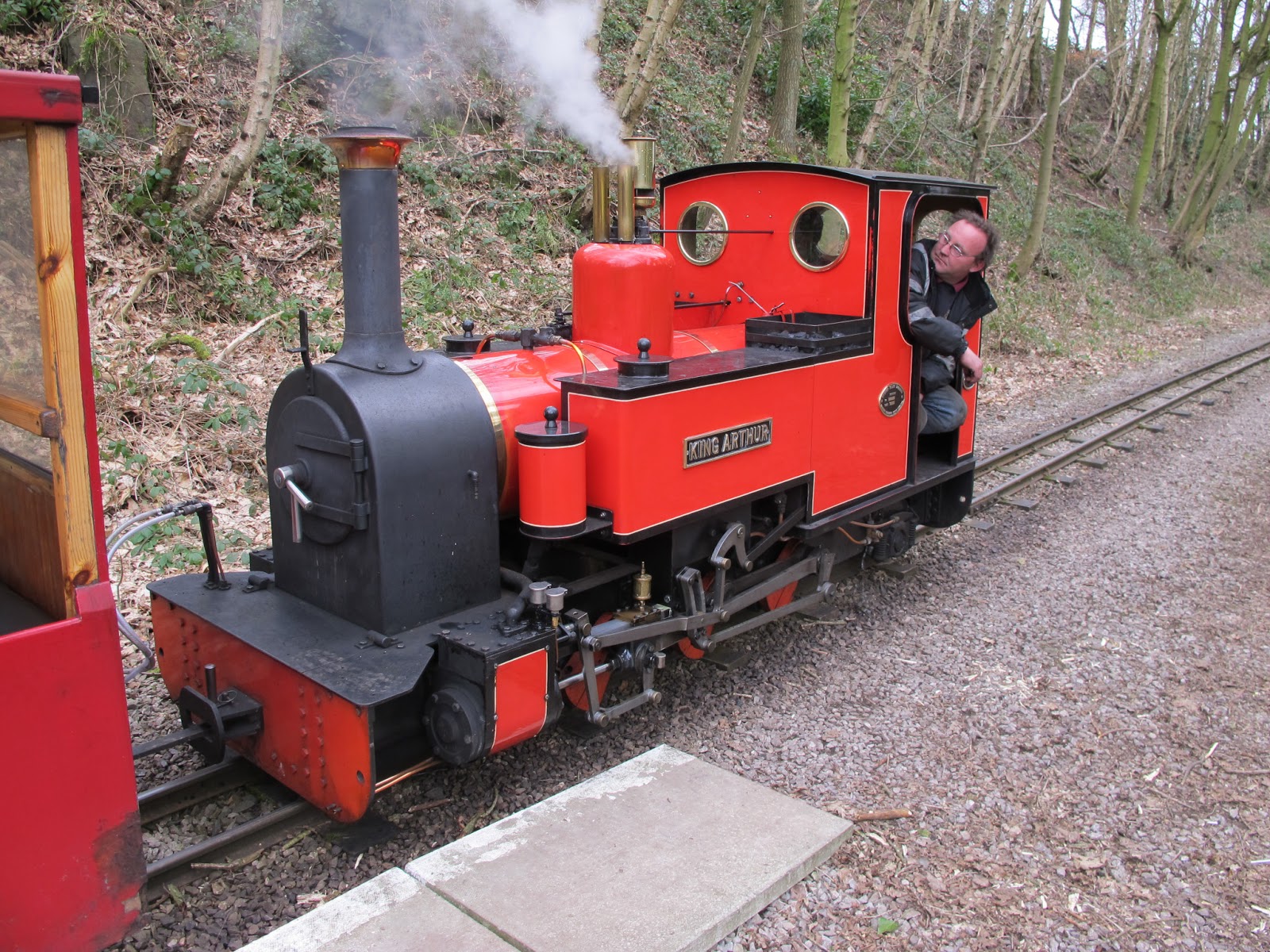
There was just one locomotive in steam today; 'King Arthur' simmers at the head of her train

A rather complicated petrol electric locomotive gets a bit of TLC!

In the shed one of the locos is stripped down ready for new boiler tubes to be fitted before the boiler is pressure tested prior to being re-installed in the frames

We boarded the two o'clock train for a ride up the lake side and back. Malc and Ivan enjoy the view from the open-sided coach.

At the far end of the line, the loco runs around the train. Spring-points negate the need to manually change them to run back down the loop.

'King Arthur' runs around her train, using the loop

The day was bright at times but quite cold. Here's a rare patch of sunshine on the lake as seen form the train.

Our driver in his cab at the station half way up the lake

Back at the terminus, one of the other locos in the 'shed' (a shipping container!)

'Merlin', another of the railway's locomotives at Rudyard Lake station

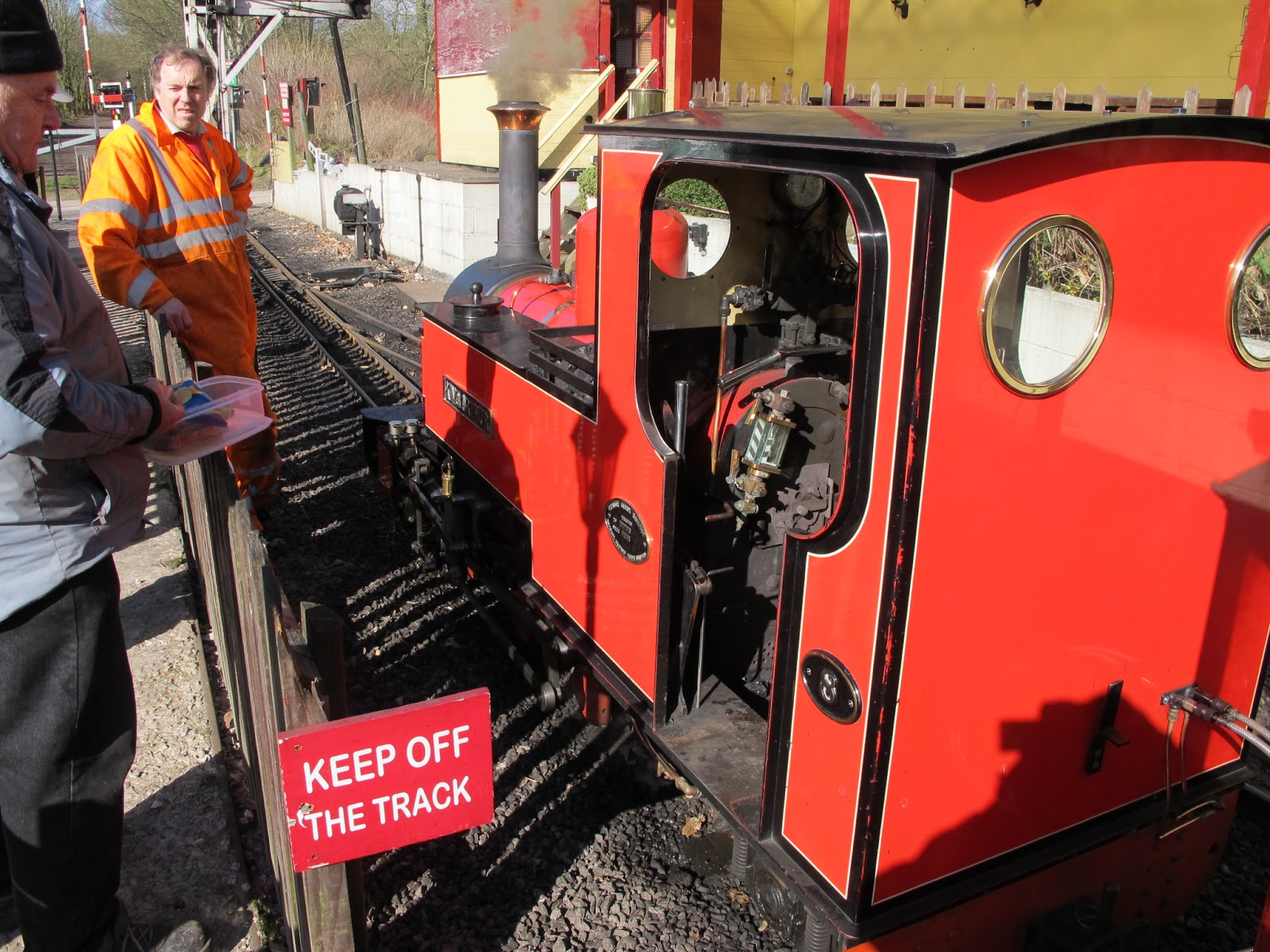
Merlin's cab

Here's a couple of videos. In the first one, 'King Arthur' is returning down the lake side to Rudyard.
https://www.youtube.com/watch?v=Nt_-aK5kBdc&feature=youtu.be


Having taken water at Rudyard shed, 'King Arthur', cylinder cocks open initially to prevent hydraulicking as steam condenses to water in the cold cylinders,  runs around the train to position at the front for another run up the lake and back.
https://www.youtube.com/watch?v=VNdO5_DeS38&feature=youtu.be


We rode home down the minor lanes over the Biddulph ridge to Congleton, then took to the lanes again past Clonter. Just after the 'Mucky Duck' pub (The Black Swan, but no-one calls it that) the road had been closed by the police, so we diverted through Hodgehill, Whisterfield, and Catchpenny Pool to Chelford before stopping at the Stag in Great Warford for a welcome pint.

Another Grand Day Out!
.