Wednesday, 14 November 2012

Manchester Bus Museum

Malc, Ivan and myself had originally planned to do this trip on two wheels, but decided to go by train and bus. We got the 09:51 Wilmslow to Manchester Piccadilly train, walked to Piccadilly Gardens, where we boarded a 135 bus to the museum in Cheetham Hill.

As ever, please click on any picture for a larger image.

Ivan and Malc in front of the horse-drawn bus

Terrain-dependant variable power for the horse bus

Such a place would need to be capable of miracles...... 

Ivan is the only one of us who is not retired, so phone calls from work even when he is on holiday are par for the course for him. I remember it well and don't miss it a bit!

Welsh spelling of Nefyn.... rather unusual for those days.....

I remember these North Western Road Car Company double deck buses which operated from Stockport on routes with low bridges. The sunken gangway on the right enabled a lower roof line.

Karrier (later part of Commer) engine, with magneto ignition

The rear of an Atlantean bus with the engine removed

The classic London Transport Routemaster earns its place in this museum as it was trialled for a few months by Manchester Corporation, but none were ordered as it was felt that the City's buses should come from North West manufacturers such as Leyland

I remember these two North Western buses; the single decker was of a type used on the Altrincham to Hale Barns service when I was at school and I travelled on them regularly. The Daimler double decker ran up Ashton Lane in Sale on the Sale Station to Ashton on Mersey service.

Malc, former Boeing 747 driver, tries the Daimler for size

 
The Daimler's 'flight deck'

 
Daimler lower deck

It doesn't seem like yesterday that the Metrolink trams began running in Manchester, and now an early one is retired to the museum

 One of the volunteers showed us around the museum, including allowing us on buses not normally open to the public, and opening up engine bays for us. This AEC engine is tilted nose-up and slewed slightly so the gear box fits under the stairs to the upper deck.

A 6 cylinder Gardner engine on display

 
Yet another engine bay is opened for us at Malc's request...

 ....To reveal the Crossley engine within


'Big Cat' themes seem popular with bus manufacturers

This Park Royal-bodied Leyland Atlantean was known as the 'Mancunuian', being developed by Manchester City Transport in the 1960s. It was Manchester's first 'one man operated' type and its handsome design would not look out of place on the City's roads today.

 A rather nice pre-war Leyland Tiger of Manchester Corporation


A Bedford light coach of Warburtons Coaches


After a fascinating morning in the museum, being shown around by a knowledgeable volunteer, we made our way back to Cheetham Hill Road for a 135 bus into central Manchester for a scoop or two of ale and some lunch. For lunch we'd planned to visit one the 'all-in buffet' Chinese restaurants on Portland St, but before that, a pint!

Holts always was a good pint at a reasonable price as I remember from my Systems Programming Limited days at Heaton Mersey, when The Griffin was our local. The barmaid at this pub on Portland Street, Manchester, pulls us a scoop each.

Then it was over the road to do a bit of 'hoovering' at the 'all you can eat' Chinese. Excellent value and very good quality, too!

We made it to Piccadilly Station in time for the 15:38, arriving in Wilmslow just after 4pm where Ivan is shown, above

And so ended another superb day out for us Old Gits. Where next, I wonder?


.

Sunday, 21 October 2012

Manchester ATC visit

National Air Traffic Services (NATS) which operates Air Traffic Control (ATC) at Manchester Airport today hosted a group of private pilots to show them 'behind the scenes' at ATC at Manchester. I was one of the lucky ones invited along. The purpose of the visit was for NATS to show PPLs (holders of Private Pilot's Licences) how ATC works 'behind the microphone' and the dramatic effect of pilots inadvertently infringing controlled airspace.

Our host, Chris, met us by Cafe Nero in Terminal 3 and took us through a secure entrance to a conference room in the Tower overlooking  the airfield.

As ever, click on the pictures for larger images.

The conference room in the Tower building, where we introduced ourselves and had a presentation from Chris on ATC at Manchester

'Emirates one-seven' (UAE 17), the daily Airbus A380 from Dubai on short final for runway 23R seen from our conference room

UAE 17 comes over the threshold...

...and flares for landing

A Virgin Atlantic Boeing 747 400 about to line up 23R for departure; a much better looking aeroplane than the massive whale-like A380 in my opinion

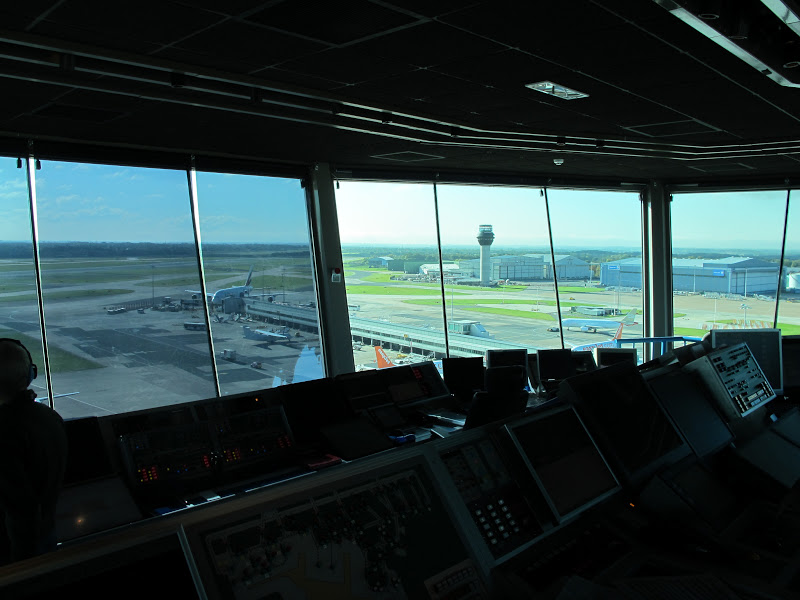
From the conference room Chris took us up to the VCR (Visual Control Room) on top of the tower. I've been here before, but am always impressed by the quiet and relaxed atmosphere of the VCR.

Looking from the VCR to the south west, the new ATC Tower nearing completion by Fairey's apron. It's almost 3 miles from the existing tower to the threshold of 05R (the far end of the new runway) and the new tower is both higher and closer to that threshold and so will give a better view of it (Manchester weather permitting!). 

But the real driver for the Airport to invest the £24m the new tower is business continuity. The present tower is on top of Terminal 1, and if that terminal had to be evacuated, or worse burned down, the Tower would be put out of action and the airport would have to close down. There is an emergency 'Tower' facility in the form of a portacabin by the runway, but it would be completely inadequate for anything but perhaps landing the last few aircraft before the airport had to close.

The A380 on stand, with its double-deck jetbridges and catering truck. 


Let's have a closer look at that A380 on stand....

An unexpected arrival was this Beluga. It was inbound to Hawarden to pick up Airbus wings for the Toulouse factory but the visibility was only 200m which is below landing minima for the ILS at Hawarden. It therefore diverted into Manchester. From the VCR we could see the line of the fog about 20 miles to the west as we bathed in glorious sunshine and unlimited visibility.

To the left of the picture a Fed Ex aircraft can be seen on the freight apron.

A view across the top of the Terminal 1 multi storey car park (where I take my students for a view of the airfield on Education airport tours) to the aircraft lined up at Terminal 2

Aircraft on Terminal 1

The new Tower, with the Concorde hangar at the Runway Visitor Park beyond

A controller on duty in the VCR

Another interior view in the VCR

The ridge of Alderley Edge to the South, with the radio mast on Sutton Common visible in the left background, and the summit of Bosley Cloud near Congleton in the right background

Down on the 4th floor of the Tower is the Radar room. The Manchester sub centre used to be here controlling all traffic below 22,000 feet from the Scottish border down to Birmingham. Now, that has been incorporated into 'Scottish' ATC at Prestwick and only three radar positions remain. 

On the right is the Manchester Approach controller who is the first contact for inbound aircraft and who vectors them either into a hold or towards final approach. To his left is Manchester Director who spaces the inbounds correctly and vectors them onto the ILS (Instrument Landing System), a radio aid that guides aircraft down final approach to a landing. At quiet times both functions are carried out by the Approach controller, while at busy times the third desk (that of Approach North out of sight to the left) splits the approach workload between two Approach controllers

A plan view of the airfield

If you're wondering what mayhem can be caused by a rogue aeroplane infringing controlled airspace, consider what has to be done if ATC don't know the aircraft's altitude (and they won't unless the miscreant is squawking Mode Charlie - that is, using an altitude-reporting radar transponder). The controllers will have to maintain a 5 nautical mile separation between the rogue and all other traffic at all levels. This might entail breaking aircraft off their approaches, holding aircraft on the ground instead of allowing take offs, and of course if the miscreant comes within 5 miles of the airport, the airport has to shut down all movements.

Here's a speeded-up radar recording of an infringement of the Manchester Low Level Route (a 1,300' high north - south corridor though the Control Zone). Click on the link and scroll down to event number 7.

 http://flyontrack.co.uk/content/radar.asp

Thankfully the vast majority of private pilots are highly trained, conscientious, and competent, so such events are vanishingly rare.

Events such as today's help keep it so. Well done NATS! And thank you for a great visit.


.


Sunday, 14 October 2012

The Cauldon Lowe branch - in sunshine!

While I've been beavering away becoming first a crossing keeper and hopefully soon a signalman on the Churnet Valley Railway, I've had a few train trips up and down the valley but only been able to watch the monthly trains that go beyond Leekbrook into Moorland & City Railway territory up to Cauldon Lowe. That's because when Cauldon trains are running there's also a service up and down the valley, so two trains, so we have Consall signalbox in operation for the trains to pass at Consall, and Leekbrook has to be manned to manage trains there. Today however was unique so far during my time as a CVR volunteer; the only train running today was doing two return trips from Froghall all the way to Cauldon Lowe. Only one train, so no signallers needed - so I could travel as a passenger!

I've been up the branch once before, in the first week following its re-opening by M&CR on 19th November 2010. That's covered early in this blog ( http://vinchad.blogspot.co.uk/2010/11/cauldon-lowe-by-train-and-some-fog.html ), and if you go and take a look you'll see it was a foggy day. This morning was a bit misty, but that soon burned off to give a gloriously sunny autumnal day. Even earlier on the blog is a post about the reopening of the M&CR Cauldon branch. It can be seen, with a schematic drawing of the geography, at:

 http://vinchad.blogspot.co.uk/2010/11/cauldon-lowe-branch-line-re-opening.html

Here's that geographic schematic:


Leek
|
Stoke-----------Endon-------------Leekbrook------------------------Cauldon Lowe
|
|
Cheddleton
|
|
Consall
|
|
Froghall
|
Oakamoor

Schematic of the geography of today's journeys were Froghall to Leekbrook (CVR) and on to Cauldon Lowe (M&CR) branch.  The Churnet Valley Line runs from Oakamoor to Leekbrook. The proposed Leek extension extends north from there, the M&CR link to Stoke to the west, and the M&CR Cauldon branch to the east.

As ever, click on any picture to enlarge it.

 Slightly misty Froghall station this morning

Lovely Consall, looking a bit 'Close Encounter'

We had the N7 tank engine on the front of the train, Class 33 Diesel 'Captain Charles' on the back. The N7's tanks need frequent refilling so we stopped at the water tower just outside Cheddleton. Here, our driver tops up his charge.

Sunny Leekbrook! The spring point was locked over for the loop line and the gate through to the M&CR from the CVR was opened. On our return from the M&CR branch to the CVR on the second (last) trip of the day the train crew unlocked the point and closed and locked the gate.

This is the northern end of the Churnet Valley railway. The line ahead used to run to Leek (and might again before too long) then on to Rudyard, Bosley, North Rode, and Macclesfield. But we branch off the CVR to the right onto the 1 in 50 climb of the Moorland & City branch to Cauldon Lowe.

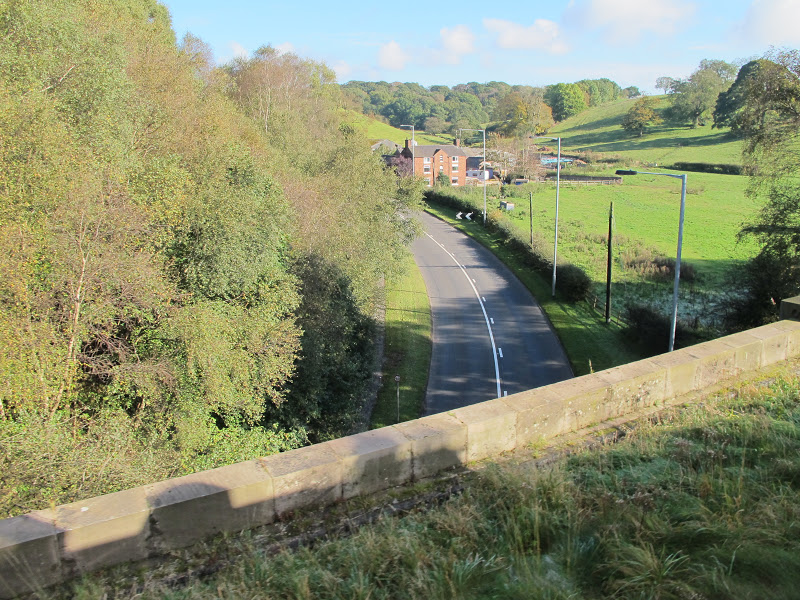
Crossing over the A520 Leek to Stone road, looking north towards Leek

Apesford crossing, which I've manned a couple of times myself (don't mention bleedin caravans!). It's John's turn today.

Up onto the high moors

Near Ipstones we encountered cows on the line. They set off towards Cauldon but soon went back up the embankment and didn't delay us long.

Arriving at Cauldon Lowe where there is now a run-round loop. We won't be using today as we are topped and tailed (we have a loco at each end of the train so can simply reverse back the way we came).

The end of the Cauldon Lowe branch. The line here used to go on to the stone quarries, and a little further back there was a branch to the left to Waterhouses from where a narrow gauge line continued up the Manifold Valley to Hulme End in the White Peak. That line closed in the 1930s but was built at the same time as the Stoke - Leekbrook - Waterhouses / Cauldon line under the same light railway order.

Before we return, the token (giving authority to run on the line),  has to be transferred to the Class 33 as that will be the leading locomotive for the return to Froghall

Our N7 loco, back at Froghall. I decided to stay on the train for its second trip up to Cauldon Lowe and back.

Crossing the A520 again, looking south towards Cheddleton this time on the train's second and final traverse of the Cauldon Lowe branch today

Pelicans at Blackbrook zoo near Ipstones

Ipstones road bridge on the return run from Cauldon Lowe. Ipstones summit is well over 1,000 feet above sea level.

John and a pair of train-watching bikers at Apesford crossing

Inside our comfortable 1st class BR Mk 1 coach

Back onto the CVR on our way down to Froghall, with the M&CR line to Endon and Stoke-on-Trent branching off to the right. This line has been re-opened as far as Endon but no passenger trains run down it yet.

Heres a short video of the N7 struggling on damp rails this morning to get the train re-started from the stop at a road crossing near Ipstones. The gradient is about 1 in 40, and the rail is wet. But eventually a hefty push from our Captain Charles at the back of the train gets us going!

http://www.youtube.com/watch?v=SNQqI7UAQ9Y&feature=youtu.be

So, a great day on the Churnet Valley and M&CR. And a lovely drive back though the peak district in the top-down MX5 via Onecote, Warslow, Longnor, Axe Edge and the Cat & Fiddle capped it off nicely.
.